Bicknell in Wayne County, Utah — The American Mountains (Southwest)
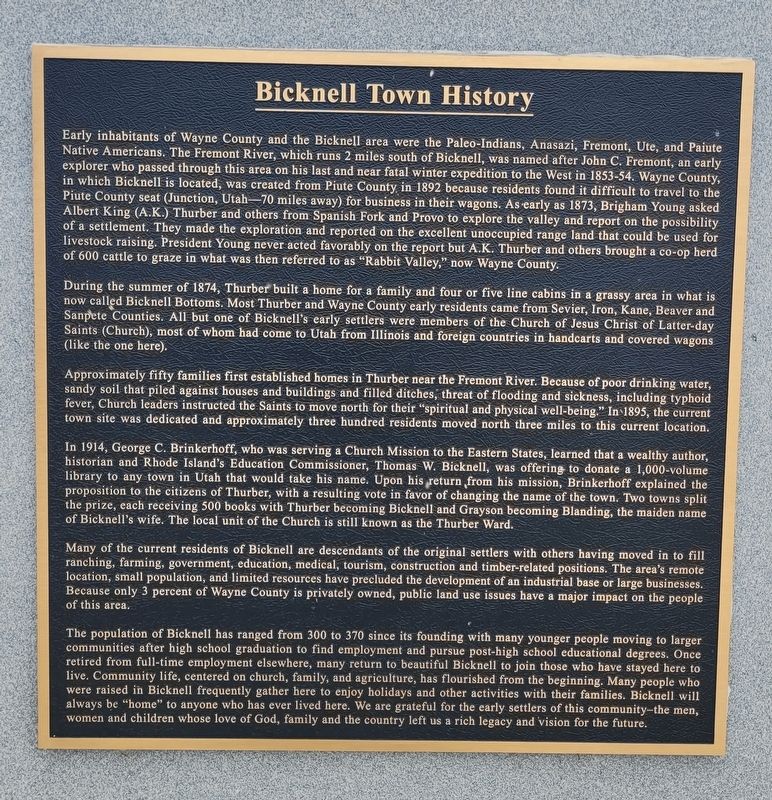
Bicknell Town History
Photographed by James Hulse, April 4, 2025
1. Bicknell Town History Marker
During the summer of 1874, Thurber built a home for a family and four or five line cabins in a grassy
this page online
Approximately fifty families first established homes in Thurber near the Fremont River. Because of poor drinking water, sandy soil that piled against houses and buildings and filled ditches, threat of flooding and sickness, including typhoid fever. Church leaders instructed the Saints to move north for their "spiritual and physical well-being." In 1895, the current town site was dedicated and approximately three hundred residents moved north three miles to this current location.
In 1914, George C. Brinkerhoff, who was serving a Church Mission to the Eastern States, learned that a wealthy author, historian and Rhode Island's Education Commissioner, Thomas W. Bicknell, was offering to donate a 1,000-volume library to any town in Utah that would take his
Photographed by James Hulse, April 4, 2025
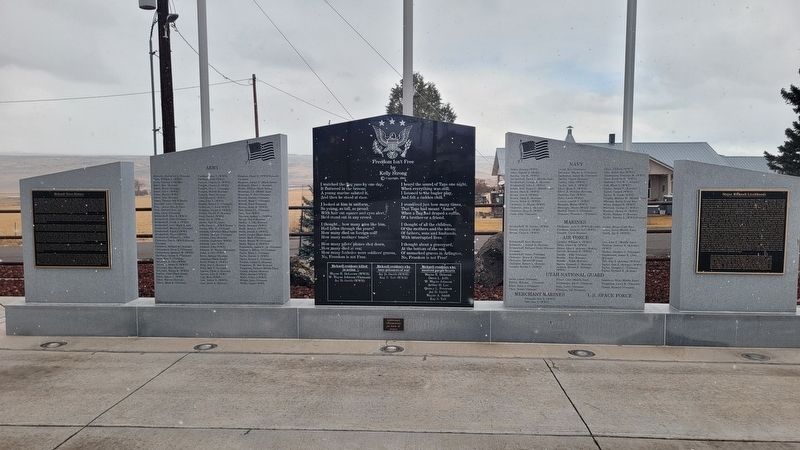
2. Bicknell Town History Marker
The marker is the left marker on the memorial.
Many of the current residents of Bicknell are descendants of the original settlers with others having moved in to fill ranching, farming, government, education, medical, tourism, construction and timber-related positions. The area's remote location, small population, and limited resources have precluded the development of an industrial base or large businesses. Because only 3 percent of Wayne County is privately owned, public land use issues have a major impact on the people of this area.
The population of Bicknell has ranged from 300 to 370 since its founding with many younger people moving to larger communities after high school graduation to find employment and pursue post-high school educational degrees. Once retired from full-time employment elsewhere,
Photographed by James Hulse, April 4, 2025
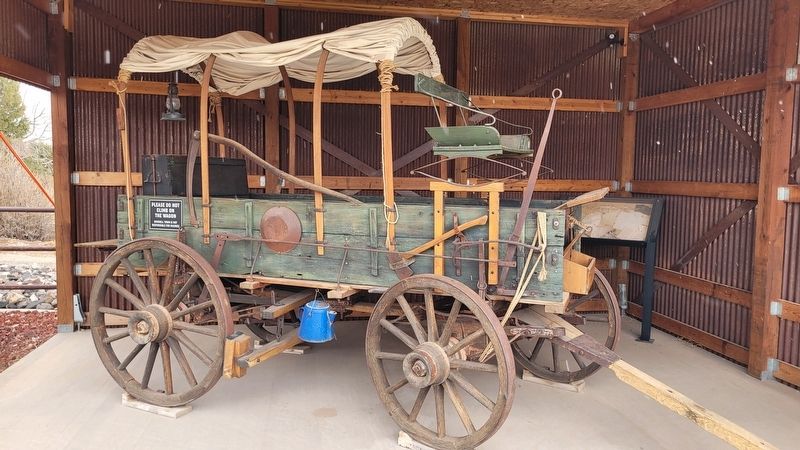
3. Early Wagon restored and donated by Warner and Maggie Stewart
Erected 2020 by Bicknell Town.
Topics. This historical marker is listed in this topic list: Settlements & Settlers. A significant historical year for this entry is 1873.
Location. 38° 20.444′ N, 111° 33.079′ W. Marker is in Bicknell, Utah, in Wayne County. It is at the intersection of West Main Street (Utah Route 24) and S 400 W, on the left when traveling west on West Main Street. The marker is located at the Bicknell Veterans & Heritage Memorial Park. Touch for map. Marker is at or near this postal address: 385 W Main St, Bicknell UT 84715, United States of America. Touch for directions.

Regionally, this marker is in Canyon Country. It is also in the American Mountain West, on the Colorado Plateau, and at the Four Corners. Globally, it is in North America, the Western Hemisphere, the Western World, and the Anglosphere. Historically, it finds itself in what was once New Spain and also Mexico’s Alta California.

Other nearby markers. At least 8 other markers are within walking distance of this marker: Early LDS Church Influence and A.K. Thurber (here, next to this marker); Early Roads and Wagons (here, next to this marker); Bicknell Veterans Memorial (here, next to this marker); Major Bicknell Livelihoods (here, next to this marker); Raising Livestock (a few steps from this marker); Culinary and Irrigation Water (a few steps from this marker); Logging and Lumber Industry (a few steps from this marker); Women and Education (a few steps from this marker). Touch for a list and map of all markers in Bicknell.
Credits. This page was last revised on May 4, 2025. It was originally submitted on May 3, 2025, by James Hulse of Medina, Texas. This page has been viewed 183 times since then and 33 times this year. Photos: 1, 2, 3. submitted on May 4, 2025, by James Hulse of Medina, Texas.
