Bicknell in Wayne County, Utah — The American Mountains (Southwest)
Major Bicknell Livelihoods
Photographed by James Hulse, April 4, 2025
1. Major Bicknell Livelihoods Marker
Inscription.
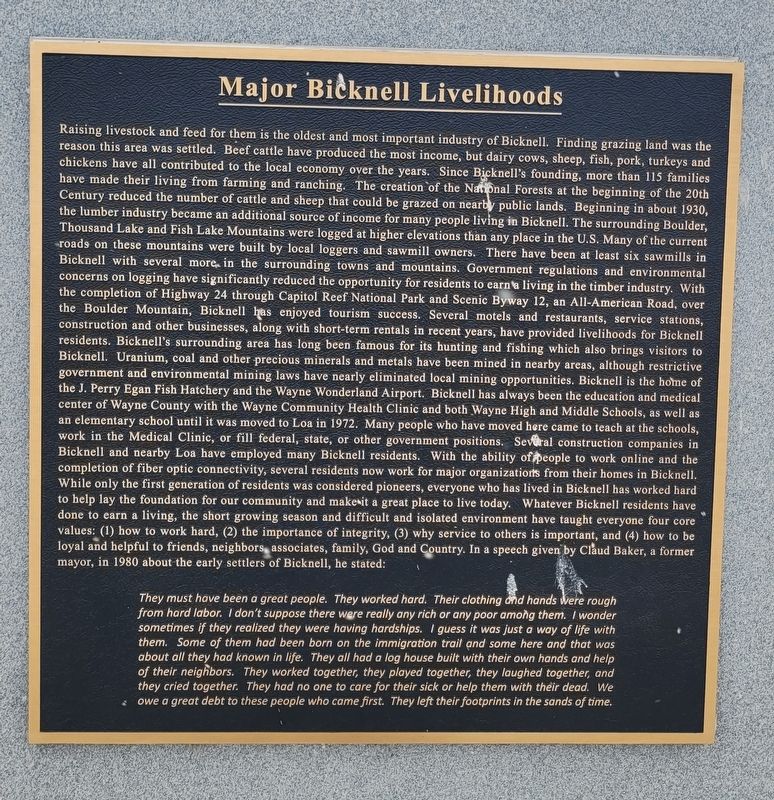
Raising livestock and feed for them is the oldest and most important industry of Bicknell. Finding grazing land was the reason this area was settled. Beef cattle have produced the most income, but dairy cows, sheep, fish, pork, turkeys and chickens have all contributed to the local economy over the years. Since Bicknell's founding, more than 115 families have made their living from farming and ranching. The creation of the National Forests at the beginning of the 20th Century reduced the number of cattle and sheep that could be grazed on nearby public lands. Beginning in about 1930, the lumber industry became an additional source of income for many people living in Bicknell. The surrounding Boulder, Thousand Lake and Fish Lake Mountains were logged at higher elevations than any place in the U.S. Many of the current roads on these mountains were built by local loggers and sawmill owners. There have been at least six sawmills in Bicknell with several more in the surrounding towns and mountains. Government regulations and environmental concerns on logging have significantly reduced the opportunity for residents to earn a living
Click or scan to see this page online
in the timber industry. With the completion of Highway 24 through Capitol Reef National Park and Scenic Byway 12, an All-American Road, over the Boulder Mountain, Bicknell has enjoyed tourism success. Several motels and restaurants, service stations, construction and other businesses, along with short-term rentals in recent years, have provided livelihoods for Bicknell residents. Bicknell's surrounding area has long been famous for its hunting and fishing which also brings visitors to Bicknell. Uranium, coal and other precious minerals and metals have been mined in nearby areas, although restrictive government and environmental mining laws have nearly eliminated local mining opportunities. Bicknell is the home of the J. Perry Egan Fish Hatchery and the Wayne Wonderland Airport. Bicknell has always been the education and medical center of Wayne County with the Wayne Community Health Clinic and both Wayne High and Middle Schools, as well as an elementary school until it was moved to Loa in 1972. Many people who have moved here came to teach at the schools, work in the Medical Clinic, or fill federal, state, or other government positions.
Photographed by James Hulse, April 4, 2025
2. Major Bicknell Livelihoods Marker
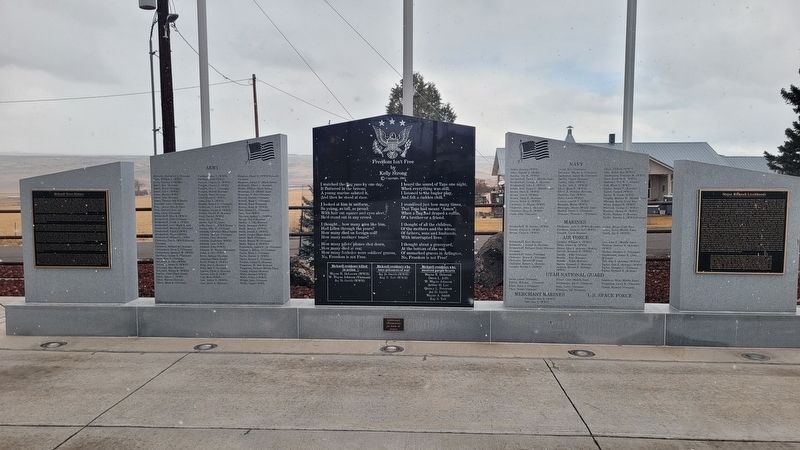
The marker is located on the right side of the memorial
Several construction companies in Bicknell and nearby Loa have employed many Bicknell residents. With the ability of people to work online and the completion of fiber optic connectivity, several residents now work for major organizations from their homes in Bicknell. While only the first generation of residents was considered pioneers, everyone who has lived in Bicknell has worked hard to help lay the foundation for our community and make it a great place to live today. Whatever Bicknell residents have done to earn a living, the short growing season and difficult and isolated environment have taught everyone four core values: (1) how to work hard, (2) the importance of integrity, (3) why service to others is important, and (4) how to be loyal and helpful to friends, neighbors, associates, family, God and Country. In a speech given by Claud Baker, a former mayor, in 1980 about the early settlers of Bicknell, he stated:
They must have been a great people. They worked hard. Their clothing and hands were rough from hard labor. I don't suppose there were really any rich or any poor among them. I wonder sometimes if they realized they were having hardships. I guess it was just a way of life with them. Some of them had been born on the immigration trail and some here and that was about all they had known in life. They all had a log house built with their own hands and help of their neighbors. They worked together, they played together, they laughed together, and they cried together. They had no one to care for their sick or help them with their dead. We owe a great debt to these people who came first. They left their footprints in the sands of time.
Location. 38° 20.448′ N, 111° 33.079′ W. Marker is in Bicknell, Utah, in Wayne County. It is at the intersection of West Main Street (Utah Route 24) and S 400 W, on the left when traveling west on West Main Street. The marker is located at the Bicknell Veterans & Heritage Memorial Park. Touch for map. Marker is at or near this postal address: 385 W Main St, Bicknell UT 84715, United States of America. Touch for directions.
Regionally, this marker is in Canyon Country. It is also in the American Mountain West, on the Colorado Plateau, and at the Four Corners. Globally, it is in North America, the Western Hemisphere, the Western World, and the Anglosphere. Historically, it finds itself in what was once New Spain and also Mexico’s Alta California.
Credits. This page was last revised on May 4, 2025. It was originally submitted on May 3, 2025, by James Hulse of Medina, Texas. This page has been viewed 108 times since then and 14 times this year. Photos:1, 2. submitted on May 4, 2025, by James Hulse of Medina, Texas.