
Canterbury in Kent, England, United Kingdom — Northwestern Europe (the British Isles)
St Augustine and his mission
Photographed by Ray Gurganus, March 29, 2025
1. St Augustine and his mission Marker
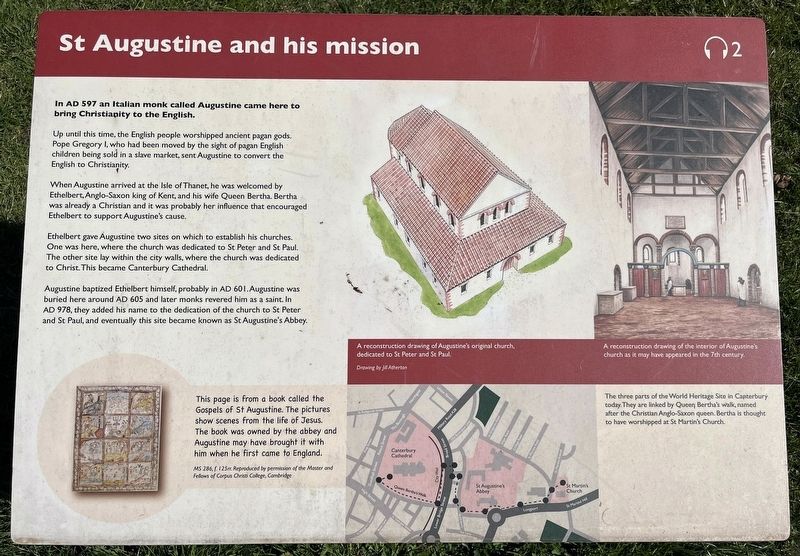
In AD 597 an Italian monk called Augustine came here to bring Christianity to the English.
Up until this time, the English people worshipped ancient pagan gods. Pope Gregory I, who had been moved by the sight of pagan English children being sold in a slave market, sent Augustine to convert the English to Christianity.
When Augustine arrived at the Isle of Thanet, he was welcomed by Ethelbert, Anglo-Saxon king of Kent, and his wife Queen Bertha. Bertha was already a Christian and it was probably her influence that encouraged Ethelbert to support Augustine's cause.
Ethelbert gave Augustine two sites on which to establish his churches. One was here, where the church was dedicated to St Peter and St Paul. The other site lay within the city walls, where the church was dedicated to Christ. This became Canterbury Cathedral.
Augustine baptized Ethelbert himself, probably in AD 601. Augustine was buried here around AD 605 and later monks revered him as a saint. In AD 978, they added his name to the dedication of the church to St Peter and St Paul, and eventually this site became known as St Augustine's Abbey.
Erected by English
this page online
Topics. This historical marker is listed in this topic list: Religion & Religious Structures. A significant historical year for this entry is 597 CE.
Location. 51° 16.67′ N, 1° 5.242′ E. Marker is in Canterbury, England, in Kent. It can be reached from Longport west of England Route A257, on the left when traveling east. Touch for map. Marker is at or near this postal address: 15 Longport, Canterbury, England CT1 1PE, United Kingdom. Touch for directions.

Regionally, this marker is in the Greater South East. Globally, it is on the Atlantic Ocean, in the North Atlantic Region, in Europe, in Atlantic Europe, on one of the British Isles, in the Western World, and in the Anglosphere. Historically, it finds itself in what was once the Roman Empire.
Other nearby markers. At least 8 other markers are within walking distance of this marker: Welcome to St Augustine's Abbey (a few steps from this marker); St Augustine of Canterbury (within shouting distance of this marker); Thomas Fyndon (within shouting distance of this marker); The Great Norman Church (within shouting distance of this marker); Reuse and Rediscovery
Photographed by Ray Gurganus, March 29, 2025
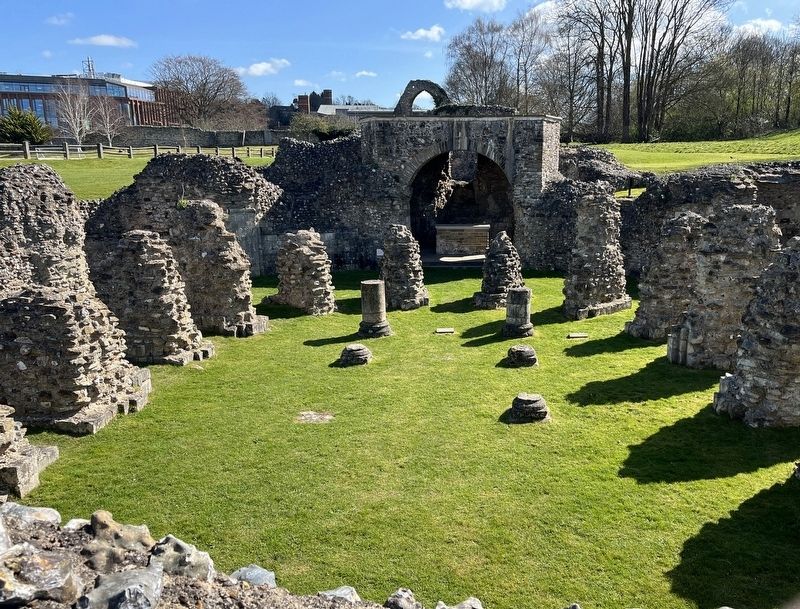
2. St Augustine's Abbey Ruins
Credits. This page was last revised on May 19, 2025. It was originally submitted on May 3, 2025, by Ray Gurganus of Washington, District of Columbia. This page has been viewed 101 times since then and 13 times this year. Photos: 1, 2. submitted on May 3, 2025, by Ray Gurganus of Washington, District of Columbia. • Devry Becker Jones was the editor who published this page.
