
Canterbury in Kent, England, United Kingdom — Northwestern Europe (the British Isles)
The Great Norman Church
St Augustine's Abbey
Photographed by Ray Gurganus, March 29, 2025
1. The Great Norman Church Marker
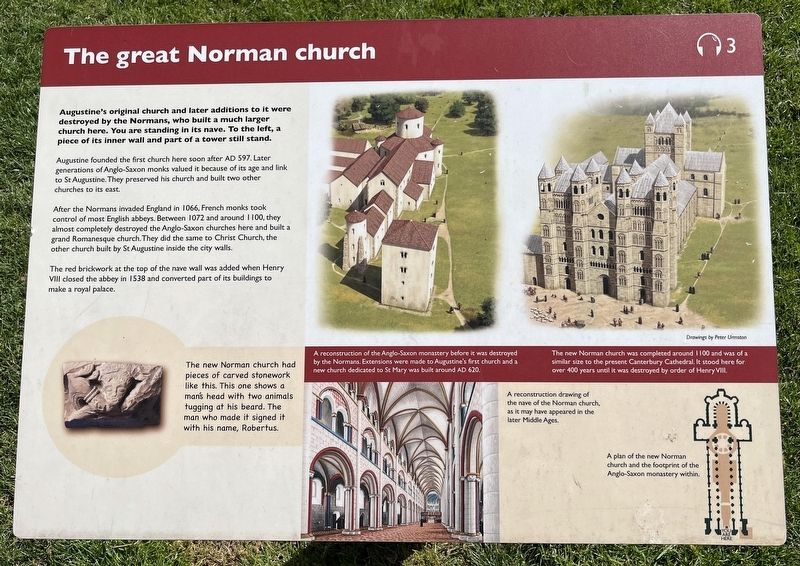
Augustine's original church and later additions to it were destroyed by the Normans, who built a much larger church here. You are standing in its nave. To the left, a piece of its inner wall and part of a tower still stand.
Augustine founded the first church here soon after AD 597. Later generations of Anglo-Saxon monks valued it because of its age and link to St Augustine. They preserved his church and built two other churches to its east.
After the Normans invaded England in 1066, French monks took control of most English abbeys. Between 1072 and around 1100, they almost completely destroyed the Anglo-Saxon churches here and built a grand Romanesque church. They did the same to Christ Church, the other church built by St Augustine inside the city walls.
The red brickwork at the top of the nave wall was added when Henry VIII closed the abbey in 1538 and converted part of its buildings to make a royal palace.
The new Norman church had pieces of carved stonework like this. This one shows a mans head with two animals tugging at his beard. The man who made it signed it with his name, Robertus.
Erected by English
this page online
Topics. This historical marker is listed in this topic list: Religion & Religious Structures. A significant historical year for this entry is 597 CE.
Location. 51° 16.696′ N, 1° 5.24′ E. Marker is in Canterbury, England, in Kent. It can be reached from Monastery Street north of Longport, on the right when traveling north. Touch for map. Marker is at or near this postal address: 16 Monastery St, Canterbury, England CT1, United Kingdom. Touch for directions.

Regionally, this marker is in the Greater South East. Globally, it is on the Atlantic Ocean, in the North Atlantic Region, in Europe, in Atlantic Europe, on one of the British Isles, in the Western World, and in the Anglosphere. Historically, it finds itself in what was once the Roman Empire.
Other nearby markers. At least 8 other markers are within walking distance of this marker: St Augustine and his mission (within shouting distance of this marker); Tombs of kings and archbishops (within shouting distance of this marker); Welcome to St Augustine's Abbey (within shouting distance of this marker); A Centre of Learning (within shouting distance

Photographed by Ray Gurganus, March 29, 2025
2. St Augustine's Abbey Ruins
Credits. This page was last revised on May 19, 2025. It was originally submitted on May 3, 2025, by Ray Gurganus of Washington, District of Columbia. This page has been viewed 164 times since then and 49 times this year. Photos: 1, 2. submitted on May 3, 2025, by Ray Gurganus of Washington, District of Columbia. • Devry Becker Jones was the editor who published this page.
