Old Town in Toronto, Ontario — Central Canada (North America)
The Great Fire of 1849
On This Site
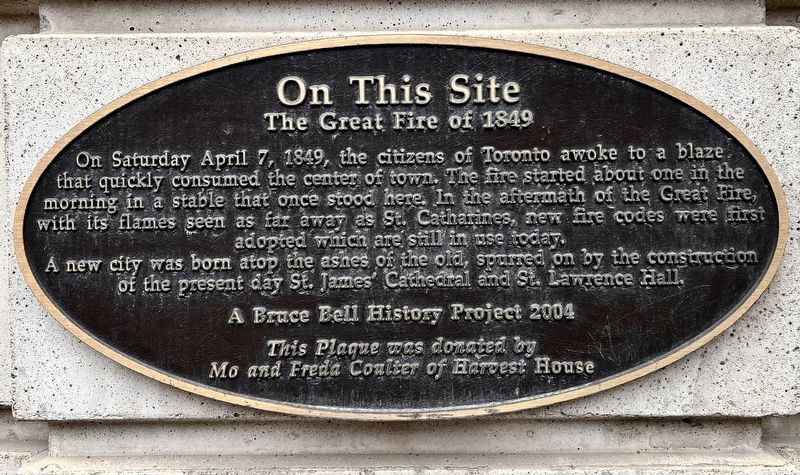
Photographed by Tim Boyd, May 3, 2025
1. The Great Fire of 1849 Marker
Erected 2004.
Topics. This historical marker is listed in this topic list: Disasters. A significant historical date for this entry is April 7, 1849.
Location. 43° 39.041′ N, 79° 22.29′ W. Marker is in Toronto, Ontario. It is in Old Town. It is at the intersection of King Street East and Jarvis Street, on the right when traveling west on King Street East. Touch for map. Marker is at or near this postal address: 158 King St E, Toronto ON M5A 1J4, Canada. Touch for directions.

Regionally, this marker is in Greater Toronto and on the Golden Horseshoe. It is also in Central Canada. Globally, it is in North America, on the Great Lakes, in the Western
this page online
Other nearby markers. At least 8 other markers are within walking distance of this marker: The Daniel Brooke Building (within shouting distance of this marker); 61-75 Jarvis Street (within shouting distance of this marker); York Council Chambers (within shouting distance of this marker); St. Lawrence Hall (within shouting distance of this marker); Francis Collins (within shouting distance of this marker); Cholera Epidemics of 1832 & 1834 (within shouting distance of this marker); Little York Hotel (within shouting distance of this marker); Home District School (about 90 meters away, measured in a direct line). Touch for a list and map of all markers in Toronto.
Also see . . . How the Great Fire of 1849 Reshaped Toronto (TV Ontario).
King Street was then Toronto’s main business artery. The block bounded by King, George, Nelson, and Duke (present-day Adelaide Street) Streets provided plenty of fuel for(Submitted on May 4, 2025, by Tim Boyd of Hamilton, Ontario.)a fire. Taverns stored large amounts of hay and straw for horses and catered to heavy-drinking clientele who might be careless. Hardware stores were filled with oils and other combustible items. Dry-goods retailers carried clothes and linens. Wooden sidewalks were high enough off the ground that they could provide a good draft. Buildings were covered with wooden shingles. There were some protective measures in place, such as a fire act passed in 1845 that prohibited such actions as smoking in stables and heavily regulated chimney sweeps.Photographed by Tim Boyd, May 3, 20252. The Great Fire of 1849 Marker

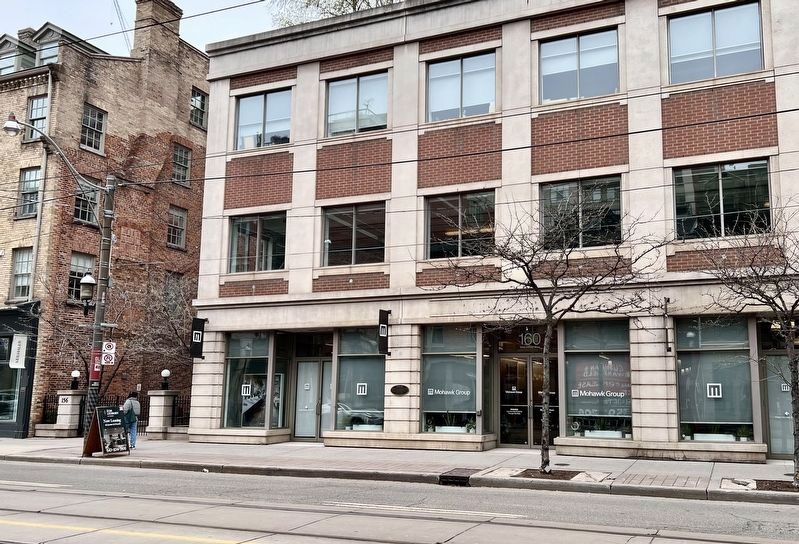
Photographed by Tim Boyd, May 3, 2025
3. The Great Fire of 1849 Marker
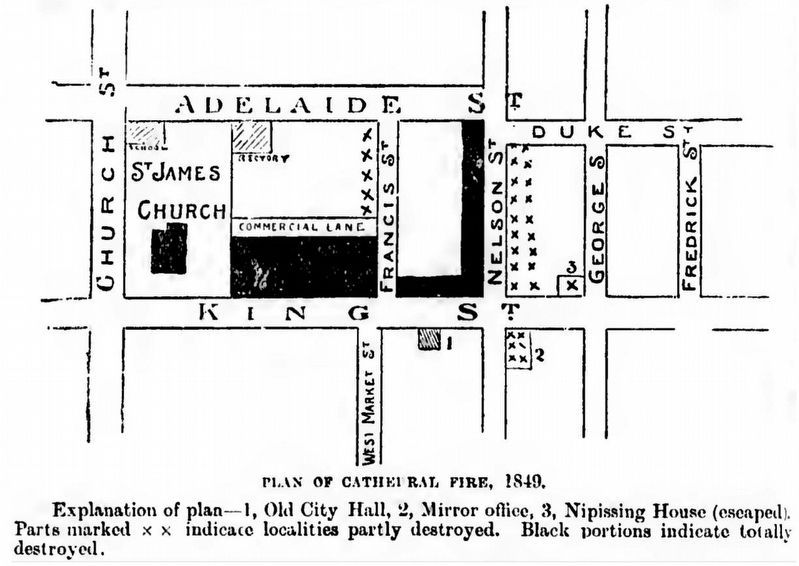
May 4, 2025
4. Great Fire of 1849, map of destroyed and damaged area
Toronto Public Library
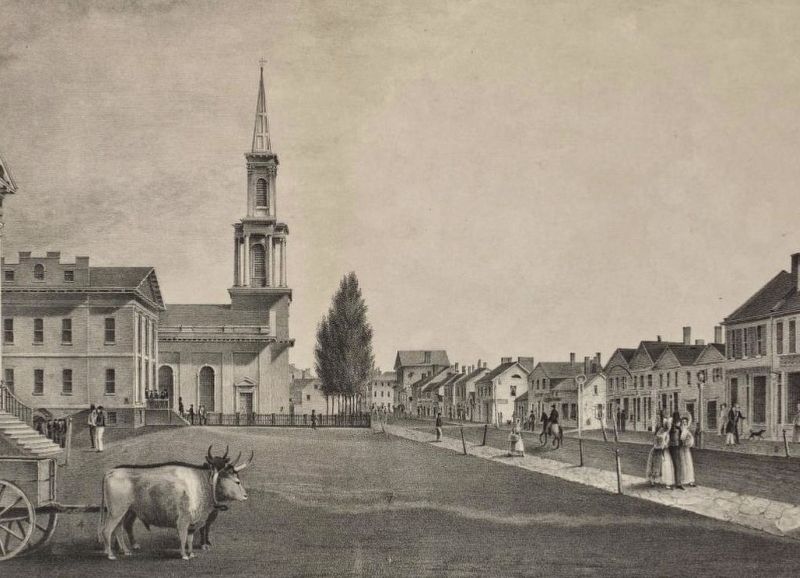
5. King Street, Toronto, 1835
Most buildings shown were destroyed in the fire
Toronto Public Library
Credits. This page was last revised on May 18, 2025. It was originally submitted on May 4, 2025, by Tim Boyd of Hamilton, Ontario. This page has been viewed 320 times since then and 130 times this year. Photos: 1, 2, 3, 4, 5. submitted on May 4, 2025, by Tim Boyd of Hamilton, Ontario. • Devry Becker Jones was the editor who published this page.
