Newell in Modoc County, California — The American West (Pacific Coastal)
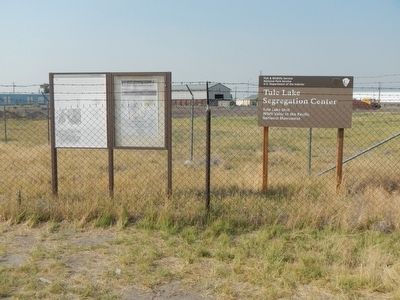
Tule Lake Segregation Center
WWII Valor in the Pacific National Monument, Tule Lake Unit
Photographed by Barry Swackhamer, August 20, 2015
1. Tule Lake Segregation Center Marker
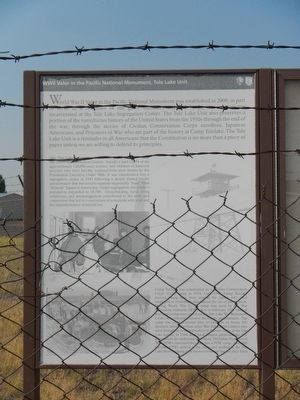
World War II Valor in the Pacific National Monument was established in 2008, in part to serve as a reminder of the grave injustices endured by Japanese Americans incarcerated at the Tule Lake Segregation Center. The Tule Lake Unit also preserves a portion of the tumultuous history of the United States from the 1930s through the end of the war, through the stories of Civilian Conservation Corps enrollees, Japanese Americans, and Prisoners of War who are part of the history of Camp Tulelake. The Tulelake Unit is a reminder to all Americans that the Constitution is no more than a piece of paper unless we are willing to defend its principles.
The Tule Lake Segregation Center was constructed in 1942 as one of ten War Relocation Centers. Initially it held 15,276 of the approximately 110,000 men, women, and children of Japanese ancestry who were forcibly removed from their homes by the Presidential Executive Order 9066. It was transformed into a segregation center in 1943 following a deeply flawed loyalty questionnaire that was used to separate supposedly "loyal" from "disloyal" Japanese Americans. Under segregation, the center's
this page online
Camp Tulelake was constructed as a Civilian Conservation Corps (CCC) camp in 1935. Until 1942, Camp Tulelake housed young men from around the nation who were employed to rehabilitate and expand the use of of public lands. During World War II, the camp was used by the War Relocation Authority (WRA), first in February 1943 when it was used to imprison men from the Tule Lake Relocation Center who refused to answer the loyalty questionnaire. The camp was used a second time in October, to house 243 Japanese Americans from other War Relocation Centers who were brought in as strikebreakers to harvest crops at the Tule Lake Center. In 1944, after local farmers petitioned the U.S. government for additional farm labor, 150 Italian Prisoners of War (POWs) converted the camp into a POW camp. Soon 800 German POWs arrived at the camp and worked in the Tule Basin, helping local farmers tend and harvest their fields.
Erected by National
Photographed by Barry Swackhamer, August 20, 2015
2. Tule Lake Segregation Center Marker
Topics. This historical marker is listed in these topic lists: Asian Americans • War, World II. A significant historical year for this entry is 1942.
Location. 41° 53.214′ N, 121° 22.302′ W. Marker is in Newell, California, in Modoc County. It is on County Road 176 north of State Highway 139, on the left when traveling east. Touch for map. Marker is at or near this postal address: 44340 Highway 139, Tulelake CA 96134, United States of America. Touch for directions.

Regionally, this marker is on the Modoc Plateau and in the Shasta Cascade. It is also in the American Mountain West. Globally, it is in North America, on the Ring of Fire, on the Pacific Rim, in the Western Hemisphere, in the Western World, and in the Anglosphere. Historically, it finds itself in what was once New Spain and also Mexico’s Alta California.
Other nearby markers. At least 8 other markers are within 4 miles of this marker, measured as the crow flies: Tule Lake (approx. 0.2 miles away); Battle of Dry Lake Memorial (approx. 0.6 miles away); Canby’s Cross (approx. 0.6 miles away); Captain Jack’s Stronghold
Photographed by Barry Swackhamer, August 20, 2015
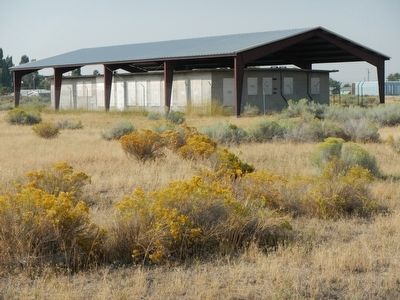
3. The last remaining, on site, Tule Lake Segregation Center building
Also see . . .
1. Tule Lake National Monument California. National Park Service Website (Submitted on March 4, 2021, by Larry Gertner of New York, New York.)
2. Tule Lake - Exploring America's Concentration Camps. Japanese American National Museum entry (Submitted on March 4, 2021, by Larry Gertner of New York, New York.)
Photographed by Barry Swackhamer, August 21, 2015
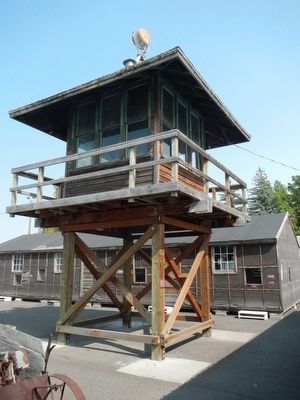
4. Tule Lake Segregation Center guard tower
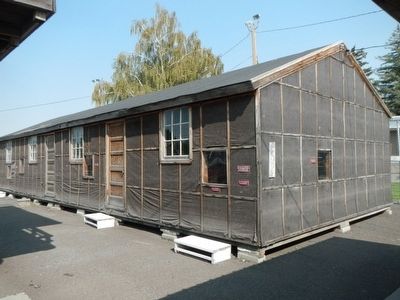
Photographed by Barry Swackhamer, August 21, 2015
5. Tule Lake Segregation Center building
Located at the WWII Valor in the Pacific National Monument visitors center.
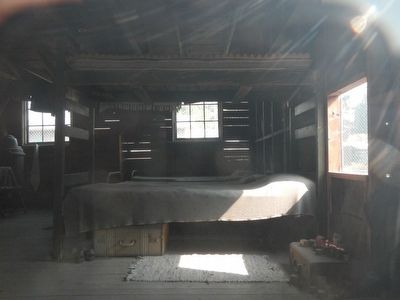
Photographed by Barry Swackhamer, August 21, 2015
6. Quarters for a family of four
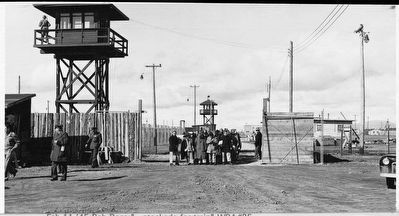
Photographed by Unknown, circa 1943
7. Tule Lake stockade gate
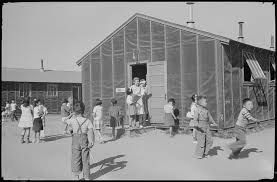
Photographed by Unknown, circa 1943
8. Tule Lake housing
Credits. This page was last revised on May 6, 2025. It was originally submitted on August 30, 2015, by Barry Swackhamer of Brentwood, California. This page has been viewed 853 times since then and 47 times this year. Last updated on May 4, 2025, by Ronald D. (Ron) Trigueiro of Fresno, California. Photos: 1, 2, 3, 4, 5, 6, 7, 8. submitted on August 30, 2015, by Barry Swackhamer of Brentwood, California. • Devry Becker Jones was the editor who published this page.
