
Near McConnells in York County, South Carolina — The American South (South Atlantic)
The Brattonsville Store
Architectural History and Preservation of the "Brick House"
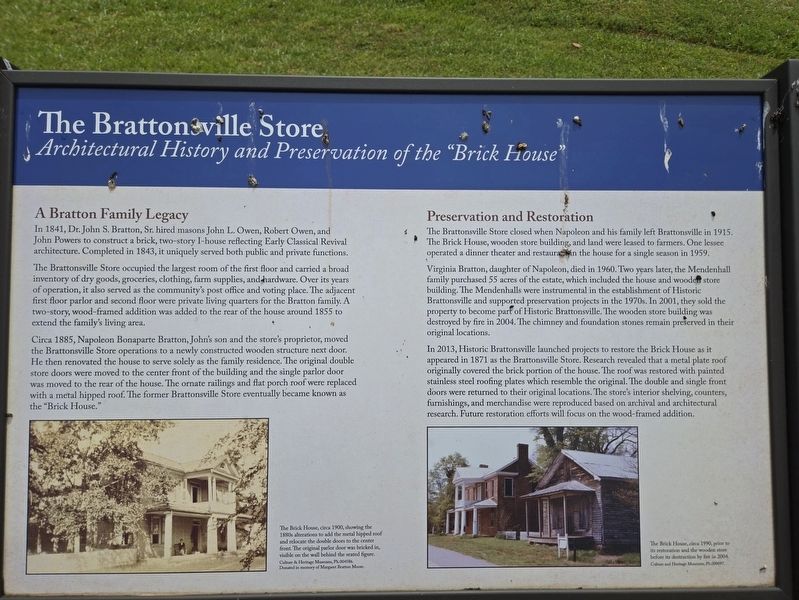
Photographed by Mark Parker, May 3, 2025
1. The Brattonsville Store Marker
A Bratton Family Legacy
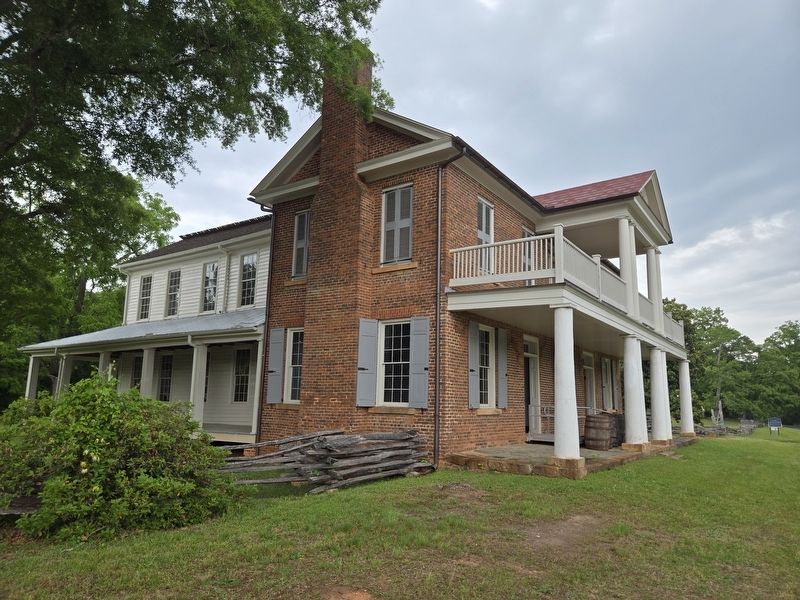
In 1841, Dr. John S. Bratton, Sr. hired masons John L. Owen, Robert Owen, and John Powers to construct a brick, two-story I-house reflecting Early Classical Revival architecture. Completed in 1843, it uniquely served both public and private functions.
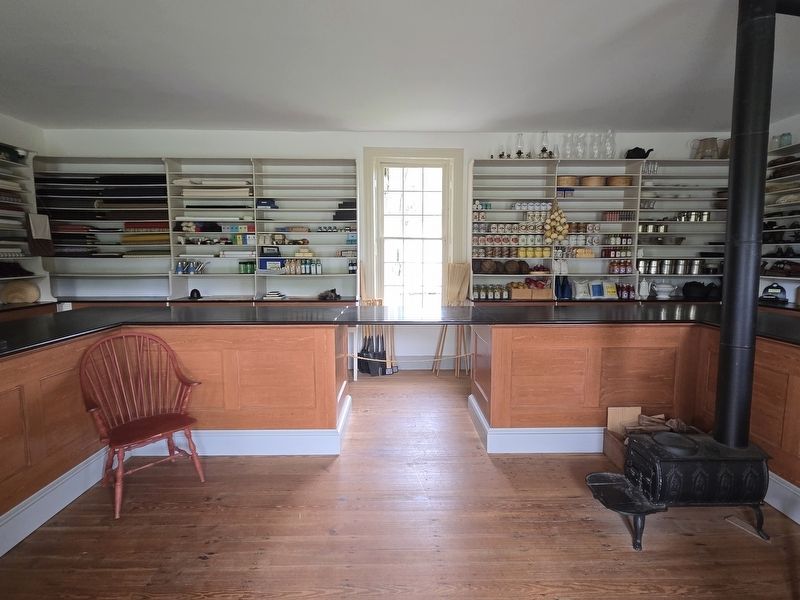
The Brattonsville Store occupied the largest room of the first floor and carried a broad inventory of dry goods, groceries, clothing, farm supplies, and hardware. Over its years of operation, it also served as the community's post office and voting place. The adjacent first floor parlor and second floor were private living quarters for the Bratton family. A two-story, wood-framed addition was added to the rear of the house around 1855 to extend the family's living area.
Circa 1885, Napoleon Bonaparte Bratton, John's son and the store's proprietor, moved the Brattonsville Store operations to a newly constructed wooden structure next door. He then renovated the house to serve solely as the family residence. The original double store doors were moved to the center front of the building and the single parlor door was moved to the rear of the house.
this page online
Preservation and Restoration
The Brattonsville Store closed when Napoleon and his family left Brattonsville in 1915. The Brick House, wooden store building, and land were leased to farmers. One lessee operated a dinner theater and restaurant the house for a single season in 1959.
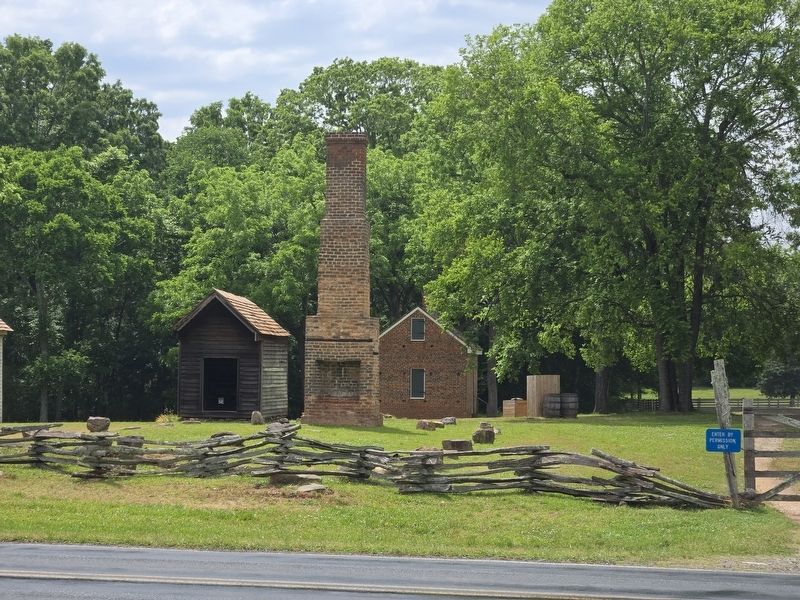
Virginia Bratton, daughter of Napoleon, died in 1960. Two years later, the Mendenhall family purchased 55 acres of the estate, which included the house and wooden store building. The Mendenhalls were instrumental in the establishment of Historic Brattonsville and supported preservation projects in the 1970s. In 2001, they sold the property to become part of Historic Brattonsville. The wooden store building was destroyed by fire in 2004. The chimney and foundation stones remain preserved in their original locations.
In 2013, Historic Brattonsville launched projects to restore the Brick House as it appeared in 1871 as the Brattonsville Store. Research revealed that a metal plate roof originally

Photographed by Mark Parker, May 3, 2025
2. The Brattonsville Store Marker across Brattonsville Road from the "Brick House"
(captions)
The Brick House, circa 1900, showing the 1880s alterations to add the metal hipped roof and relocate the double doors to the center front. The original parlor door was bricked in, visible on the wall behind the seated figure. Culture & Heritage Museums, Ph.004586 Donated in memory of Margaret Bratton Moore
The Brick House, circa 1990, prior to its restoration and the wooden store before its destruction by fire in 2004. Culture and Heritnge Museums Ph.000097.
Topics. This historical marker is listed in this topic list: Architecture. A significant historical year for this entry is 1843.
Location. 34° 51.872′ N, 81° 10.519′ W. Marker is near McConnells, South Carolina, in York County. It is at the intersection of Brattonsville
Photographed by Mark Parker, May 3, 2025
3. Chimney and foundation remains from the wooden store which burned in 2004.

Regionally, this marker is in the Midlands and in the Olde English District. It is also in the American South and specifically in the Deep South. Globally, it is in North America, the Western Hemisphere, the Western World, and the Anglosphere. Historically, it finds itself in what was once the original Cherokee Nation, the territory of the Mississippian Culture, one of the original Thirteen Colonies, one of the Confederate States of America, and the Antebellum South.
Other nearby markers. At least 8 other markers are within walking distance of this marker: Brattonsville (a few steps from this marker); Brick House / Lynching of Jim Williams (within shouting distance of this marker); A House of Untold Stories (about 300 feet away, measured in a direct line); a different marker also named Battle of Huck's Defeat (about 400 feet away); Field of Huck's Defeat
Photographed by Mark Parker, May 3, 2025
4. The Brick House
Other markers no longer nearby. The Homestead (was within shouting distance of this marker but has been replaced with another marker now near it); Brick Kitchen (was about 400 feet away but has been replaced with another marker now near it); The Battle of Huck’s Defeat (was about 400 feet away but has been replaced with another marker now near it).
Also see . . . Historic Brattonsville. Culture & Heritage Museums (Submitted on May 5, 2025.)
Photographed by Mark Parker, May 3, 2025
5. Replica Brattonsville Store in the front room of the Brick House
Credits. This page was last revised on May 5, 2025. It was originally submitted on May 4, 2025, by Mark Parker of Hickory, North Carolina. This page has been viewed 161 times since then and 12 times this year. Photos: 1, 2, 3, 4, 5. submitted on May 4, 2025, by Mark Parker of Hickory, North Carolina. • Bernard Fisher was the editor who published this page.
