
Fort Howard in Edgemere in Baltimore County, Maryland — The American Northeast (Mid-Atlantic)
Battery Nicholson
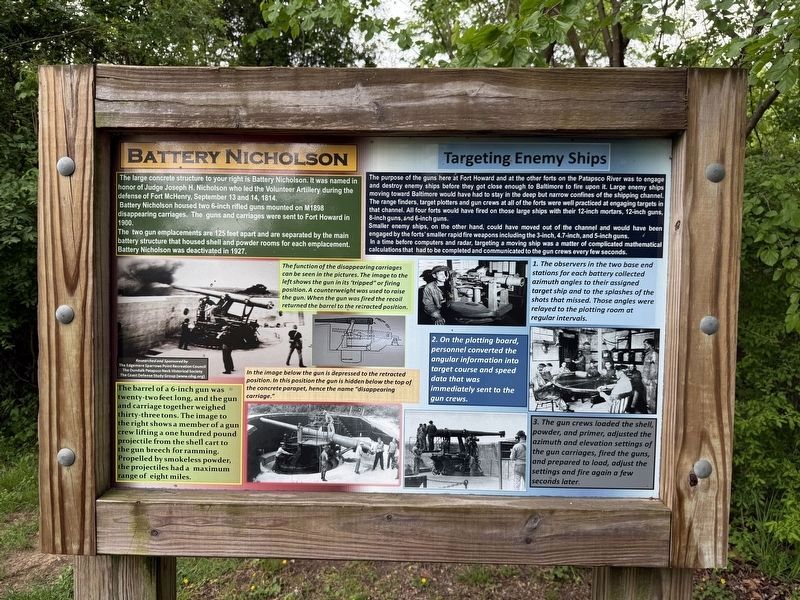
The large concrete structure to your right is Battery Nicholson. It was named in honor of Judge Joseph H. Nicholson who led the Volunteer Artillery during the defense of Fort McHenry, September 13 and 14, 1814.
Battery Nicholson housed two 6-inch rifled guns mounted on M1898 disappearing carriages. The guns and carriages were sent to Fort Howard in 1900.
The two gun emplacements are 125 feet apart and are separated by the main battery structure that housed shell and powder rooms for each emplacement. Battery Nicholson was deactivated in 1927.
Smaller
this page online
In a time before computers and radar, targeting a moving ship was a matter of complicated mathematical calculations that had to be completed and communicated to the gun crews every few seconds.
1. The observers in the two base end stations for each battery collected azimuth angles to their assigned target ship and to the splashes of the shots that missed. Those angles were relayed to the plotting room at regular intervals.
2. On the plotting board, personnel converted the angular information into target course and speed data that was immediately sent to the gun crews.
3. The gun crews loaded the shell, powder, and primer, adjusted the azimuth and elevation settings of the gun carriages, fired the guns, and prepared to load, adjust the settings and fire again and a few seconds later.
[Captions:]
The function of the disappearing carriages can be seen in the pictures. The image to the left shows the gun in its 'tripped" or firing position A counterweight was used to raise the gun. When the gun was fired the recoil returned the barrel to the retracted position.
In the image below the gun is depressed to the retracted position. In this position the gun is hidden below the top of the concrete parapet, hence the name "disappearing carriage."
The
Erected by The Edgemere Sparrows Point Recreation Council; The Dundalk Patapsco Neck Historical Society; The Coast Defense Study Group.
Topics. This historical marker is listed in this topic list: Forts and Castles. A significant historical date for this entry is September 13, 1814.
Location. 39° 11.771′ N, 76° 26.648′ W. Marker is in Edgemere, Maryland, in Baltimore County. It is in Fort Howard. It can be reached from Fort Howard Park Road west of Key Street. Touch for map. Marker is at or near this postal address: 9598 Fort Howard Park Rd, Fort Howard MD 21052, United States of America. Touch for directions.

Regionally, this marker is in the Baltimore Metro Region and in Central Maryland. It is also in the American Mid-Atlantic, in the Chesapeake Bay Region, and on the Eastern Seaboard. Globally, it is in

Photographed by Evan Dwyer, March 7, 2026
3. Battery Nicholson
Other nearby markers. At least 8 other markers are within walking distance of this marker: Battery Stricker (within shouting distance of this marker); Searchlight Power House (about 300 feet away, measured in a direct line); This Maple (about 400 feet away); Battery Harris (about 500 feet away); Life at Fort Howard 1898-1917 (about 600 feet away); Fort Howard During World War I (about 600 feet away); Life at Fort Howard 1920-1940 - The 12th Infantry (about 700 feet away); Artillery District of Baltimore 1899-1920 (about 700 feet away). Touch for a list and map of all markers in Edgemere.
Another marker is no longer nearby. Battery Nicholson (was within shouting distance of this marker but has been replaced with another marker now near it).
Related marker. Click here for another marker that is related to this marker. This marker has replaced the linked marker.
Credits. This page was last revised on March 18, 2026. It was originally submitted on May 4, 2025, by Devry Becker Jones of Washington, District of Columbia. This page has been viewed 108 times since then and 19 times this year. Photos: 1, 2. submitted on May 4, 2025, by Devry Becker Jones of Washington, District of Columbia. 3. submitted on March 8, 2026, by Evan Dwyer of Richmond, Virginia.
