Charing in Kent, England, United Kingdom — Northwestern Europe (the British Isles)
Corporal Frederick George Coppins VC
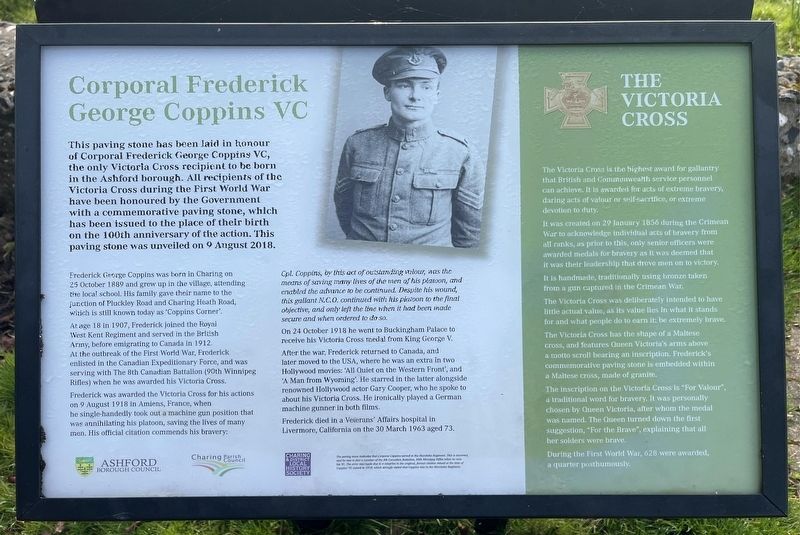
Photographed by Ray Gurganus, March 27, 2025
1. Corporal Frederick George Coppins VC Marker
Frederick George Coppins was born in Charing on 25 October 1889 and grew up in the village, attending the local school. His family gave their name to the junction of Pluckley Road and Charing Heath Road, witch is still known today as "Coppins Corner".
At age 18 in 1907, Frederick joined the Royal West Kent Regiment and served in the British Army, before emigrating to Canada in 1912 At the outbreak of the First World War, Frederick) enlisted in the Canadian Expeditionary Force, and was serving with The 8th Canadian Battalion (90th Winnipeg Rifles) when he was awarded his Victoria Cross.
Frederick was awarded the Victoria Cross for his actions on 9 August 1918 in Amiens, France, when he single-handedly
this page online
Cpl. Coppins, by this act of outstanding valour, was the means of saving many lives of the men of his platoon, and enabled the advance to be continued. Despite his wound, this gallant N.C.O. continued with his platoon to the final objective, and only left the time when it had been made secure and when ordered to do so.
On 24 October 1918 he went to Buckingham Palace to receive his Victoria Cross medal from King George V.
After the war, Frederick returned to Canada, and later moved to the USA, where he was an extra in two Hollywood movies: "All Quiet on the Western Front", and "A Man from Wyoming". He starred in the latter alongside renowned Hollywood actor Gary Cooper, who he spoke to about his Victoria Cross. He ironically played a German machine gunner in both films.
Frederick died in a Veterans' Affairs hospital in Livermore, California on the 30 March 1963 aged 73.
The Victoria Cross
The Victoria Cross is the highest award for gallantry that British and Commonwealth service personnel can achieve. It is awarded for acts of extreme bravery, daring acts of valour or self-sacrifice, or extreme devotion to duty.
It was created on 29 January 1856 during the Crimean War to acknowledge individual acts of bravery from all ranks, as prior to this, only senior officers were awarded medals for bravery as It was deemed that it was their leadership that drove men on to victory.
It is handmade, traditionally using bronze taken from a gun captured in the Crimean War.
The Victoria Cross was deliberately intended to have little actual value, as its value lies In what it stands for and what people do to earn it be extremely brave.
The Victoria Cross has the shape of a Maltese cross, and features Queen Victoria's arms above a motto scroll bearing an inscription. Frederick's commemorative paving stone is embedded within a Maltese cross, made of granite.
The inscription on the Victoria Cross Is "For Valour", a traditional word for bravery. It was personally chosen by Queen Victoria, after whom the medal was named. The Queen turned down the first suggestion, "For the Brave", explaining that all her solders were brave.
During the First World War, 628 were awarded, a quarter pathumously.
Topics and series. This historical marker is listed in this topic list: War, World I. In addition, it is included in the Victoria Cross and George Cross Recipients series list. A significant historical year for this entry is 1918.
Location. 51° 12.626′ N, 0° 47.726′ E. Marker is in Charing, England, in Kent. It is on Market Place east of The High Street, on the right when traveling east. Touch for map. Marker is at or near this postal address: 5 Market Pl, Charing, England TN27 0LR, United Kingdom. Touch for directions.

Regionally, this marker is in the Greater South East. Globally, it is on the Atlantic Ocean, in the North Atlantic Region, in Europe, in Atlantic Europe, on one of the British Isles, in the Western World, and in the Anglosphere. Historically, it finds itself in what was once the Roman Empire.
Other nearby markers. At least 8 other markers are within 10 kilometers of this marker, measured as the crow flies: Historic Charing (a few steps from this marker); a different marker also named Historic Charing (a few steps from this marker); In the Parish of Calehill with Westwell (within shouting distance of this marker); A medieval building (about 210 meters away, measured in a direct line); Ronald N. Stuart Victoria Cross (approx. 0.3 kilometers away); To mark the Centenary of the WW1 Armistice (approx. 0.3 kilometers away); Simone Weil (approx. 8.3 kilometers away); British Mark IV Female Tank, No 245 (approx. 8.5 kilometers away). Touch for a list and map of all markers in Charing.
Credits. This page was last revised on May 19, 2025. It was originally submitted on May 5, 2025, by Ray Gurganus of Washington, District of Columbia. This page has been viewed 120 times since then and 9 times this year. Photo 1. submitted on May 5, 2025, by Ray Gurganus of Washington, District of Columbia. • Devry Becker Jones was the editor who published this page.
Editor’s want-list for this marker. A wide shot of the marker in context. • Can you help?
