
Floyd in Floyd County, Virginia — The American South (Mid-Atlantic)
Glenanna

Photographed by Mark Parker, May 7, 2025
1. Glenanna Marker
has been placed on the
National Register
of Historic Places
by the United States
Department of the Interior
1849
Erected by United States Department of the Interior.
Topics. This historical marker is listed in this topic list: Notable Buildings. A significant historical year for this entry is 1849.
Location. 36° 54.67′ N, 80° 19.306′ W. Marker is in Floyd, Virginia, in Floyd County. It can be reached from the intersection of West Main Street (U.S. 221) and Harris Street Northwest, on the right when traveling west. Touch for map. Marker is at or near this postal address: 204 W Main St, Floyd VA 24091, United States of America. Touch for directions.

Regionally, this marker is in Southwest Virginia and in the Blue Ridge Highlands. It is also in the American South, specifically in the Upper South, in Appalachia, and specifically in Southern Appalachia. Globally, it is in North America, the Western Hemisphere, the Western World, and the Anglosphere. Historically, it finds itself in what was once the territory of the Mississippian Culture, one of the original Thirteen Colonies, one of the
this page online
Other nearby markers. At least 8 other markers are within walking distance of this marker: Floyd (about 500 feet away, measured in a direct line); Floyd County Confederate Memorial (about 500 feet away); Floyd County War Memorial (about 600 feet away); Park to Library Trail (about 600 feet away); Warren G. Lineberry Community Park (about 700 feet away); Warren G. Lineberry (about 700 feet away); Warren G. Lineberry Community Park Patio (about 700 feet away); a different marker also named Floyd (about 700 feet away). Touch for a list and map of all markers in Floyd.
Another marker is no longer nearby. Warren G. Lineberry (was about 700 feet away but has been replaced with another marker now near it).
Regarding Glenanna. Excerpt from the Glenanna Nomination Form:
Built in 1849 in the courthouse town of Floyd for wealthy physician Tazewell Headen, the house served as the residence of a number of prominent Floyd citizens in the antebellum and postbellum periods. After Headen's death, his son-in-law, Henry Lane, Commonwealth's Attorney and newspaper editor, inheritedthe property. After Lane's death in the Civil War, Dr. John Stuart, bother of Confederate General J. E. B. Stuart, rented the house. The house was sold in 1870 to Dr. Thomas H. Howard, a Civil War surgeon who practiced in Floyd for 51 years. Henry Dillon, a master carpenter responsible for a number of public and private buildings in the courthouse town of Floyd, built the house, which is imposing in size, but simple in its details and their execution. The house assumed its present appearance in the late 1910s, when Dr. Thomas's widow had the two-story portico, one-story kitchen wing, side porch, and conservatory added. The five surviving vernacular antebellum outbuildings - a brick kitchen/servants house, a brick well house/dairy, a brick smokehouse, a log stable and log crib - all contribute to the property's architectural significance.Photographed by Mark Parker, May 7, 20252. Front portico of Glenanna. Marker is to the right of the entrance
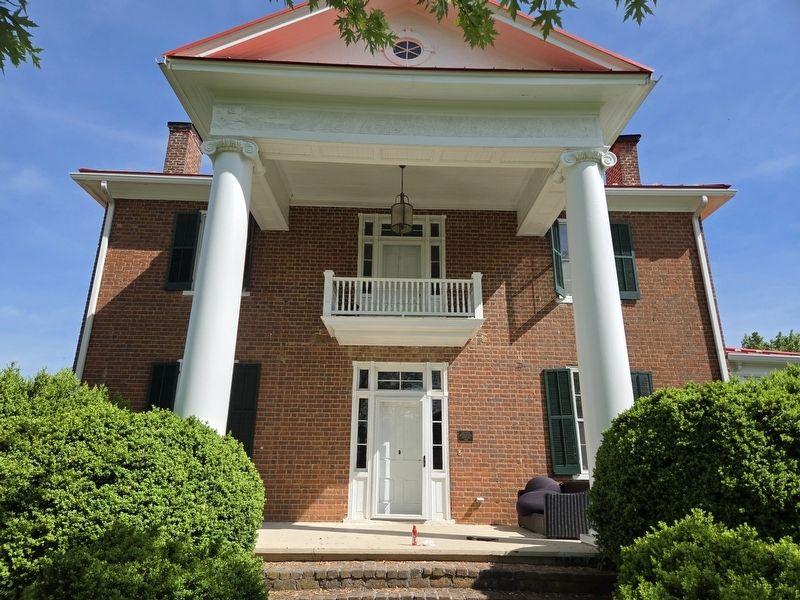
Also see . . . Glenanna Nomination Form (pdf). Form prepared by Katherine Houston, Consultant, 2001 (Submitted on May 8, 2025, by Mark Parker of Hickory, North Carolina.)
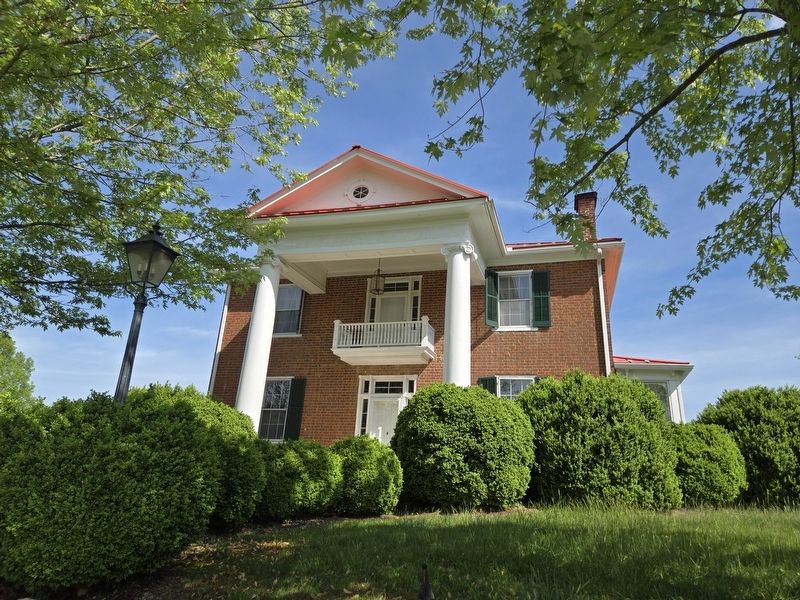
Photographed by Mark Parker, May 7, 2025
3. Full view of Glenanna from West Main Street
Credits. This page was last revised on May 17, 2025. It was originally submitted on May 8, 2025, by Mark Parker of Hickory, North Carolina. This page has been viewed 205 times since then and 43 times this year. Photos: 1, 2, 3. submitted on May 8, 2025, by Mark Parker of Hickory, North Carolina. • Bernard Fisher was the editor who published this page.
