Sault Ste. Marie in Algoma District, Ontario — Central Canada (North America)
Clergue Blockhouse
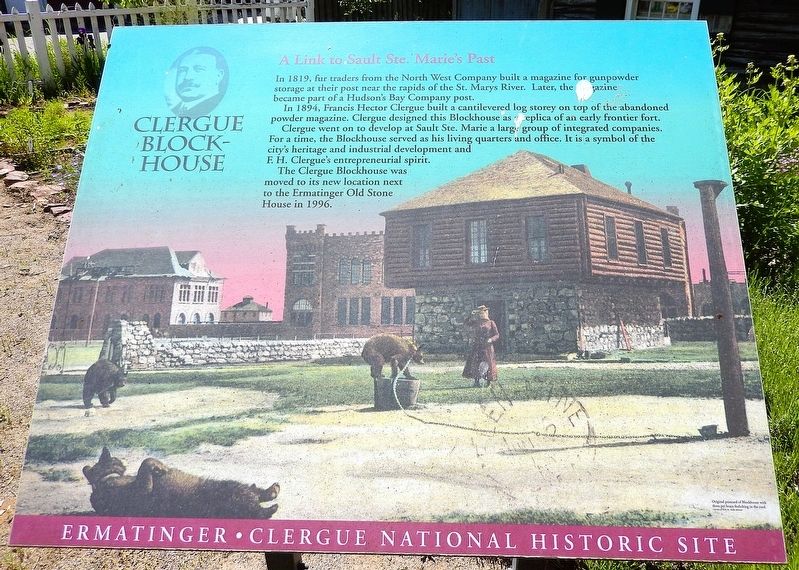
A Link to Sault Ste. Marie's Past
| — | Ermatinger • Clergue National Historic Site | — |
Photographed by Cosmos Mariner, June 11, 2024
1. Clergue Blockhouse Marker
In 1819, fur traders from the North West Company built a magazine for gunpowder storage at their post near the rapids of the St. Marys River. Later, the magazine became part of a Hudson's Bay Company post.
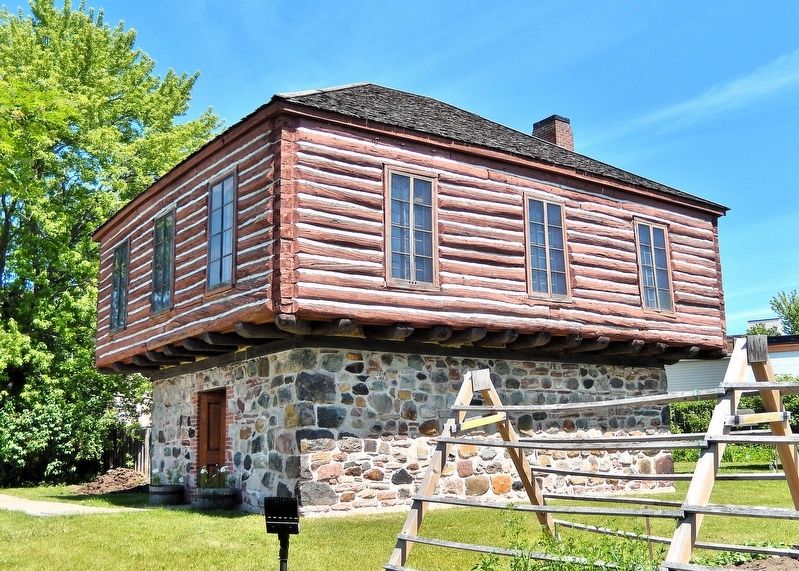
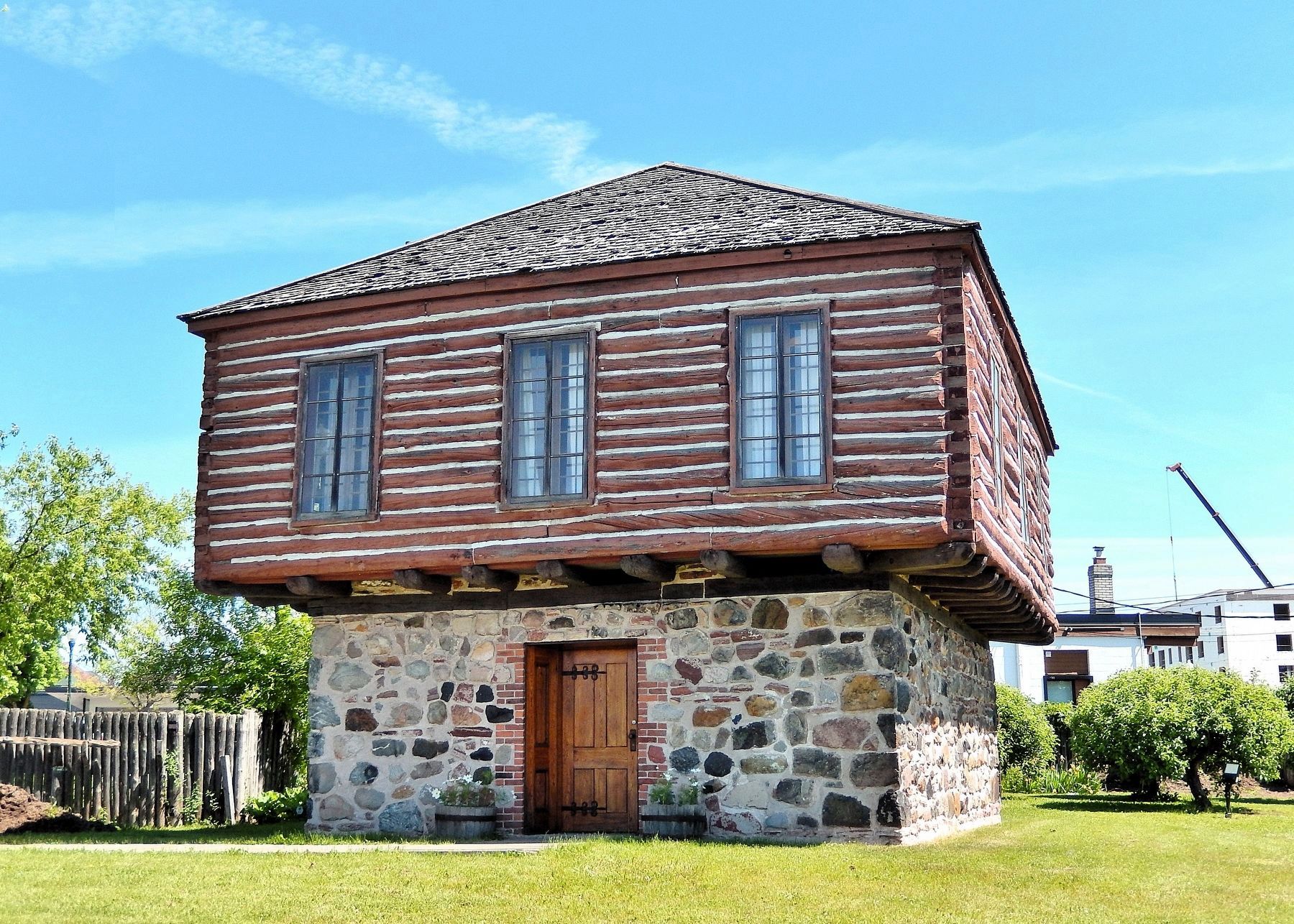
In 1894, Francis Hector Clergue built a cantilevered log storey on top of the abandoned powder magazine. Clergue designed this Blockhouse as a replica of an early frontier fort.
Clergue went on to develop at Sault Ste. Marie a large group of integrated companies. For a time, the Blockhouse served as his living quarters and office. It is a symbol of the city's heritage and industrial development and F. H. Clergue's entrepreneurial spirit.
The Clergue Blockhouse was moved to its new location next to the Ermatinger Old Stone House in 1996.
[marker background photo caption]
Original postcard of Blockhouse with three pet bears frolicking in the yard.
Topics. This historical marker is listed in these topic lists: Architecture • Forts and Castles • Industry & Commerce • Settlements & Settlers. A significant historical year for this entry is 1894.
Location. 46° 30.385′ N, 84° 19.465′ W. Marker is in Sault Ste. Marie,
this page online

Regionally, this marker is in the Sault Ste. Marie and Algoma Area and in Northern Ontario. It is also in Central Canada. Globally, it is in North America, in the Great North Woods, on the Great Lakes, on Lake Superior’s North Shore, in the Western Hemisphere, in the Western World, and in the Anglosphere. Historically, it finds itself in what was once a British colony, the Viceroyalty of New France, the Haudenosaunee (Iroquois) Confederacy, and Rupert’s Land.
Other nearby markers. At least 8 other markers are within walking distance of this marker: Herbs in the 19th Century (here, next to this marker); Ermatinger Old Stone House (here, next to this marker); Blossoms and Berries (within shouting distance of this marker); The Three Sisters Garden (within
Photographed by Cosmos Mariner, June 11, 2024
2. Clergue Blockhouse Marker
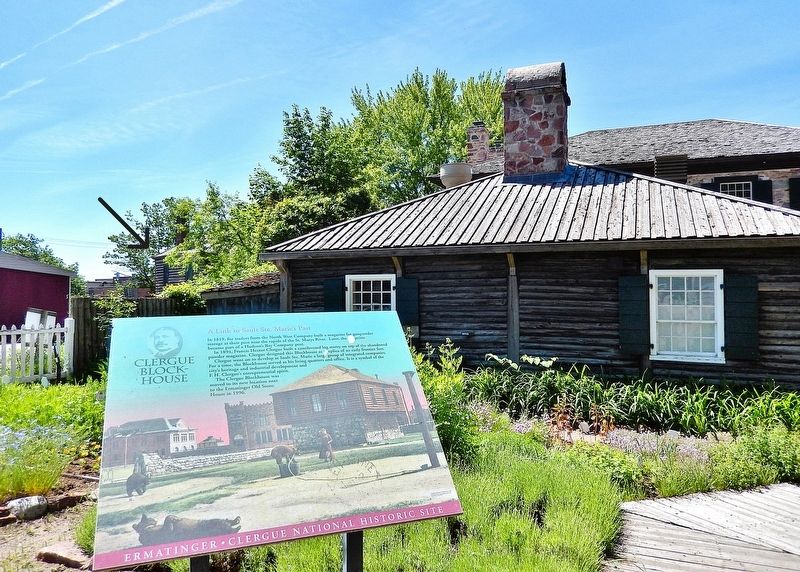
Looking south from Queen Street East; the top story of the blockhouse is partially visible through the trees in the left background.
Related markers. Click here for a list of markers that are related to this marker. Ermatinger • Clergue National Historic Site
Also see . . .
1. Ermatinger Clergue National Historic Site: Clergue Blockhouse (Wikipedia).
Excerpt: The Clergue blockhouse was originally a powder magazine at a North West Company trading post before the merger of the North West Company and the Hudson's Bay Company. When the last remaining factor at the post resigned in 1867, the site fell into disuse, until only the powder magazine's foundation building remained. American industrialist F.H. Clergue purchased the property and began the process of transforming it from powder magazine to living space. He lived in the blockhouse from 1894 to 1902.(Submitted on May 12, 2025, by Cosmos Mariner of Cape Canaveral, Florida.)In 1979 the blockhouse was
designated as a local historical site by the City of Sault Ste. Marie, Ontario. In 1995 the St. Mary's Paper Mill was planning development that would jeopardize the location and structure of the blockhouse. The following year the City of Sault Ste. Marie purchased the building and relocated it from the St. Mary's Paper Mill to the Ermatinger Old Stone House site, forming a complex of historic buildings.Photographed by Cosmos Mariner, June 11, 20243. Clergue Blockhouse (southeast elevation)
2. Francis Hector Clergue (1856-1939) (Wikipedia).
Excerpt: American businessman who became the leading industrialist of Sault Ste. Marie, Ontario, Canada, at the turn of the 20th century. Canada was a logical investment choice for American finance capital, and Clergue soon arrived there to scout for opportunities. Along the way, he took an interest in Sault Ste. Marie, which had water and rail transport connections, but had been bypassed by the Canadian Pacific Railway's transcontinental mainline a decade earlier, and whose economy had stagnated with the decline of the fur trade. Local businessmen had attempted a hydropower scheme intending(Submitted on May 12, 2025, by Cosmos Mariner of Cape Canaveral, Florida.)to capitalize on the rapids of the St. Marys River, but a construction disaster left the project unfinished.Photographed by Cosmos Mariner, June 11, 20244. Clergue Blockhouse (south elevation)Clergue, who had arrived in 1894, sensed an opportunity and bought up the defunct power company, promising Sault Ste. Marie a large injection of American investment. The town council in return gave him an exclusive 20-year franchise on hydroelectric power generation, as well as a 10-year municipal tax exemption. Clergue soon expanded power generation at Sault Ste. Marie to a level where it could supply both municipal power and power for several industries and used hydropower as the nexus of a whirlwind of industrialization.
Credits. This page was last revised on May 13, 2025. It was originally submitted on May 9, 2025, by Cosmos Mariner of Cape Canaveral, Florida. This page has been viewed 153 times since then and 36 times this year. Photos: 1, 2, 3, 4. submitted on May 12, 2025, by Cosmos Mariner of Cape Canaveral, Florida.
