Riverview in Tulsa in Tulsa County, Oklahoma — The American South (West South Central)
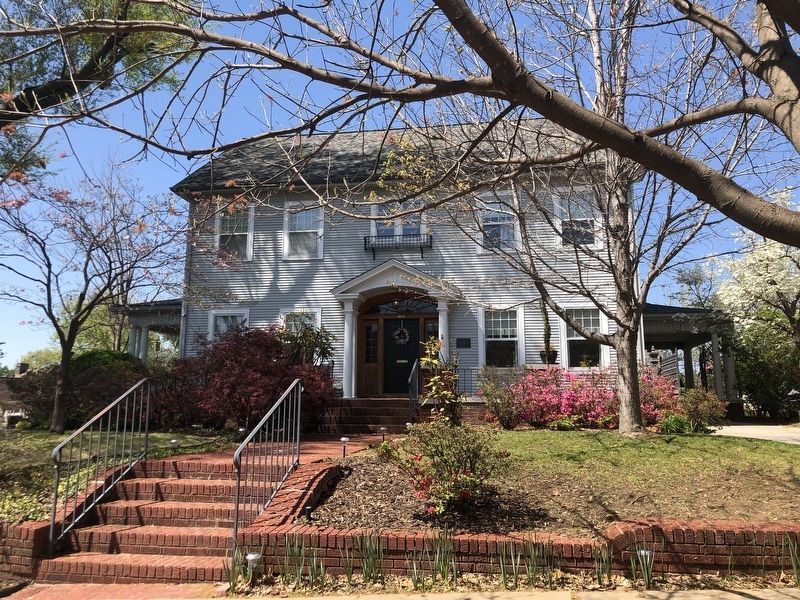
Clinton–Hardy House

Photographed by Duane and Tracy Marsteller, April 8, 2025
1. Clinton–Hardy House Marker
placed on the
National Register
of Historic Places
by the United States
Department of the Interior
Topics and series. This historical marker is listed in this topic list: Architecture. In addition, it is included in the National Register of Historic Places (NRHP) series list. A significant historical year for this entry is 1919.
Location. 36° 8.573′ N, 95° 59.771′ W. Marker is in Tulsa, Oklahoma, in Tulsa County. It is in Riverview. It is at the intersection of South Guthrie Avenue and West 14th Street, on the right when traveling south on South Guthrie Avenue. Touch for map. Marker is at or near this postal address: 1322 S Guthrie Ave, Tulsa OK 74119, United States of America. Touch for directions.

Regionally, this marker is in the Muscogee Nation, specifically in the Cherokee Nation, and in Northeast Oklahoma—Green Country. It is also in the American South, specifically on the prairies, and on the Southern Plains. Globally, it is in North America, the Western Hemisphere, the Western World, and the Anglosphere. Historically, it finds itself in what was once the territory of the Mississippian
this page online
Other nearby markers. At least 8 other markers are within walking distance of this marker: Sophian Plaza (approx. 0.2 miles away); Bruce Goff • Patti Adams Shriner (approx. 0.2 miles away); Tulsa Spotlight Theatre and “The Drunkard” (approx. 0.2 miles away); Carlton Place Historic District (approx. 0.3 miles away); The Bridge that Saved Tulsa (approx. 0.4 miles away); The Bridge Builder (approx. 0.4 miles away); Cyrus Avery Route 66 Memorial Bridge (approx. 0.4 miles away); Cyrus Stevens Avery (approx. 0.4 miles away). Touch for a list and map of all markers in Tulsa.
Another marker is no longer nearby. 11th Street Bridge, Tulsa, Oklahoma (was approx. 0.4 miles away but has been permanently removed).
Regarding Clinton–Hardy House. Excerpts from the National Register nomination:
Lee Clinton was born in 1875 on a ranch south of the Arkansas River in what is now West Tulsa. It was then Red Fork, Indian Territory. His father was white, his mother half Creek Indian. In 1896 he became a bookkeeper at the Tulsa Banking Company, the first bank in Tulsa, which then had a population of around1,300. (That institution later merged into what is now the First National Bank of Tulsa.) In 1906 Clinton became vice president of the Bank of Commerce, which he helped organize with his brother-in-law, James H. McBirney. In 1916 he founded the Union National Bank of Tulsa and he remained in banking, and real estate, the rest of his life. …Photographed by Duane and Tracy Marsteller, April 9, 20252. Clinton–Hardy House Marker
Clinton's involvement in real estate spread to development of a prestige sub-division to be located on a series of modest hills running along the east bank of the Arkansas a dozen blocks or so south of downtown Tulsa, but then on the city's outskirts. Childers Heights was platted in 1918. Clinton had [architect George] Winkler design his new house for the highest point on the bluffs.
Also see . . . Clinton–Hardy House. Wikipedia entry:
Links to National Register of Historic Places Nomination Form (Submitted on May 18, 2025, by Larry Gertner of New York, New York.)
Credits. This page was last revised on May 18, 2025. It was originally submitted on May 13, 2025, by Duane and Tracy Marsteller of Murfreesboro, Tennessee. This page has been viewed 193 times since then and 32 times this year. Photos: 1, 2. submitted on May 13, 2025, by Duane and Tracy Marsteller of Murfreesboro, Tennessee.
