Big Oaks near Chicago in Cook County, Illinois — The American Midwest (Great Lakes)
Location of the 1st Tee at Irving Golf Club
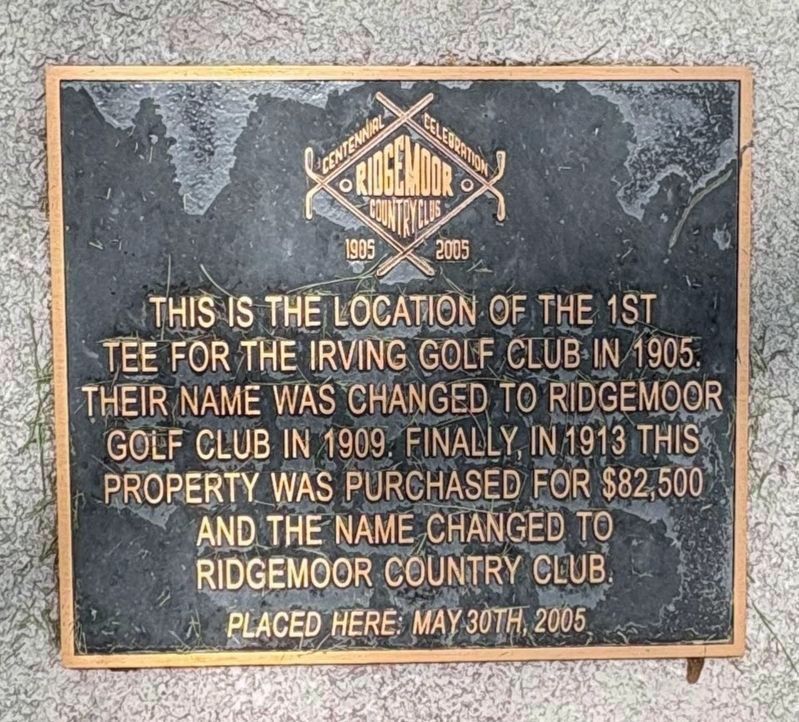
Photographed by Sean P. Flynn, May 13, 2025
1. Location of the 1st Tee at Irving Golf Club Marker
Erected 2005 by Ridgemoor Country Club.
Topics. This historical marker is listed in this topic list: Sports. A significant historical year for this entry is 1905.
Location. 41° 58.089′ N, 87° 47.519′ W. Marker is near Chicago, Illinois, in Cook County. It is in Big Oaks. It can be reached from West Gunnison Street 0.2 miles west of North Nagle Avenue, on the right when traveling east. The marker is just east of the entry road into Ridgemoor Country Club. Touch for map. Marker is at or near this postal address: 6601 West Gunnison Street, Harwood Heights IL 60706, United States of America. Touch for directions.

Regionally, this marker is on Chicago’s North Side. It is also in the American Midwest. Globally, it is in North America, on the Great Lakes, in the Western Hemisphere, in the Western World, and in the Anglosphere. Historically, it finds itself in what was once the Viceroyalty
this page online
Other nearby markers. At least 8 other markers are within walking distance of this marker: Wright College Prairie Garden (approx. 0.6 miles away); a different marker also named Wright College Prairie Garden (approx. 0.7 miles away); Cook County Cemetery at Dunning — 1854 (approx. 0.9 miles away); Unknown and Itinerant Poor of Cook County (approx. 0.9 miles away); Civil War Memorial (approx. 0.9 miles away); Unidentified Victims of the 1871 Chicago Fire (approx. 0.9 miles away); Cook County Poorhouse (approx. 0.9 miles away); Read-Dunning Cemetery No. 3 (approx. 0.9 miles away). Touch for a list and map of all markers in Chicago.
Regarding Location of the 1st Tee at Irving Golf Club. The country club is something of an enclave within an enclave. It is completely surrounded by the suburb of Harwood Heights, which, combined with the neighboring suburb of Norridge, is completely surrounded by the City of Chicago. However, the golf club uses a Chicago address and, according to government maps, sits on about 115 acres of unincorporated Cook County.
Also see . . . Ridgemoor Country Club: Our Story.
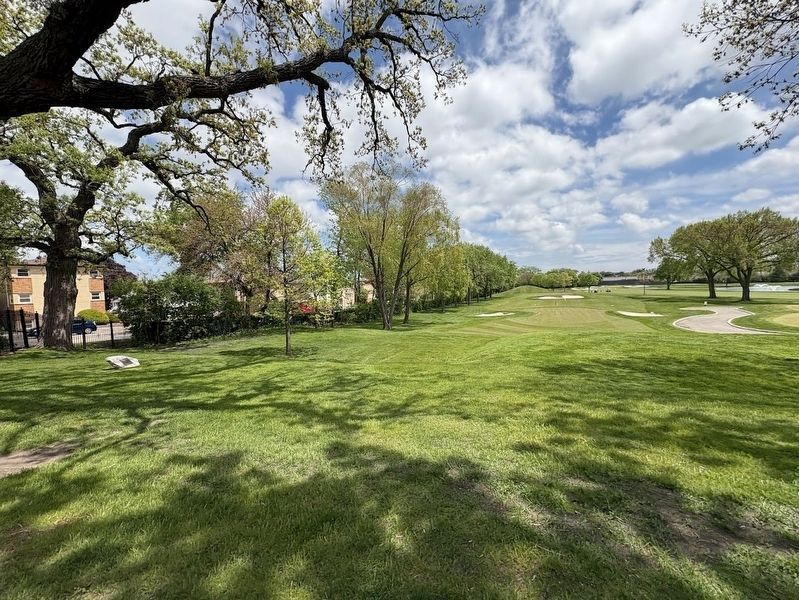
Photographed by Sean P. Flynn, May 13, 2025
2. Ridgemoor Country Club
The marker is on the left.
Excerpt: "Golf was unheard of when Israel G. Smith purchased a quarter section of land (160 acres) at about $1.25 per acre on the northwest outskirts of Chicago in the early 1840's. For his $200 investment, he became the first non-Indian settler in what, nearly 40 years later, would become Norwood Park Township."(Submitted on May 13, 2025, by Sean P. Flynn of Oak Park, Illinois.)
Additional commentary.
1. Ridgemoor is laid out on along natural glacial ridge.
Ridgemoor Country Club is located upon a "Glacial Ridge" named in 1909 to reflect its location on a natural ridge and to echo the Scottish heritage of golf. Originally, the Irving Golf Club (est. 1905) later became Ridgemoor Country Club in 1913 after expanding to an 18-hole course.
— Submitted April 21, 2026, by M.Bloom of Leyden, Illinois.
2.
Irving Park Country Club was originally located on the corner of Irving Park Road and Kildare, located on 40 acres of land that went south all the way to Addison Street in Chicago. The club was incorporated circa 1901.
— Submitted April 21, 2026, by M.Bloom of Leyden, Illinois.
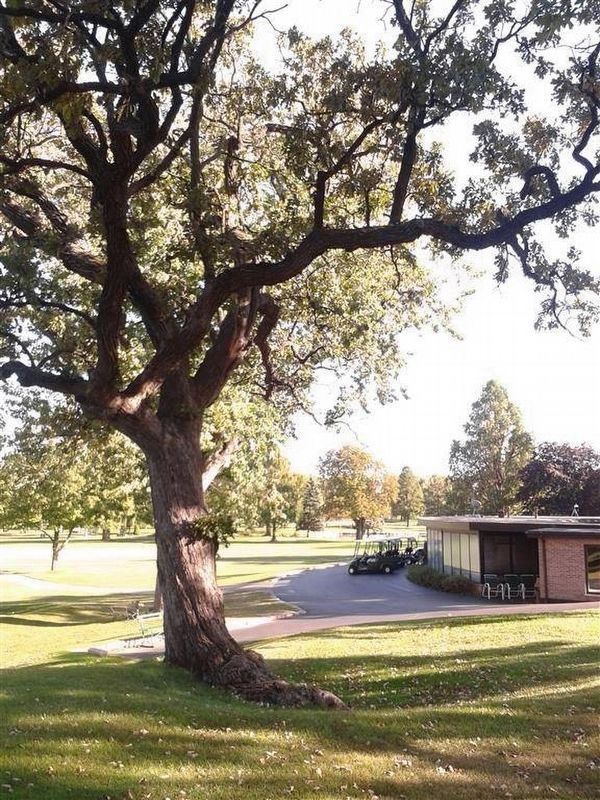
circa/2017
3. Native American Trail Marker Tree
Trail Marker Tree inside Ridgemoor entrance shown prior to removal which was less than a ¼ north of the “Indian Boundary” line, whereby native tribes ceded land in a 20 mile corridor to the United States, at the Treaty of St. Louis - 1816.
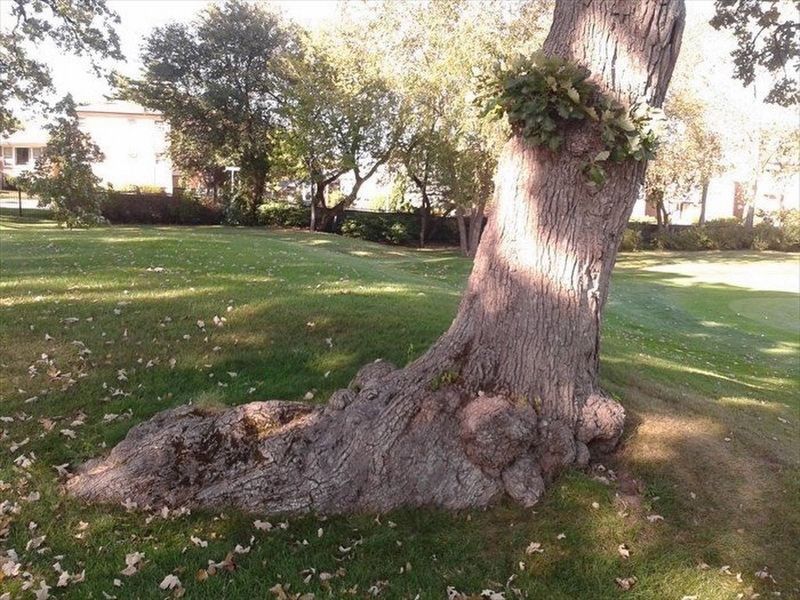
circa/2017
4. Trail Tree Trunk
Trunk of Oak Trail Marker Tree inside Ridgemoor entrance with tree pointing east towards Lake Michigan. Trail marker trees or signal trees such as this one are formed when young sapling trees are intentionally bent and secured, by Native Americans, to grow in specific unnatural shapes. This was a living navigational system to mark paths, water sources, and important resources.

circa April 21, 2026
5. Location of the 1st Tee at Irving Golf Club Marker
The Ridgemoor Logo depicts the Native America trail marker tree which lived near the entrance, before the 1st Tee of the golf course. It grew on the edge of the ancient glacial ridge which runs through the course.
Credits. This page was last revised on September 30, 2026. It was originally submitted on May 13, 2025, by Sean P. Flynn of Oak Park, Illinois. This page has been viewed 1,118 times since then and 59 times this year. Photos: 1, 2. submitted on May 13, 2025, by Sean P. Flynn of Oak Park, Illinois. 3, 4, 5. submitted on April 21, 2026, by M.Bloom of Leyden, Illinois.
