South Los Angeles in Los Angeles County, California — The American West (Pacific Coastal)
Crenshaw Square

Photographed by Craig Baker
1. Crenshaw Square Marker
The Japanese in Crenshaw
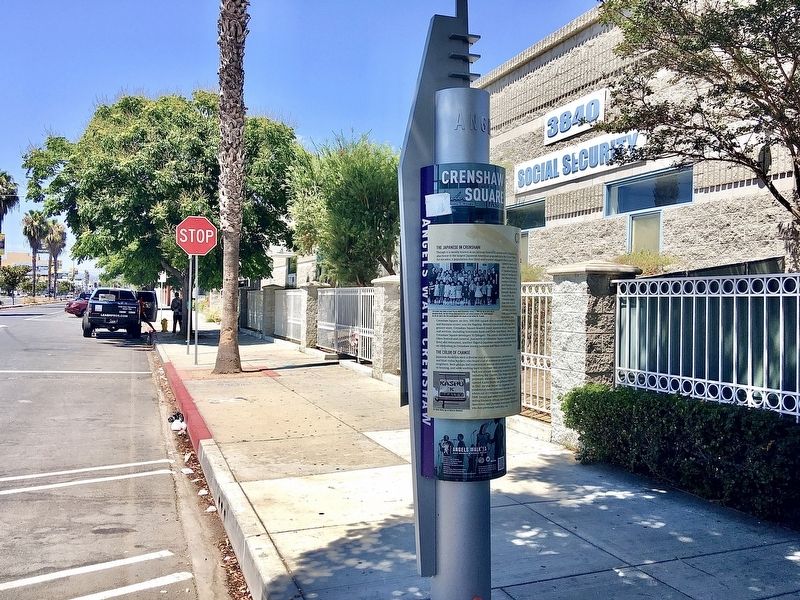
Though it is mostly known as an African American community, Crenshaw was also home to the largest Japanese American population in the United States for decades, a population that lived and worked alongside blacks and left an indelible mark on the area. After World War II, Japanese Angelenos started moving out of the ethnic Downtown enclave of Little Tokyo and Crenshaw was their first foray into the westside. Beginning in the 1950s, the Crenshaw district, especially Leimert Park and the Jefferson Corridor, was dotted with Japanese-owned businesses, and Crenshaw Square, an airy, 300,000-square-foot courtyard-style shopping and business center, was the flagship. Besides typical mall offerings like a grocery store, Crenshaw Square boasted many Japanese shops, restaurants, and services, including Sumitomo Bank and Cren-Star Realty, owned by Crenshaw Square developer Yo Takagaki. The center also had its own annual Obon Festival and carnival. Just north of Crenshaw Square was the Holiday Bowl and restaurant, another flagship Japanese-owned business that became an institution in Crenshaw among Japanese and black residents alike.
The Color of Change
Japanese residents were a diverse mix of entrepreneurs, professionals, and blue-collar workers who found a lot of common ground with their black neighbors. Both groups had experienced intense discrimination, especially in housing, and were working hard to increase their social mobility. Leimert Park was already known for its black celebrities, including Ray Charles, Ella Fitzgerald, and the politically ambitious Tom Bradley. Kazuo Inouye opened Kashu Realty on Jefferson Boulevard in 1947, the year before the Supreme Court invalidated racial covenants that had kept non-whites out of Crenshaw and elsewhere. After 1948, Inouye and other
this page online
The multiethnic community proved hard to maintain. When white flight began to accelerate in the mid-1960s, Japanese members of Crenshaw Neighbors, a homeowners group devoted to integration, attempted to convince white residents to remain, but to little avail. Many whites moved out of Crenshaw in the passing years, and African Americans became the prominent presence in the community. In the 1970s, Crenshaw Square was sold to Logan Westbrooks, a pioneering black music executive and marketer who instituted the popular Sunny Sunday Arts show, a place for local artists to gather and sell their work.
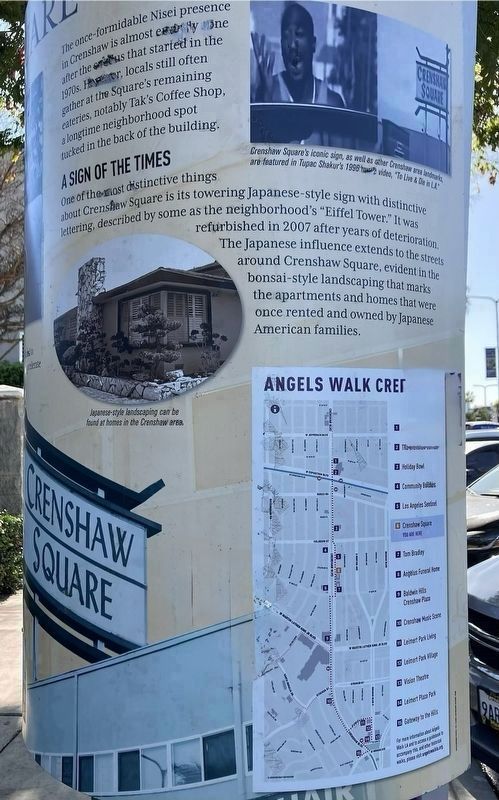
The once-formidable Nisei presence in Crenshaw is almost entirely gone after the exodus that started in the 1970s. However, locals still often gather at the Square's remaining eateries, notably Tak's Coffee Shop, a longtime neighborhood spot tucked in the back of the building.
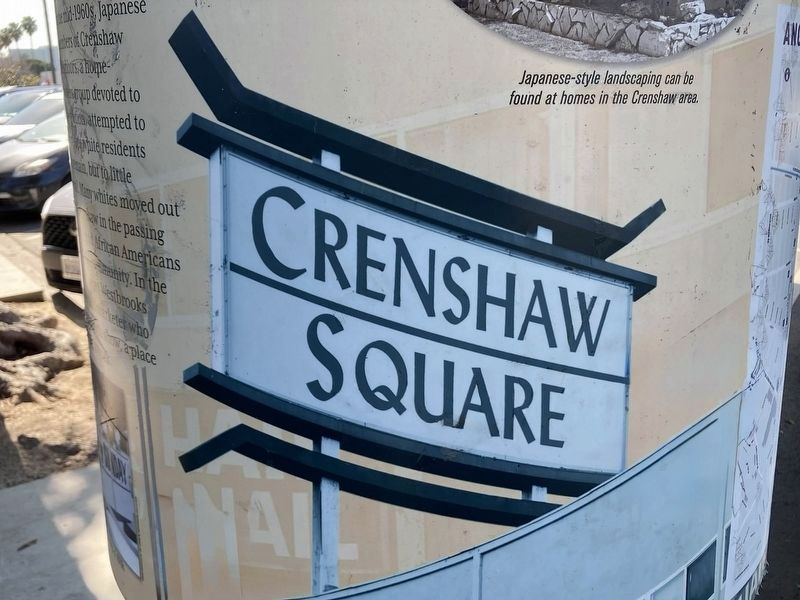
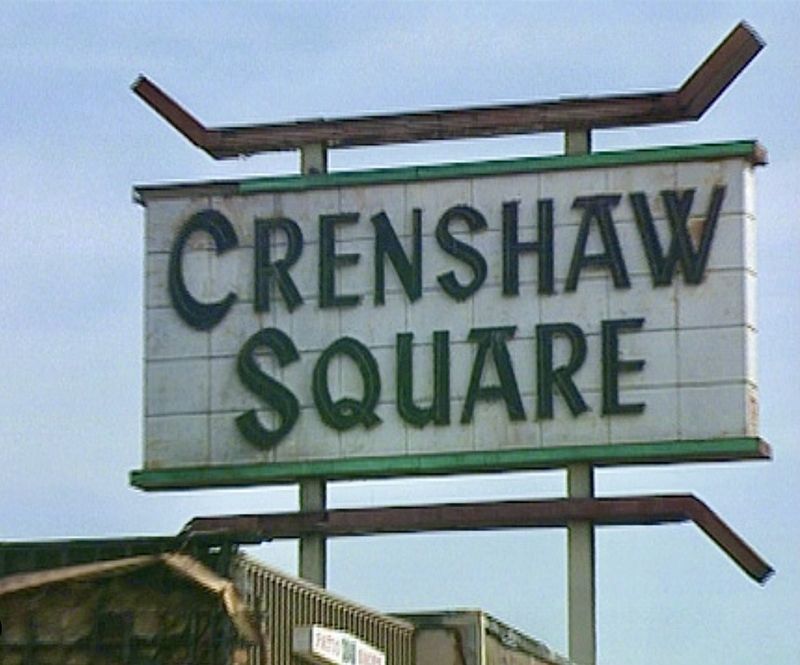
A Sign of the Times
One of the most distinctive things about Crenshaw

Photographed by LaRita Shelby, November 21, 2019
2. Crenshaw Square Marker
Erected by City of Los Angeles.
Topics. This historical marker is listed in these topic lists: African Americans • Asian Americans • Industry & Commerce • Settlements & Settlers.
Location. 34° 0.972′ N, 118° 20.09′ W. Marker is in Los Angeles, California, in Los Angeles County. It is in South Los Angeles. It is on Crenshaw Boulevard north of 39th Street, on the right when traveling north. Touch for map. Marker is at or near this postal address: 3848 Crenshaw Blvd, Los Angeles CA 90008, United States of America. Touch for directions.

Regionally, this marker is in the Transverse Ranges. It is also on the American Pacific Coast. Globally, it is in North America, on the Ring of Fire, on the Pacific Rim, in the Western Hemisphere, in the Western World, and in the Anglosphere. Historically, it finds itself in what was once New Spain and also Mexico’s Alta California.
Other nearby markers. At least 8 other markers are within walking distance of this marker: Los Angeles Sentinel (about 300 feet away, measured in a direct line); Tom Bradley (about 500 feet away); Holiday Bowl (approx. 0.2 miles away); Crenshaw Plaza (approx. 0.3 miles away); Pacific Electric (approx. 0.4 miles away); The Crenshaw Corridor (approx. half a mile away); Tom and Ethel Bradley Residence (approx. half a mile away); West Angeles Church (approx. half a mile away). Touch for a list and map
Photographed by Craig Baker
3. Crenshaw Square Marker
Also see . . . Angels Walk L.A. Self-guided walking tours of historic neighborhoods in Los Angeles. The Crenshaw Square marker is part of the Crenshaw walk. (Submitted on April 8, 2023.)
Photographed by Craig Baker, July 9, 2022
4. Crenshaw Square Marker

Photographed by LaRita Shelby, November 21, 2019
5. Closeup of the Marker
Sunny Sunday Art Show
Photographed by Craig Baker
6. Crenshaw Square Sign
Public Domain
7. Original Crenshaw Square Sign
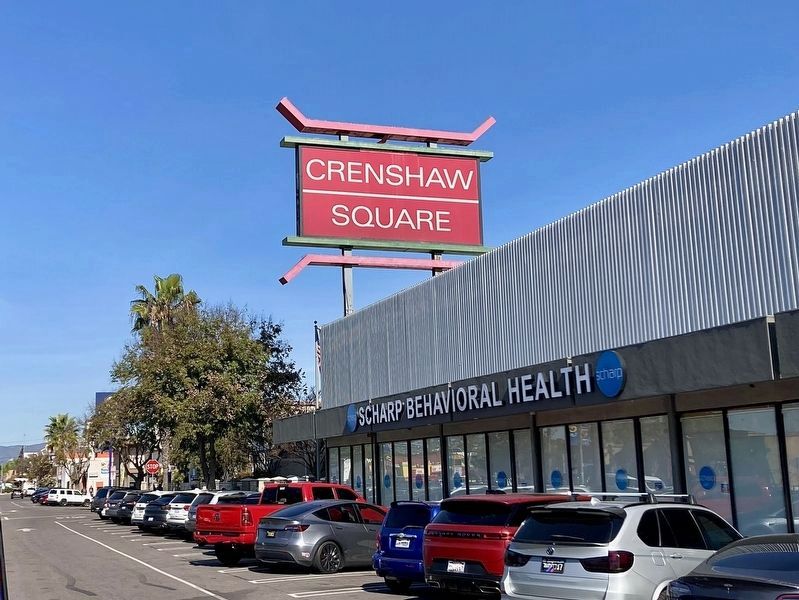
Photographed by Craig Baker, January 30, 2026
8. Today’s Crenshaw Square Sign
Credits. This page was last revised on January 31, 2026. It was originally submitted on April 8, 2023, by Craig Baker of Sylmar, California. This page has been viewed 4,701 times since then and 447 times this year. Last updated on May 13, 2025, by LaRita Shelby of Studio City, CA 91604, California. Photos: 1. submitted on April 8, 2023, by Craig Baker of Sylmar, California. 2. submitted on May 13, 2025, by LaRita Shelby of Studio City, CA 91604, California. 3. submitted on January 31, 2026, by Craig Baker of Sylmar, California. 4. submitted on April 8, 2023, by Craig Baker of Sylmar, California. 5. submitted on May 13, 2025, by LaRita Shelby of Studio City, CA 91604, California. 6, 7, 8. submitted on January 31, 2026, by Craig Baker of Sylmar, California. • Devry Becker Jones was the editor who published this page.
