Deco District in Tulsa in Tulsa County, Oklahoma — The American South (West South Central)
Tulsa Municipal Building
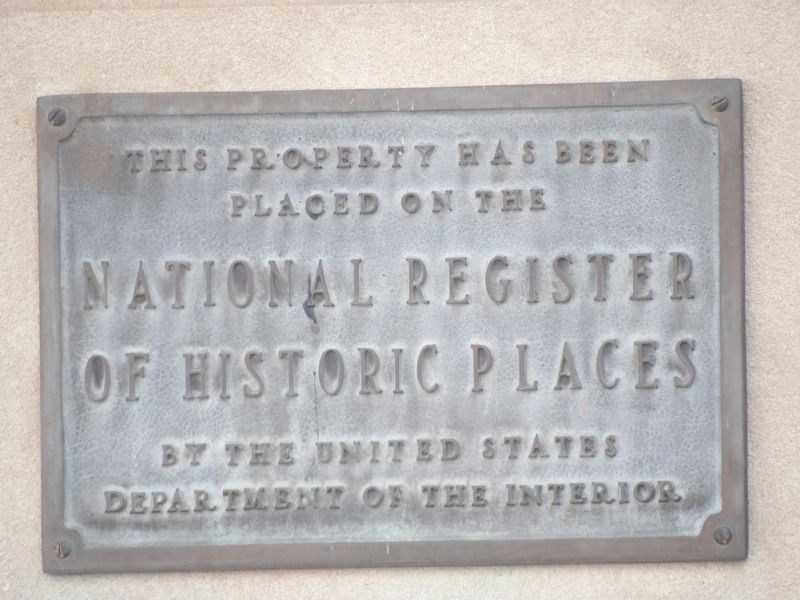
Photographed by Duane and Tracy Marsteller, April 8, 2025
1. Tulsa Municipal Building Marker
placed on the
National Register
of Historic Places
by the United States
Department of the Interior
Topics and series. This historical marker is listed in these topic lists: Architecture • Government & Politics. In addition, it is included in the National Register of Historic Places (NRHP) series list. A significant historical year for this entry is 1917.
Location. 36° 9.183′ N, 95° 59.315′ W. Marker is in Tulsa, Oklahoma, in Tulsa County. It is in the Deco District. It is at the intersection of East 4th Street and South Cincinnati Avenue, on the right when traveling east on East 4th Street. Touch for map. Marker is at or near this postal address: 124 E 4th St, Tulsa OK 74103, United States of America. Touch for directions.

Regionally, this marker is in the Muscogee Nation, specifically in the Cherokee Nation, and in Northeast Oklahoma—Green Country. It is also in the American South, specifically on the prairies, and on the Southern Plains. Globally, it is in North America, the Western Hemisphere, the Western World, and the Anglosphere. Historically, it finds itself in what was
this page online
Other nearby markers. At least 8 other markers are within walking distance of this marker: The Mid-Continent Building (within shouting distance of this marker); Philtower Building (about 400 feet away, measured in a direct line); In Memoriam (about 600 feet away); Tulsa (about 600 feet away); Pentane (C5H12) Molecular Model (about 600 feet away); The Mayo Building (about 700 feet away); Oklahoma Natural Gas Company Building (approx. 0.2 miles away); Blue Dome District (approx. 0.2 miles away). Touch for a list and map of all markers in Tulsa.
Regarding Tulsa Municipal Building. Excerpts from the National Register nomination:
Constructed in 1917, Tulsa's old Municipal Building has a generally Greek Classic facade. Its principal elevation features two-story, fluted Ionic columns. The simplified columns on the east and west elevations are modified Tuscan. Walls of the four-story building are of gray, 36-inch cut stone. …
The Old City Hall, first occupied in 1917, served Tulsa all those years it was energetically building its "Oil Capital" claim. Thatit succeeded in establishing the claim is why, ironically, the handsome old neo-classic structure eventually proved inadequate and, in 1969, was vacated. …Photographed by Duane and Tracy Marsteller, April 9, 20252. Tulsa Municipal Building MarkerThe city vacated the building in 1969, but private developers renovated it five years later. The building was the second in Tulsa to be listed on the National Register.
For some 52 years, then, Tulsa's classic Municipal Building watched a modern major city grow up about it, dealing with countless matters concerning the lives and businesses of those directing and shaping that growth. What Tulsa is today was largely determined by the day-to-day actions and decisions that unfolded within its walls.

Also see . . . Tulsa Municipal Building (PDF). National Register nomination for the building, which was listed in 1975. (Prepared by Kent Ruth, Oklahoma Historical Society; via State Historic Preservation Office of Oklahoma) (Submitted on May 15, 2025, by Duane and Tracy Marsteller of Murfreesboro, Tennessee.)

The History of Tulsa, vol. I, Clarence B. Douglas; via Google Books (Public Domain), circa 1920
3. Tulsa's First City Hall
City voters approved a bond issue in 1915 to construct the building, which was designed by architect Joe Bruce.
Credits. This page was last revised on May 15, 2025. It was originally submitted on May 15, 2025, by Duane and Tracy Marsteller of Murfreesboro, Tennessee. This page has been viewed 178 times since then and 44 times this year. Photos: 1, 2, 3. submitted on May 15, 2025, by Duane and Tracy Marsteller of Murfreesboro, Tennessee.
