
Greenwood in Tulsa in Tulsa County, Oklahoma — The American South (West South Central)
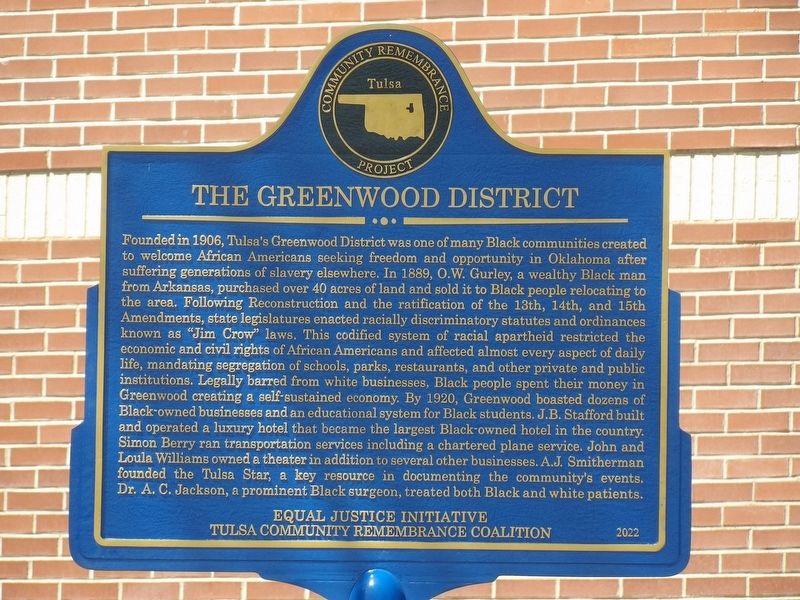
The Greenwood District
Photographed by Duane and Tracy Marsteller, April 8, 2025
1. The Greenwood District Marker
this page online
Erected 2022 by Equal Justice Initiative • Tulsa Community Remembrance Coalition.
Topics. This historical marker is listed in these topic lists: African Americans • Industry & Commerce • Settlements & Settlers. A significant historical year for this entry is 1906.
Location. 36° 9.868′ N, 95° 59.253′ W. Marker is in Tulsa, Oklahoma, in Tulsa County. It is in Greenwood. It is at the intersection of North Greenwood Avenue and East John Hope Franklin Boulevard, on the right when traveling south on North Greenwood Avenue. Touch for map. Marker is at or near this postal address: 700 N Greenwood Ave, Tulsa OK 74120, United States of America. Touch for directions.

Regionally, this marker is in Oklahoma’s Muscogee Nation and specifically in the Cherokee Nation. It is also in the American South, specifically on the prairies,
Photographed by Duane and Tracy Marsteller, April 9, 2025
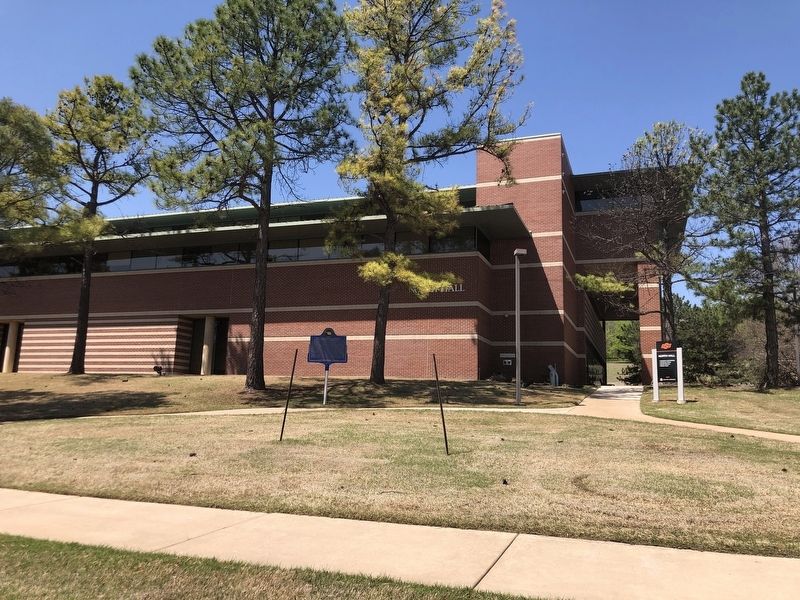
2. The Greenwood District Marker
Other nearby markers. At least 8 other markers are within walking distance of this marker: Booker T. Washington High School (about 400 feet away, measured in a direct line); Mabel B. Little Heritage House (approx. 0.2 miles away); Black Wall Street - 1921 (approx. 0.2 miles away); 1921 Black Wall Street Memorial / O Greenwood!/Commercial Destruction During 1921 Race War (approx. 0.2 miles away); A Bench by the Road (approx. 0.2 miles away); Mt. Zion Baptist Church (approx. 0.2 miles away); Vernon A.M.E. Church (approx. 0.2 miles away); Lynching in America / The 1921 Tulsa Massacre (approx. ¼ mile away). Touch for a list and map of all markers in Tulsa.
Also see . . .
1. Section 1: Black Wall Street. Segregation made Black Wall Street’s insular economy a necessity. This necessity, however, coupled with the vision among Greenwood’s residents to create a self-sufficient
Mozella Franklin Jones collection, Museum of Tulsa History (used by permission), 1918
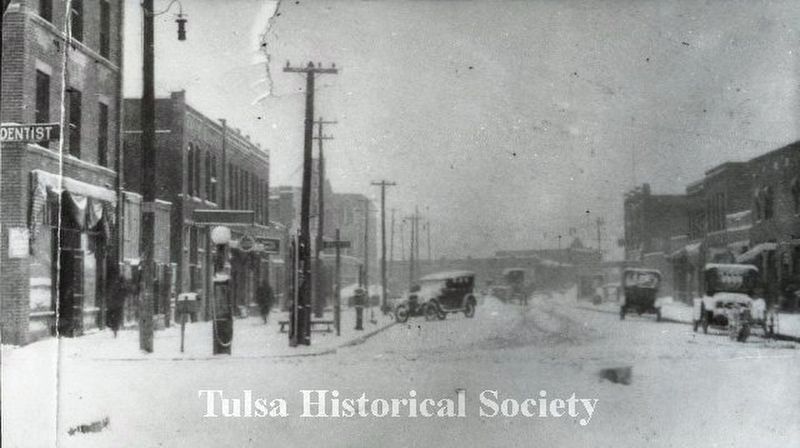
3. Greenwood Avenue business district
Looking north along Greenwood Avenue from Archer Street. The building on the far left is the Williams Building. The sign for dentist J. J. McKeever is visible. This photograph is one of the few that shows the Greenwood District prior to its destruction in the 1921 Tulsa Race Massacre.
2. Black Wall Street Established in Tulsa, Oklahoma (video). In the 1920s, the Greenwood District of Tulsa, Oklahoma, also known as Black Wall Street, was one of the most prosperous African American communities in the United States. Filled with booming businesses and thriving entrepreneurs, the district served as a mecca of Black ingenuity and promise, until the evening of May 31, 1921, which marked the start of the devastating Tulsa Race Massacre. (Excerpt from "Tulsa Burning: The 1921 Race Massacre"; History, uploaded May 31, 2021) (Submitted on May 17, 2025, by Duane and Tracy Marsteller of Murfreesboro, Tennessee.)
Credits. This page was last revised on July 19, 2025. It was originally submitted on May 16, 2025, by Duane and Tracy Marsteller of Murfreesboro, Tennessee. This page has been viewed 573 times since then and 94 times this year. Photos: 1, 2. submitted on May 16, 2025, by Duane and Tracy Marsteller of Murfreesboro, Tennessee. 3. submitted on May 19, 2025, by Duane and Tracy Marsteller of Murfreesboro, Tennessee.
