Near La Verkin in Washington County, Utah — The American Mountains (Southwest)
Hurricane Mesa

Photographed by James Hulse, April 7, 2025
1. Hurricane Mesa Marker
• July 1954. Funding approved for the construction of a U.S. Air Force Rocket Sled Test Track on Hurricane Mesa.
• July 8, 1955. Initial test run completed at "Project Smart" (code name) by Coleman Engineering Co., the contract operator for the Air Force.
• September 1957. Over 100 tests completed, 15 involving human subjects, with Colonel John Paul Stapp holding the 630 mph speed record.
• April 1959. Name changed from "Project Smart" to Hurricane Supersonic Research Site; 40 to 60 tests run per year.
• December 1960. Air Force announced abandonment of the test track, effective June 1, 1961.
• 1963. Stanley Aviation Corporation purchased the government facilities and secured leases from the BLM and state lands.
• 1981. Stencel Aero Engineering of Nashville, NC, a Talley Industries of Arizona, Inc. company, purchased the facilities and later merged to form Universal Propulsion Company.
• 2003. Goodrich Corporation purchased the facilities and conducted 160 tests.
• 2012. UTC Aerospace Systems purchased the facilities and currently operates the site. Under all ownerships, over 1,700 tests
this page online
Captions
(Photo #1) Hurricane Mesa, behind you on the other side of the road, is the home of the rocket sled test track.
(Photo #2) Ready-to-go, a fully dressed mannequin strapped into an early aircraft ejection seat and the propulsion system of a "Project Smart" test. Donor: Utah State Historical Society, circa 1958.
(Photo #3) Test track layout: This track is the nation's only privately owned supersonic test track providing test facilities for worldwide users. The 12,000-foot track can handle propulsion velocities up to supersonic (950+ mph). The water brake system can stop a 15,000-pound mass travelling at 200 feet per second, or the test can be programmed to permit exit "off the muzzle" and over the 500-foot vertical cliff. Donor: USHL & Ron Chase
(Photo #4) Ejection-system test: Rockets propel the cockpit and pilot down the track; pilot ejected from aircraft cockpit; parachutes deploy for the pilot and ejection system. Donor: Ron Chase, Universal Propulsion Co. circa 1990
Dedicated to the heritage and hardworking cowboy spirit of Washington County, exemplified by former County Commissioner Alan Gardner 1996-2016.
Erected by Washington
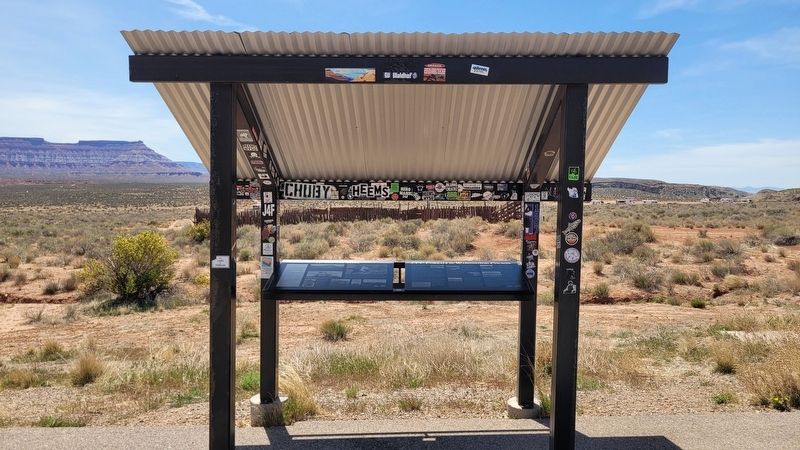
Photographed by James Hulse, April 7, 2025
2. Hurricane Mesa Marker (left side)
Topics. This historical marker is listed in this topic list: Air & Space. A significant historical month for this entry is April 1959.
Location. 37° 12.544′ N, 113° 14.22′ W. Marker is near La Verkin, Utah, in Washington County. It is on State Road 9 3½ miles east of State Road 17, on the right when traveling east. The marker is located along the highway. Touch for map. Marker is in this post office area: La Verkin UT 84745, United States of America. Touch for directions.

Regionally, this marker is in Color Country. It is also in the American Southwest, in the Mountain West, and on the Colorado Plateau. Globally, it is in North America, the Rocky Mountains, the Western Hemisphere, the Western World, and the Anglosphere. Historically, it finds itself in what was once New Spain and also Mexico’s Alta California.
Other nearby markers. At least 8 other markers are within 3 miles of this marker, measured as the crow flies: CCC Corrals in Washington County (here, next to this marker); La Verkin Canal (approx. 1.9 miles away); La Verkin (approx. 1.9 miles away); Hurricane/LaVerkin Bridge (approx. 2.4
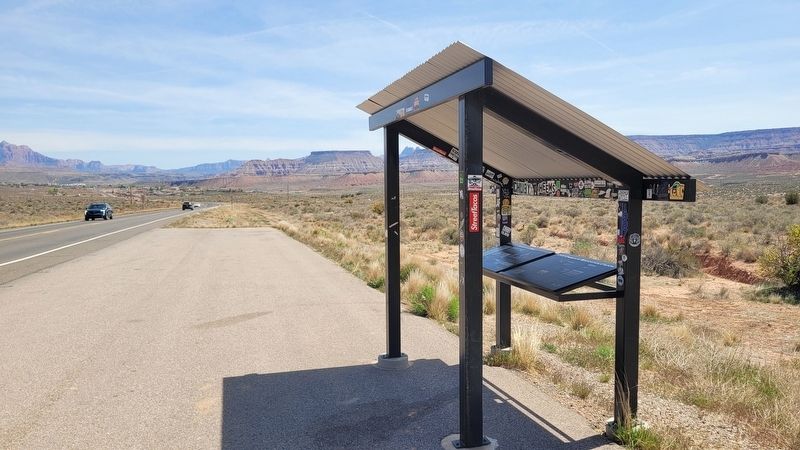
Photographed by James Hulse, April 7, 2025
3. The view of the marker along the highway
Also see . . . Hurricane Mesa Test Facility. Washington County Historical Society
The Hurricane Mesa Test Facility includes a 12,000 foot long test track. It was initially owned by the U.S. Air Force, constructed in 1954 and 1955 by Coleman Engineering and subsequently operated by Coleman. The site was used in the testing of ejection seat systems and other aviation systems. The U.S. Air Force ceased operations in 1961 at the site. Since 1963 the facility has been owned and operated by Goodrich Corporation, Aircraft Interior Products, Propulsion Systems. It remains in operation as a private test facility.(Submitted on May 17, 2025, by James Hulse of Medina, Texas.)
Credits. This page was last revised on May 17, 2025. It was originally submitted on May 17, 2025, by James Hulse of Medina, Texas. This page has been viewed 741 times since then and 234 times this year. Photos: 1, 2, 3. submitted on May 17, 2025, by James Hulse of Medina, Texas.
