Bremen-Mitte in Mitte, Germany — Central Europe
Bremen-Minsk Jewish Deportation Memorial
Photographed by Andrew Ruppenstein, May 18, 2025
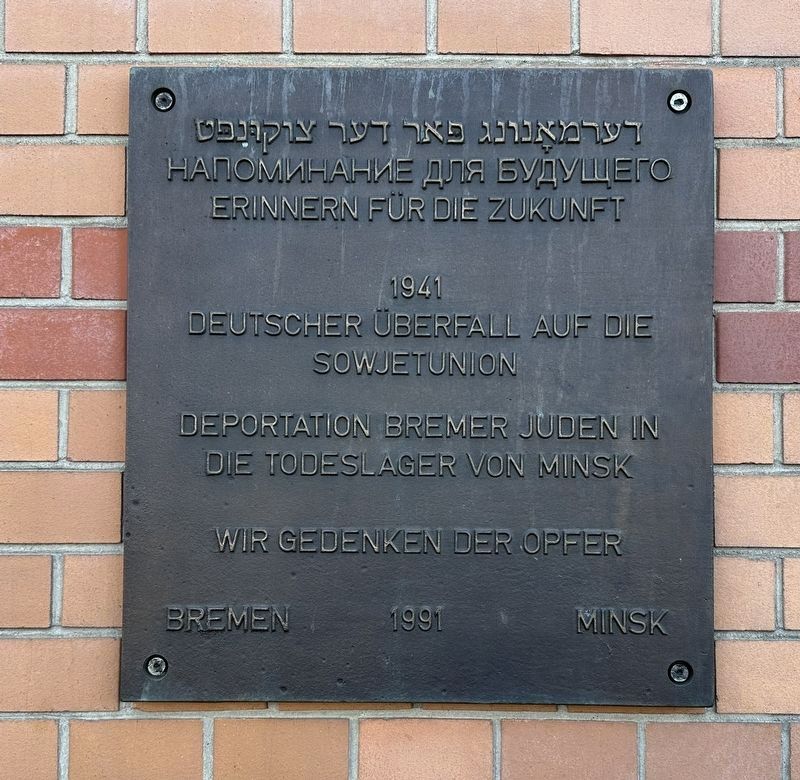
1. Bremen-Minsk Jewish Deportation Memorial

(Hebrew and Russian text not transcribed)
Erinnern für die Zukunft
1941
Deutscher überfall auf die
Sowjetunion
Deportation Bremer Juden in
die Todeslager von Minsk
Wir gedenken der Opfer
Bremen 1991 Minsk
Remembering for the Future
1941
German invasion of the Soviet Union
Deportation of Bremen Jews to the Minsk death camps
We remember the victims
Bremen 1991 Minsk
Erected 1991.
Topics and series. This memorial is listed in this topic list: War, World II. In addition, it is included in the The Holocaust series list.
Location. 53° 4.966′ N, 8° 48.762′ E. Memorial is in Bremen, in Mitte. It is in Bremen-Mitte. It is on Bahnhofsplatz, on the right when traveling west. Touch for map. Memorial is at or near this postal address: Bahnhofsplatz 15, Bremen 28195, Germany. Touch for directions.

Regionally, it is in Europe, the European Union, Atlantic Europe, Central Europe, the Schengen Area, Western Europe, and the Western World. Historically, it finds itself in what was once the Holy Roman
this page online
Other nearby markers. At least 8 other markers are within walking distance of this marker: Hauptbahnhof / Main Railway Station (within shouting distance of this marker); Übersee-Museum / Overseas Museum (about 120 meters away, measured in a direct line); Fruchthof (approx. 0.3 kilometers away); Ohamakari (approx. 0.4 kilometers away); Antikolonialdenkmal „Der Elefant“ / Anticolonial Memorial “The Elephant” (approx. 0.4 kilometers away); Hotel am Hillmanplatz (approx. 0.4 kilometers away); Hermann-Böse-Gymnasium (approx. 0.4 kilometers away); Wilhelm Kaisen (approx. half a kilometer away). Touch for a list and map of all markers in Bremen.
Also see . . . Deportation ins Ghetto Minsk (Spurensuche Bremen, in German). Excerpt (in translation):
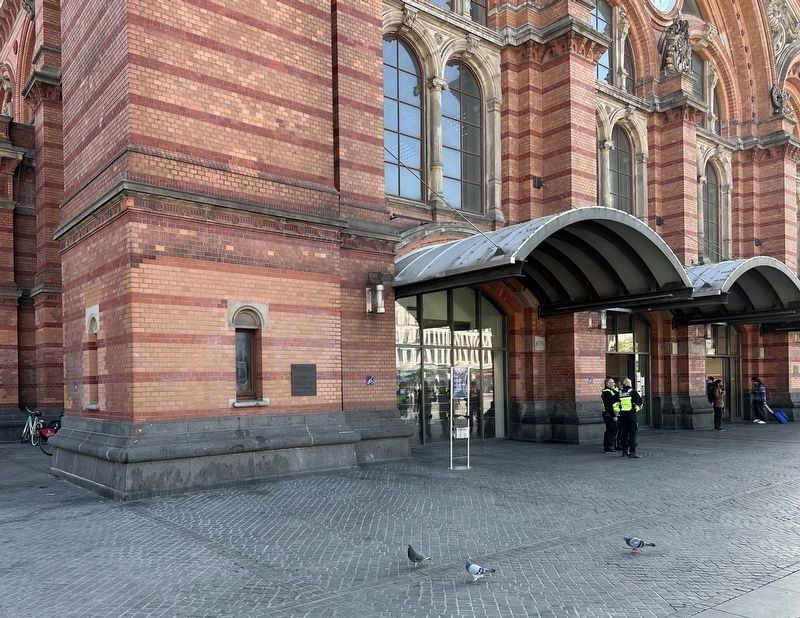
Between November 1 and December 4, 1941, approximately 50,000 Jews were deported from the territory of the German Reich to the ghettos of Riga and Minsk. In Bremen, the Gestapo compiled the deportation list with the forced cooperation of the Bremen branch of the Reich Association of Jews. The 443 affected individuals received their deportation(Submitted on May 18, 2025.)orders around November 11. On November 17, they were to report to two collection points: the Lettow-Vorbeck School (now the Hermann-Böse-Gymnasium) and the Carl-Peters School (now the Oberschule am Barkhof). In addition, 130 people from the Stade administrative district were also collected there.Photographed by Andrew Ruppenstein, May 18, 20252. Bremen-Minsk Jewish Deportation Memorial - wide viewThe memorial is visible here just to the left of the entrance into the Bremen Hauptbahnhof (“Main Railway Station”).
On the morning of November 18, the people (570 in total) were taken from the collective accommodations in groups under guard to the Lloydbahnhof (a special terminal building for emigrant traffic to Bremerhaven, east of the station hall). They had previously been required to sign a declaration declaring themselves enemies of the German government, relinquishing their right to the property they had left behind, and renouncing their German citizenship. They were only allowed to take one suitcase containing equipment weighing up to 50 kg and hand luggage. The transport train left Bremen for Hamburg at around 8:40 a.m. There, additional passenger cars carrying approximately 400 Hamburg Jews were added. The train arrived at the Minsk freight station on November 22.
In addition to Russian Jews, approximately 7,000 Reich German Jews were interned in the ghetto. Those able to work were subjected to forced labor. The cold of the winter of 1941/42, malnutrition, and appalling hygiene led to the death of many. Arbitrary executions occurred repeatedly. The majority of Bremen's Jews were suffocated in an "action" on July 28/29, 1942, mostly in gas vans en route to Blagovshchina, a forest clearing near Trostenets near Minsk.
When the ghetto was dissolved in September 1943, approximately 1,000 Reich German inmates were still alive. Approximately 300 of them were deported to camps in occupied Poland; almost all the others were killed by October 1943. Of the Bremen deportees, only six men survived.
Credits. This page was last revised on October 26, 2025. It was originally submitted on May 18, 2025, by Andrew Ruppenstein of Lamorinda, California. This page has been viewed 100 times since then and 12 times this year. Photos: 1, 2. submitted on May 18, 2025, by Andrew Ruppenstein of Lamorinda, California.
