Manzanar National Historic Site near Independence in Inyo County, California — The American West (Pacific Coastal)
Manzanar National Historic Site

Photographed by Craig Baker, April 28, 2023
1. Manzanar National Historic Site Marker
Explore its Layers of History
Throughout human history, water drew people to this arid land in the shadow of Mt. Williamson.
It is complex history - from the 1860s battles between Paiutes and the US Army to the unconstitutional incarceration of 11,070 Japanese Americans here during World War II. Yet it is also testimony to human determination to survive and make the best of hard times.
It is relevant history. Paiutes and descendants of homesteaders, ranchers, and farmers still live in this valley. Some Japanese Americans lead a pilgrimage here every year on the last Saturday of April.
This cultural landscape chronicles the history of the settlement and displacement of three distinct populations by more powerful groups.
Paiutes
Paiutes have lived in this area for centuries,h building willow huts called novis, hunting wild game, and weaving baskets to collect pine nuts and acorns. They diverted streams coming from the Sierra to nurture wild plants. They crafted arrowheads from obsidian found in this region. Some of their descendants worked at Manzanar during World War II, and many still live in this valley.
The Paiute way of life was forever changed in
this page online
John Shepherd homesteaded a ranch here in 1864, hiring some of the Paiutes. He built a two-story Victorian-style house on the north side of what would become Manzanar.
The Town of Manzanar
In 1905, John Shepherd sold his ranch to Charles Chaffey. In 1910, Charles and his brother George formed the Owens Valley Improvement Company. They subdivided the land and built a concrete pipe system to gravity-flow water from Shepherd Creek to irrigate new fruit orchards. By 1921, more than 20,000 apple and pear trees filled this vista. Some of these historic trees remain.
Locals named the town "Manzanar" - Spanish for apple orchard. A store, gas stationation, and school once stood just north of here, to serve the town's
Photographed by Craig Baker, April 28, 2023
2. Visiting the Site
The last resident, a poultry farmer, moved away in 1935. On October 6, 1941, at the request of the City of Los Angeles, the Inyo County Board of Supervisors declared the town abandoned.
Manzanar War Relocation Center
In spring 1942, the US Army transformed the abandoned townsite of Manzanar into a camp for Japanese Americans and Japanese immigrants. Accused of no crime except their ancestry, the US government confined 11,070 men, women and children here. A square-mile housing area was surrounded by eight guard towers, military police, and a five-strand barbed wire fence. The camp operated from March 21, 1942 to November 21, 1945.
Outside the fence, Japanese Americans farmed 440 acres and raised chickens, hogs, and, for a while, cattle, supplying two-thirds of the food needed for the camp. Japanese American

Photographed by Craig Baker, April 28, 2023
3. Manzanar National Historic Site Marker
After all these years, evidence of Manzanar's layers of history remains. All artifacts, rocks, and plants are preserved and protected under federal law. Please do not disturb or collect anything.
Visiting the Site
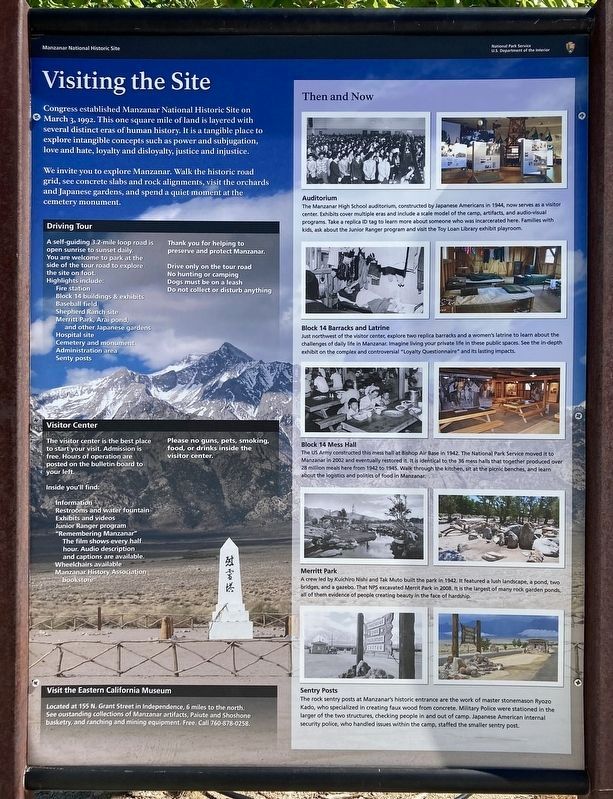
Congress established Manzanar National Historic Site on March 3, 1992. This one square mile of land is layered with several distinct eras of human history. It is a tangible place to explore intangible concepts such as power and subjugation, love and hate, loyalty and disloyalty, justice and injustice.
We invite you to explore Manzanar. Walk the historic road grid, see concrete slabs and rock alignments, visit the orchards and Japanese gardens, and spend a quiet moment at the cemetery monument.
Driving Tour
A self-guiding 3.2-mile loop road is open sunrise to sunset daily. You are welcome to park at the side of the tour road to explore the site on foot.
Highlights include:
Fire station
Block 14 buildings
Photographed by Craig Baker
4. Sentry Posts
Baseball field
Shepherd Ranch site
Merritt Park, Arai pond and other Japanese gardens
Hospital site
Cemetery and monument
Administration area
Senty posts
Thank you for helping to preserve and protect Manzanar.
Drive only on the tour road. No hunting or camping. Dogs must be on a leash. Do not collect or disturb anything.
Visitor Center
The visitor center is the best place to start your visit. Admission is free. Hours of operation are posted on the bulletin board to your left.
Inside you'll find:
Information
Restrooms and water fountain
Exhibits and videos
Junior Ranger program
"Remembering Manzanar" film shows every half hour. Audio description and captions are available.
Wheelchairs available
Manzanar History Association bookstore
Please no guns, pets, smoking, food, or drinks inside the visitor center.
Then and Now:
Auditorium
The Manzanar High School auditorium, constructed by Japanese Americans in 1944, now serves as a visitor center. Exhibits cover multiple eras and include a scale model of the camp, artifacts, and audiovisual programs. Take a replica ID tag to learn more about someone who was incarcerated

Dorothea Lange/National Archives, July 3, 1942
5. Manzanar - 1942
Block 14 Barracks and Latrine
Just northwest of the visitor center, explore two replica barracks and a women's latrine to learn about the challenges of daily life in Manzanar. Imagine living your private life in these public spaces. See the in-depth exhibit on the complex and controversial "Loyalty Questionnaire" and its lasting impact.
Block 14 Mess Hall
The US Army constructed this mess hall at Bishop Air Base in 1942. The National Park Service moved it to Manzanar in 2002 and eventually restored it. It is identical to the 36 mess halls that together produced over 28 million meals here from 1942 to 1945. Walk through the kitchen, sit at the picnic benches, and learn about the logistics and politics of food in Manzanar.
Merritt Park
A crew led by Kuichiro Nishi and Tak Muto built the park in 1942. It featured a lush landscape, a pond, two bridges, and a gazebo. NPS excavated Merit Park in 2008. It is the largest of many rock garden ponds, all of them evidence of people creating beauty in the face of hardship.
Sentry Posts
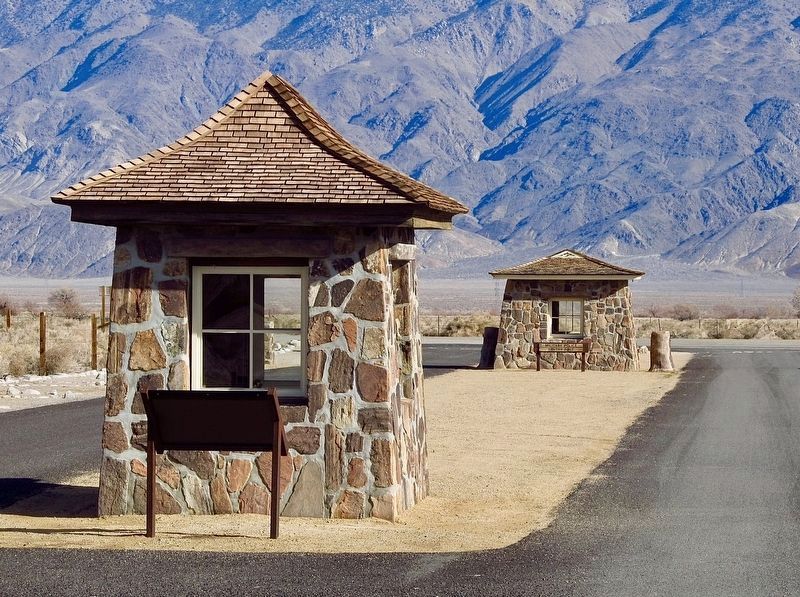
The rock sentry posts at Manzanar's historic entrance are the work of master stonemason Ryozo Kado, who specialized in creating faux wood from concrete. Military Police were stationed in the larger of the two structures, checking people in and out of camp. Japanese American internal security police, who handled issues within the camp, staffed the smaller sentry post.
Visit the Eastern California Museum
Located at 155 N. Grant Street in Independence, 6 miles to the north. See outstanding collections of Manzanar artifacts, Paiute and Shoshone basketry, and ranching and mining equipment. Free. Call 760-878-0258.
Erected by National Park Service.
Topics. This historical marker is listed in these topic lists: Asian Americans • War, World II. A significant historical date for this entry is March 21, 1942.
Location. 36° 43.682′ N, 118° 8.851′ W. Marker is near Independence, California, in Inyo County. It is in Manzanar National Historic Site. It can be reached from Manzanar Reward Road west of U.S. 395. Located next to the flagpole in front of the Visitor Center. Touch for map. Marker is at or near this postal address: 5001 US-395, Independence CA 93526, United States of America. Touch for directions.

Regionally, this marker is in California’s Sierra Nevada. It is also in the American Mountain West. Globally, it is in North America, on the Ring of Fire, in the Pacific Rim, in the Western Hemisphere, in the Western World, and in the Anglosphere. Historically, it finds itself in what was once New Spain and also Mexico’s Alta California.
Other nearby markers. At least 10 other markers are within walking distance of this marker: Manzanar (a few steps from this marker); A Community's Living Room (within shouting distance of this marker); Block 14 (about 600 feet away, measured in a direct line); Crowded Quarters (about 600 feet away); "That's What You Call Survival" (about 700 feet away); Enduring Humiliation (approx. 0.2 miles away); The Manzanar Riot (approx. 0.2 miles away); "Zeal for Cleanliness" (approx. 0.2 miles away); Managing Manzanar (approx. 0.2 miles away); Community Activities (approx. 0.2 miles away). Touch for a list and map of all markers in Independence.
Also see . . . Manzanar National Historic Site. (Submitted on July 6, 2026.)
Credits. This page was last revised on July 6, 2026. It was originally submitted on May 19, 2025, by Craig Baker of Sylmar, California. This page has been viewed 396 times since then and 85 times this year. Photos: 1, 2, 3, 4. submitted on May 19, 2025, by Craig Baker of Sylmar, California. 5. submitted on July 6, 2026, by Craig Baker of Sylmar, California.
