Potomac West in Alexandria, Virginia — The American South (Mid-Atlantic)
Alexandria War Memorial
City of Alexandria
| — | est. 1749 | — |
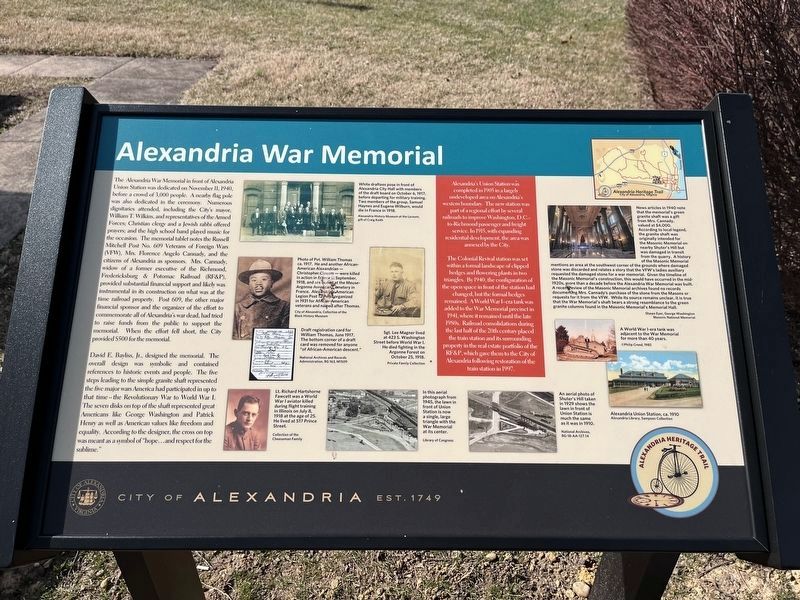
The Alexandria War Memorial in front of Alexandria Union Station was dedicated on November 11, 1940, before a crowd of 3,000 people. A nearby flag pole was also dedicated in the ceremony. Numerous dignitaries attended, including the City's mayor, William T. Wilkins, and representatives of the Armed Forces; Christian clergy and a Jewish rabbi offered prayers; and the high school band played music for the occasion. The memorial tablet notes the Russell Mitchell Post No. 609 Veterans of Foreign Wars (VFW), Mrs. Florence Angelo Cannady, and the citizens of Alexandria as sponsors. Mrs. Cannady, widow of a former executive of the Richmond, Fredericksburg & Potomac Railroad (RF&P), provided substantial financial support and likely was instrumental in its construction on what was at the time railroad property. Post 609, the other major financial sponsor of the organizer of the effort to commemorate all of Alexandria's war dead, had tried to raise funds from the public to support the memorial. When the effort fell short, the City provided $500 for the memorial.
David E. Bayliss, Jr., designed the memorial. The overall design
this page online
(Sidebar)
Alexandria's Union Station was completed in 1905 in a largely undeveloped area on Alexandria's western boundary. The new station was part of a regional effort by several railroads to improve Washington, D.C.-to-Richmond passenger and freight service. In 1915, with expanding residential development, the area was annexed by the City.
The Colonial Revival station was set within a formal landscape of clipped hedges and flowering plants in two triangles. By 1940, the configuration of the open space in front of the station had changed, but the formal hedges remained. A World War I-era tank was added to the War Memorial precinct in 1941, where it remained until the late 1980s. Railroad consolidations during the last half of the 20th century placed the train station and its surrounding property in the real estate portfolio of the RF&P, which gave them tot he City of Alexandria following the restoration of the train station in 1997.
(Captions)
White draftees pose in front of Alexandria City Hall with members of the draft board on October 6, 1917, before departing for military training. Two members of the group, Samuel Haynes and Eugene Wilburn, would die in France in 1918.
Photo of Pvt. William Thomas, ca. 1917. He and another African-American Alexandria — Christopher Cloxom — were killed in action in France in September, 1918, and are buried at the Meuse-Argonne American Cemetery in France. Alexandria's American Legion Post 129 was organized in 1931 for African Americans and named after Thomas.
Draft registration card for William Thomas, June 1917. The bottom corner of a draft card was removed for anyone "of African-American descent."
Sgt. Lee Magner lived at 423 S. Washington Street before World War I. He died fighting in the Argonne Forest on October 25, 1918.
Lt. Richard Hartshorne Fawcett was a World War II aviator killed during flight training in Illinois on July 8, 1918 at the age of 25. He lived at 517 Prince Street.
In this aerial photograph from 1945, the lawn in front of Union Station is now a single, large triangle with the War Memorial at its center.
News articles in 1940 note that the memorial's green granite shaft was a gift from Mrs. Cannady, valued at $4,000. According to local legend, the granite shaft was originally intended for the Masonic Memorial on nearby Shuter's Hill but was damaged in transit from the quarry. A history mentions an area at the southwest corner of the grounds where damaged stone was discarded and relates a story that the VFW's ladies auxiliary requested the damaged stone for a war memorial. Given the timeline of the Masonic Memorial's construction, this would have occurred in the mid-1920s, more than a decade before the Alexandria War Memorial was built. A recent review of the Masonic Memorial archives found no records documenting Mrs. Cannady's purchase of the stone from the Masons or requests for it from the VFW. While its source remains unclear, it is true that the War Memorial's shaft bears a strong resemblance tot he green granite columns found in the Masonic Memorial's Memorial Hall.
A World War I-era tank was adjacent to the War Memorial for more than 40 years.
An aerial photo of Shuter's Hill taken in 1929 shows the lawn in front of Union Station is much the same as it was in 1910.
Alexandria Union Station, ca. 1910.
Erected by City
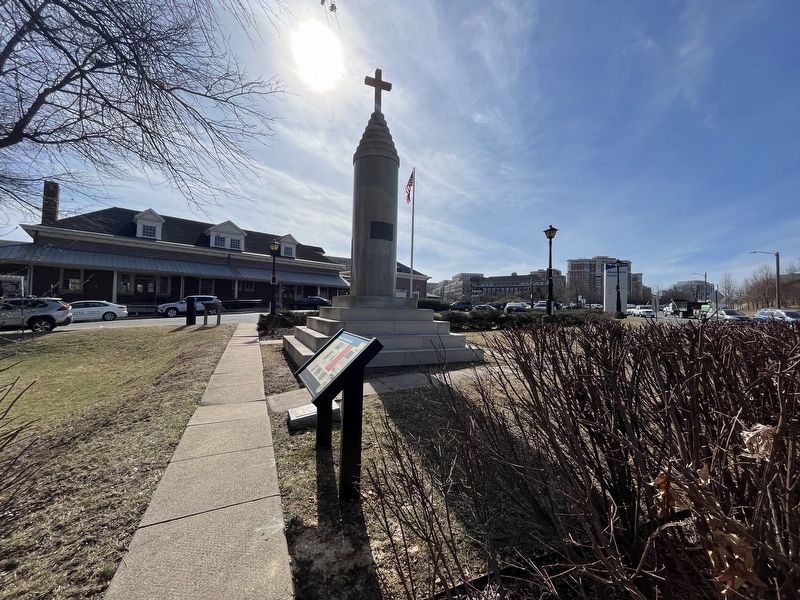
Topics and series. This historical marker and memorial is listed in these topic lists: Architecture • Fraternal or Sororal Organizations • Railroads & Streetcars • War, World I. In addition, it is included in the Virginia, The City of Alexandria series list. A significant historical month for this entry is June 1917.
Location. 38° 48.41′ N, 77° 3.744′ W. Marker is in Alexandria, Virginia. It is in Potomac West. It is at the intersection of King Street (Virginia Route 7) and Callahan Drive, on the right when traveling east on King Street. Touch for map. Marker is at or near this postal address: 110 Callahan Dr, Alexandria VA 22301, United States of America. Touch for directions.

Regionally, this marker and memorial is in the Washington Metropolitan Area and in Northern Virginia. It is also in the American South, specifically in the Upper South, in the Mid-Atlantic, and on the Eastern Seaboard. Globally, it is in the North Atlantic Region, North America, the Western Hemisphere, the Western World, and the Anglosphere. Historically, it finds itself in what was once the territory of the Mississippian
Photographed by Devry Becker Jones (CC0), July 6, 2024
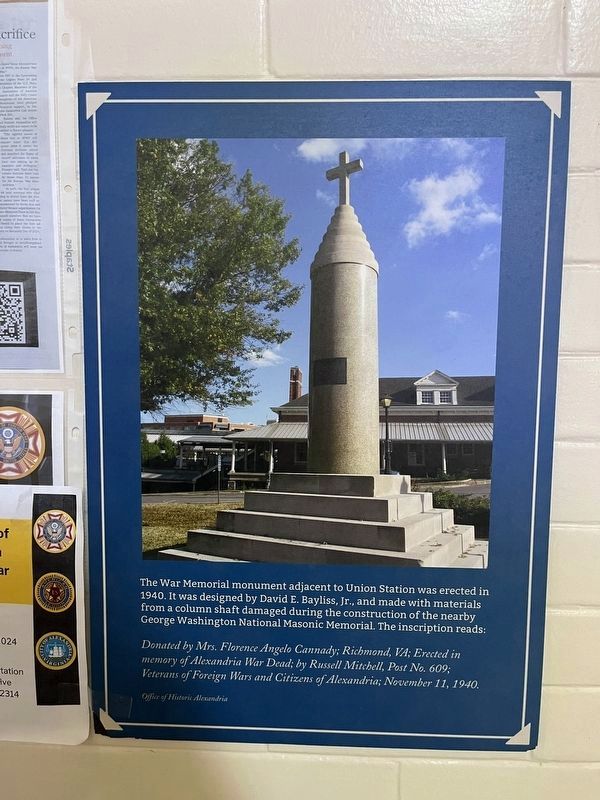
3. Plaque for the War Memorial inside of Alexandria Union Station
The War Memorial monument adjacent to Union Station was erected in 1940. It was designed by David E. Bayliss, Jr., and made with materials from a column shaft damaged during the construction of the nearby George Washington National Masonic Memorial. The inscription reads:
Donated by Mrs. Florence Angelo Cannady; Richmond, VA; Erected in memory of Alexandria War Dead; by Russell Mitchell, Post No. 609; Veterans of Foreign Wars and Citizens of Alexandria; November 11, 1940.
Office of Historic Alexandria
Other nearby markers. At least 8 other markers are within walking distance of this marker: World War I Memorial (here, next to this marker); Veterans Memorial (here, next to this marker); Vietnam War Memorial (a few steps from this marker); Alexandria in the Civil War (a few steps from this marker); All Aboard at Alexandria Union Station (within shouting distance of this marker); Fighting Back (about 300 feet away, measured in a direct line); Original Federal Boundary Stone, District of Columbia, Southwest 2 (about 300 feet away); Shuter's Hill and the West End (about 400 feet away). Touch for a list and map of all markers in Alexandria.
Other markers no longer nearby. Alexandria (was a few steps from this marker but has been replaced with another marker now near it); Visiting Old Town (was about 400 feet away but has been replaced with another marker now near it).
Regarding Alexandria War Memorial. The tank once displayed at the Alexandria War Memorial was moved to Nitro, WV, in the 1980s for restoration, a project supported by a $5,000 donation to the local VFW. In 2005, it went to a now-closed Indiana museum, then briefly to Kansas, before finding its permanent home at the National Museum of Military Vehicles in Dubois, Wyoming (see link below).
Also see . . . National Museum of Military Vehicles’ WWI M1917 Light Tank (video). YouTube (Submitted on May 20, 2025.)
Credits. This page was last revised on May 20, 2025. It was originally submitted on February 12, 2023, by Devry Becker Jones of Washington, District of Columbia. This page has been viewed 794 times since then and 69 times this year. Last updated on May 20, 2025, by Evan Dwyer of Richmond, Virginia. Photos: 1, 2. submitted on February 12, 2023, by Devry Becker Jones of Washington, District of Columbia. 3. submitted on July 6, 2024, by Devry Becker Jones of Washington, District of Columbia. • Bernard Fisher was the editor who published this page.
