
Canterbury in Kent, England, United Kingdom — Northwestern Europe (the British Isles)
The End of the Abbey
St Augustine's Abbey
Photographed by Ray Gurganus, March 29, 2025
1. The End of the Abbey Marker
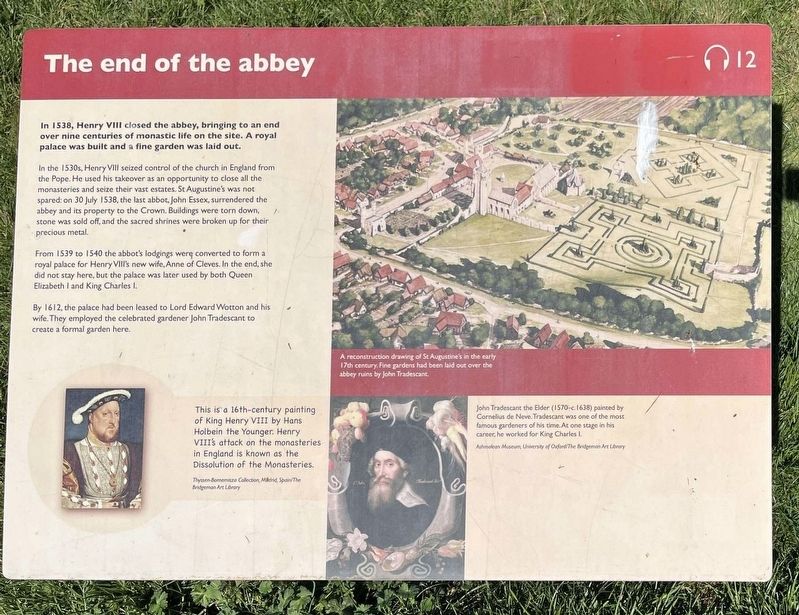
In the 1530s, Henry VIII seized control of the church in England from the Pope. He used his takeover as an opportunity to close all the monasteries and seize their vast estates. St Augustine's was not spared on 30 July 1538, the last abbot, John Essex, surrendered the abbey and its property to the Crown. Buildings were torn down, stone was sold off, and the sacred shrines were broken up for their precious metal.
From 1539 to 1540 the abbot's lodgings were converted to form a royal palace for Henry VIII's new wife, Anne of Cleves. In the end, she did not stay here, but the palace was later used by both Queen Elizabeth I and King Charles I.
By 1612, the palace had been leased to Lord Edward Wotton and his wife. They employed the celebrated gardener John Tradescant to create a formal garden here.
Erected by English Heritage. (Marker Number 12.)
Topics. This historical marker is listed in this topic list: Religion & Religious Structures. A significant historical year for this entry is 1538.
Location. 51° 16.664′ N,
this page online

Regionally, this marker is in the Greater South East. Globally, it is on the Atlantic Ocean, in the North Atlantic Region, in Europe, in Atlantic Europe, on one of the British Isles, in the Western World, and in the Anglosphere. Historically, it finds itself in what was once the Roman Empire.
Other nearby markers. At least 8 other markers are within walking distance of this marker: Abandonment and Ruin (a few steps from this marker); Reuse and Rediscovery (within shouting distance of this marker); The Crypt (within shouting distance of this marker); Wulfric's Rotunda (within shouting distance of this marker); A Centre of Learning (within shouting distance of this marker); Tombs of kings and archbishops (within shouting distance of this marker); Thomas Fyndon (within shouting distance of this marker); Welcome to St Augustine's Abbey (about 90 meters away, measured in a direct line). Touch for a list and map

Hans Holbein the Younger
2. Henry VIII
This is a 16th-century painting of King Henry VIII by Hans Holbein the Younger. Henry VIII's attack on the monasteries in England is known as the Dissolution of the Monasteries.
Credits. This page was last revised on May 28, 2025. It was originally submitted on May 20, 2025, by Ray Gurganus of Washington, District of Columbia. This page has been viewed 113 times since then and 13 times this year. Photos: 1, 2. submitted on May 20, 2025, by Ray Gurganus of Washington, District of Columbia. • Andrew Ruppenstein was the editor who published this page.
Editor’s want-list for this marker. photo of the marker within its surroundings • Can you help?
