
Canterbury in Kent, England, United Kingdom — Northwestern Europe (the British Isles)
The Riding Gate
Photographed by Ray Gurganus, March 29, 2025
1. The Riding Gate Marker
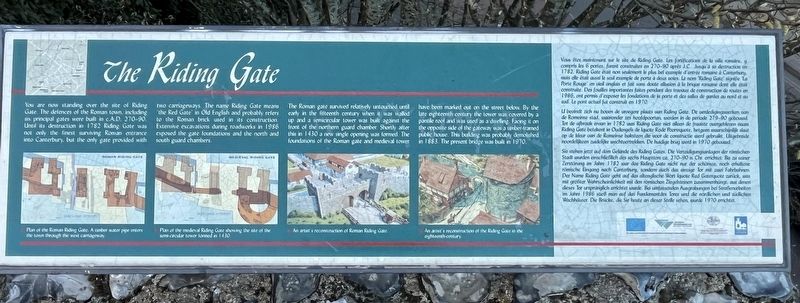
 You are now standing over the site of Riding Gate. The defences of the Roman town, including six principal gates, were built c. A.D. 270-90. Until its destruction in 1782 Riding Gate was not only the finest surviving Roman entrance into Canterbury, but the only gate provided with no carriageways. The name Riding Gate means 'the Red Gate' in Old English and probably refers to the Roman brick used in its construction. Extensive excavations during roadworks in 1986 exposed the gate foundations and the north and south guard chambers.
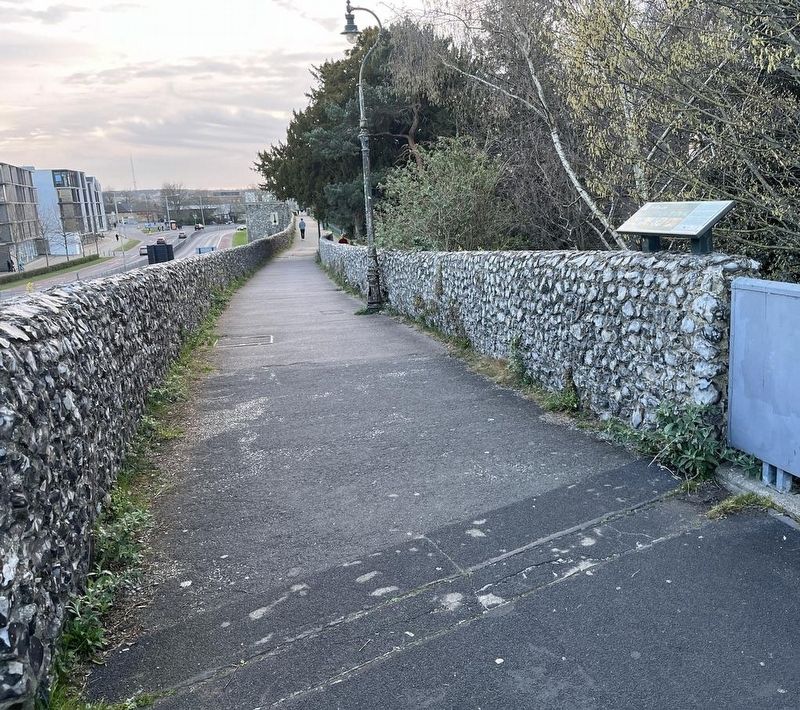
The Roman gate survived relatively untouched until early in the fifteenth century when was it was walled up and a semicircular tower was built against the front of the northern guard chamber. Shortly after this in 1430 a new single opening was formed. The foundations of the Roman gate and medieval tower have been marked out on the street below. By the late eighteenth century the tower was covered by a pantile roof and was used as a dwelling. Facing it on the opposite side of the gateway was a timber-framed public house. This building was probably demolished in 1883. The present bridge
this page online
Photographed by Ray Gurganus, March 29, 2025
2. City Wall walk and marker
Erected by Canterbury City Council.
Topics. This historical marker is listed in this topic list: Forts and Castles. A significant historical year for this entry is 270 CE.
Location. 51° 16.545′ N, 1° 4.843′ E. Marker is in Canterbury, England, in Kent. It can be reached from City Wall. Touch for map. Marker is at or near this postal address: City Wall, Canterbury, England CT1 2QU, United Kingdom. Touch for directions.

Regionally, this marker is in the Greater South East. Globally, it is on the Atlantic Ocean, in the North Atlantic Region, in Europe, in Atlantic Europe, on one of the British Isles, in the Western World, and in the Anglosphere. Historically, it finds itself in what was once the Roman Empire.
Other nearby markers. At least 8 other markers are within walking distance of this marker: Cattle Market Tower (about 90 meters away, measured in a direct line); Royal East Kent Imperial Yeomanry Boer War Memorial (about 120 meters away); The Dane John Mound (about 180 meters away); The Simmons Memorial (about 210 meters away); Baedeker Raid (about 240 meters away); The Three Tuns (approx. 0.2 kilometers away); Welcome to the old site of St Mary de Castro Church (approx. 0.3 kilometers away); Zoar Chapel (approx. 0.3 kilometers away). Touch for a list and map of all markers in Canterbury.
Credits. This page was last revised on May 30, 2025. It was originally submitted on May 20, 2025, by Ray Gurganus of Washington, District of Columbia. This page has been viewed 86 times since then and 9 times this year. Photos: 1, 2. submitted on May 20, 2025, by Ray Gurganus of Washington, District of Columbia. • Andrew Ruppenstein was the editor who published this page.
