Big Bog State Recreation Area near Waskish in Beltrami County, Minnesota — The American Midwest (Upper Plains)
Historic Waskish Hatchery 1941–1979

Photographed by McGhiever, August 30, 2021
1. Historic Waskish Hatchery 1941–1979 Marker
As far back as 1927, walleye eggs were harvested at the mouth of the Tamarac River. Eggs collected here were sent to the State Hatchery at Redby for hatching until 1941 when the Waskish Hatchery was built as a Works Progress Administration project. The last harvest at the Waskish Hatchery was held in the spring of 1979.
The Waskish Hatchery was not built or operated to sustain the Red Lake walleye population. Natural reproduction of walleye in Red Lake are more than adequate. The Red Lake walleye hatched here were used for stocking needs elsewhere in Minnesota, as well as being shipped throughout the United States.
Today's hatchery technology is very similar to that of the late 1800s. The hatchery utilizes a small portion of the eggs produced in a lake, incubates them in a controlled environment, and improves the hatch rate substantially. This creates a surplus of fry to be used in other lakes where natural reproduction is lacking. The longstanding policy of returning a portion of the hatchery fry back to the parent lake actually results in a significant net gain in overall fry production for the parent lake.
Since
this page online
Spawning runs
As spring days lengthen and water temperatures rise, the walleye begin their spawning run up the Tamarac River. This photo, taken in the early 1970s, shows the trapping structure in the river where spawning walleye were captured briefly for stripping. Only mature walleye spawn: females first spawn at about 15-17 inches or 5-6 years of age while the faster maturing males spawn about 4 years of age.
Trapping spawning walleye in the mouth of the Tamarac River in the early 1970s
Stripping eggs
Stripping is the common term used by fish culturists for forcibly removing both eggs and sperm from "ripe" fish. "Ripe" refers to that time when reproductive material freely flows from the fish with gentle pressure. Unripe (or "green") females can be held 1-3 days in cribs until they ripen, at which time the eggs are stripped from the fish on special tables at the water's edge.
Stripping eggs from a female walleye
Fertilization
Eggs are carefully stripped to minimize contact with water. Sperm stripped

Photographed by McGhiever, September 1, 2021
2. Historic Waskish Hatchery Marker (right) on the platform at the end of the Old Marina Trail
Coating
Eggs are naturally covered with an adhesive allowing them to adhere to pebbly river bottoms or shoreline substrates where running water and wave action oxygenates them. For hatchery incubation, eggs are coated with bentonite (clay) to remove the natural adhesive.
Washing and Hardening
Once coated, the eggs are washed in screen boxes to remove the excess bentonite and then gently placed in containers for water hardening. During this process, the soft, very fragile eggs absorb water and swell to twice their size. After about four hours of water hardening the eggs are quite durable and can be safely transferred to hatchery jars.
Battery of jars
The jars are arranged on racks called batteries. Here at the Washkish Hatchery there are 4 batteries, each with 120 jars. When full, the Waskish hatchery held about 120,000,000 eggs! Once the hatchery
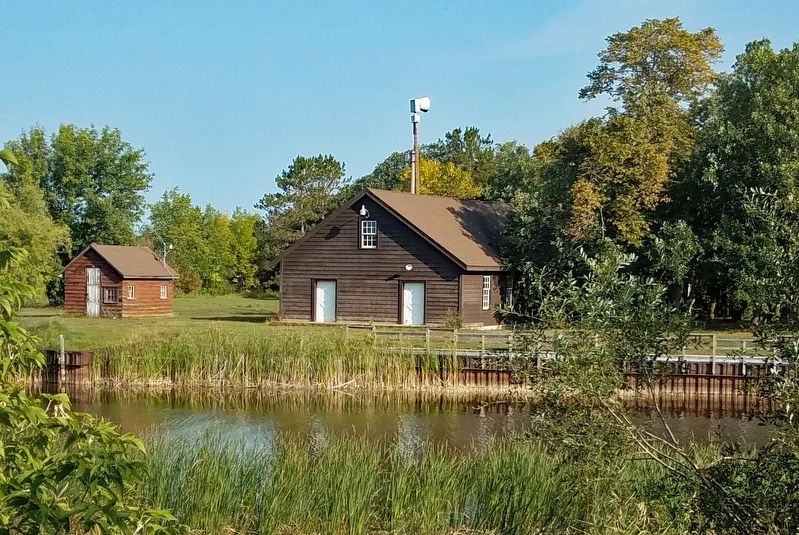
Photographed by McGhiever, September 1, 2021
3. The historic Waskish Hatchery viewed across the Tamarac River from this marker
Incubation
Each jar holds about 2 quarts or 250,000 eggs. The oxygen needed by the eggs is provided by water flowering from faucets down a standpipe to the bottom of the jars. This creates an upwelling flow that gently rolls the eggs, ensuring that all eggs are continuously exposed to freshly oxygenated water. The eggs are denser than water so they remain on the bottom while excess water overflows into the trough.
Fry
As the eggs hatch, the fry follow the water flow, swimming up and out of the jar and into the trough where they follow the flow through a series of water pipes into metal fry tanks. The young fry can survive up to three days in the tanks without food by using their yolk sack for nutrition. By weight, one pound is about 100,000 fry. One day old walleye fry are ready to be stocked into Minnesota lakes or rearing ponds.
Erected 2004 by Minnesota Department of Natural Resources.
Topics. This historical marker is listed in this topic list: Animals. A significant historical year for this entry is 1941.
Location. 48° 10.487′ N, 94° 30.832′ W. Marker is near Waskish, Minnesota, in Beltrami County. It is in the Big Bog State Recreation Area. It can be reached from Waskish Beach Road N.E. west of Minnesota Highway 72, on the right when traveling west. The marker is in the southern unit of Big Bog State Recreation Area (fee area) at the north end of the Old Marina Trail. Touch for map. Marker is at or near this postal address: 55716 Minnesota Highway 72, Waskish MN 56685, United States of America. Touch for directions.

Regionally, this marker is in the Northland. It is also in the American Midwest and in the Corn Belt. Globally, it is in North America, the Great North Woods, the Western Hemisphere, the Western World, and the Anglosphere. Historically, it finds itself in what was once Rupert’s Land, the territory of the Mississippian Culture, the Louisiana Purchase, and the Northwest Territory.
Other nearby markers. At least 8 other markers are within walking distance of this marker: Journey along the waters… (here, next to this marker); The Old Waskish Town Site (about 700 feet away, measured in a direct line); Harry Davidson (approx. 0.2 miles away); The Marina (approx. 0.2 miles away); Pure Peatland / A Boring Story (approx. 0.3 miles away); Red Lake is Minnesota's Largest Lake! / Flat Terrain Lets Water Pool (approx. 0.3 miles away); Where There is Smoke / Forests of the Agassiz Lowlands (approx. 0.3 miles away); The Red Lake Walleye Story (approx. 0.3 miles away). Touch for a list and map of all markers in Waskish.
Credits. This page was last revised on May 20, 2025. It was originally submitted on May 20, 2025, by McGhiever of Minneapolis, Minnesota. This page has been viewed 236 times since then and 54 times this year. Photos: 1. submitted on May 20, 2025, by McGhiever of Minneapolis, Minnesota. 2. submitted on May 18, 2025, by McGhiever of Minneapolis, Minnesota. 3. submitted on May 20, 2025, by McGhiever of Minneapolis, Minnesota.
