Pomona in Los Angeles County, California — The American West (Pacific Coastal)
Santa Fe 3450
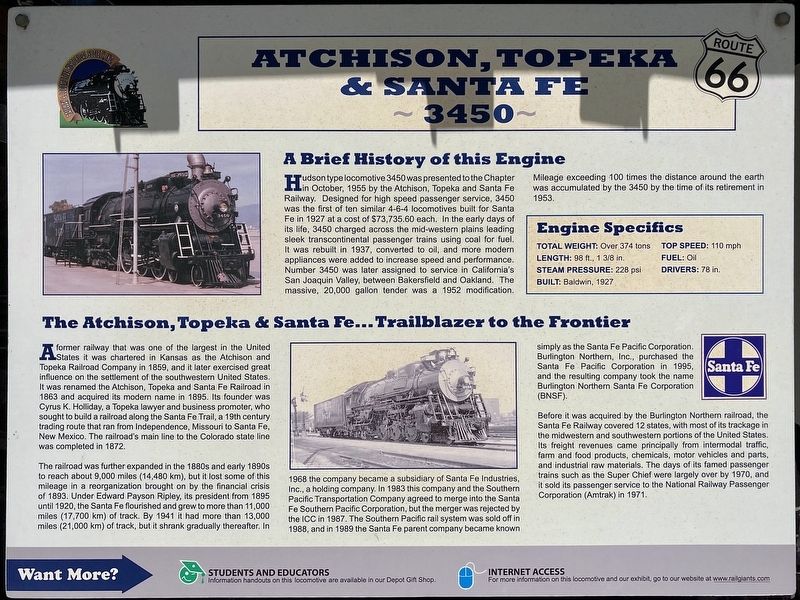
Photographed by Craig Baker, May 9, 2025
1. Santa Fe 3450 Marker
A Brief History of this Engine
Hudson type locomotive 3450 was presented to the Chapter Railway. Designed for high speed passenger service, 3450 was the first of ten similar 4-6-4 locomotives built for Santa Fe in 1927 at a cost of $73,735.60 each. In the early days of its life, 3450 charged across the mid-western plains leading sleek transcontinental passenger trains using coal for fuel. It was rebuilt in 1937, converted to oil, and more modern appliances were added to increase speed and performance. Number 3450 was later assigned to service in California's San Joaquin Valley, between Bakersfield and Oakland. The massive, 20,000 gallon tender was a 1952 modification. Mileage exceeding 100 times the distance around the earth was accumulated by the 3450 by the time of its retirement in 1953.
Engine Specifics
Total Weight: Over 374 tons
Length: 98 ft., 1 3/8 in.
Steam Pressure: 228 psi
Built: Baldwin, 1927
Top Speed: 110 mph
Fuel: Oil
Drivers: 78 in.
The Atchison, Topeka & Santa Fe... Trailblazer to the Frontier
A former railway that was one of the
this page online
The railroad was further expanded in the 1880s and early 1890s to reach about 9,000 miles (14,480 km), but it lost some of this mileage in a reorganization brought on by the financial crisis of 1893. Under Edward Payson Ripley, its president from 1895 until 1920, the Santa Fe flourished and grew to more than 11,000 miles (17,700 km) of track. By 1941 it had more than 13,000. miles (21,000 km) of track, but it shrank gradually thereafter. In 1968 the company became a subsidiary of Santa Fe Industries, Inc., a holding

Photographed by Craig Baker, May 9, 2025
2. Santa Fe 3450 and Marker
Before it was acquired by the Burlington Northern railroad, the Santa Fe Railway covered 12 states, with most of its trackage in the midwestern and southwestern portions of the United States. Its freight revenues came principally from intermodal traffic, farm and food products, chemicals, motor vehicles and parts, and industrial raw materials. The days of its famed passenger trains such as the Super Chief were largely over by 1970, and it sold its passenger service to the National Railway Passenger Corporation (Amtrak) in 1971.
Want More?
Students and Educators:
Information
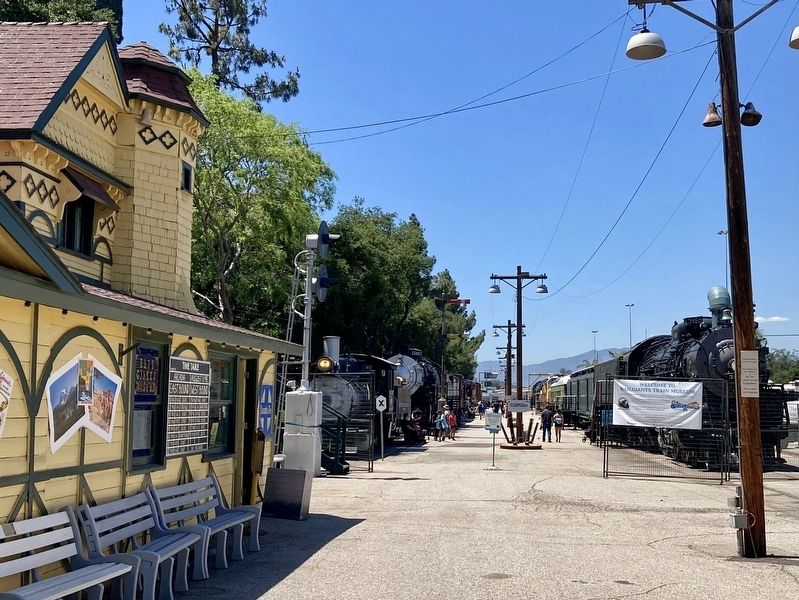
Photographed by Craig Baker, May 9, 2025
3. Rail Giants Exhibits
Internet Access:
For more information on this locomotive and our exhibit, go to our website at www.ralgiants.com
Erected by Rail Giants Train Museum.
Topics. This historical marker is listed in this topic list: Railroads & Streetcars.
Location. 34° 5.023′ N, 117° 46.225′ W. Marker is in Pomona, California, in Los Angeles County. It can be reached from McKinley Avenue near Fairplex Drive. Located at the Pomona fairgrounds. Touch for map. Marker is at or near this postal address: 1101 W McKinley Ave, La Verne CA 91750, United States of America. Touch for directions.

Regionally, this marker is in Greater Los Angeles and in the Transverse Ranges. It is also on the American Pacific Coast. Globally, it is in North America, on the Ring of Fire, on the Pacific Rim, in the Western Hemisphere, in the Western World, and in the Anglosphere. Historically, it finds itself in what was once New Spain and also Mexico’s Alta California.
Other nearby markers. At least 8 other markers are within one mile of this marker, measured as the crow flies: Steam Locomotives - How They Work (a few steps from this marker); Santa Fe Station (within shouting distance of this marker); Johnstone Peak Fire Lookout (about 400 feet away, measured in a direct line); Pomona Assembly Center (approx. 0.3 miles away); Millard Sheets Gallery (approx. 0.3 miles away); The Big Round (approx. 0.4 miles away); La Casa Primera (approx. 1.1 miles away); La Casa Primera Dedication (approx. 1.1 miles away). Touch for a list and map of all markers in Pomona.
Also see . . . Rail Giants Train Museum. The exhibits are open one weekend a month. Also open during the L.A. County Fair. (Submitted on May 21, 2025.)
Additional keywords. Atchison, Topeka & Santa Fe, Atchison Topeka & Santa Fe
Credits. This page was last revised on August 5, 2025. It was originally submitted on May 21, 2025, by Craig Baker of Sylmar, California. This page has been viewed 221 times since then and 52 times this year. Photos: 1, 2, 3. submitted on May 21, 2025, by Craig Baker of Sylmar, California.
Editor’s want-list for this marker. • • Photos of the other railcar markers, on their own marker pages. • • Can you help?
