Pomona in Los Angeles County, California — The American West (Pacific Coastal)
Steam Locomotives - How They Work

Photographed by Craig Baker, May 9, 2025
1. Steam Locomotives Marker
The steam locomotive is a complex piece of engineering that has been developed over the past 2000 years. The first steam engine, described in the 1st Century, was a simple turbine that spun when heated. Later inventors used steam to push vanes to turn a shaft to operate equipment. The first steam piston systems were developed in the early 1700's and were used as pumps for draining mines. These were large stationary units. James Watt introduced an improved version in 1765. Modified versions of this engine were used to turn a large paddle-wheel to make the first steamboat. Developments in better boilers led to higher pressure steam which improved the efficiency of the system. Around the end of the 18th Century, people started connecting steam pumps to wagon wheels to make the first or Stram Pump powered vehicles. Putting these wagons on rails then led to the first steam locomotives. Richard Trevithik built the first railway in 1804. The first U.S.-built locomotive was the Baltimore and Ohio Railroad's Tom Thumb, manufactured in 1830. Over the next 130 years bigger locomotives were developed to pull
this page online
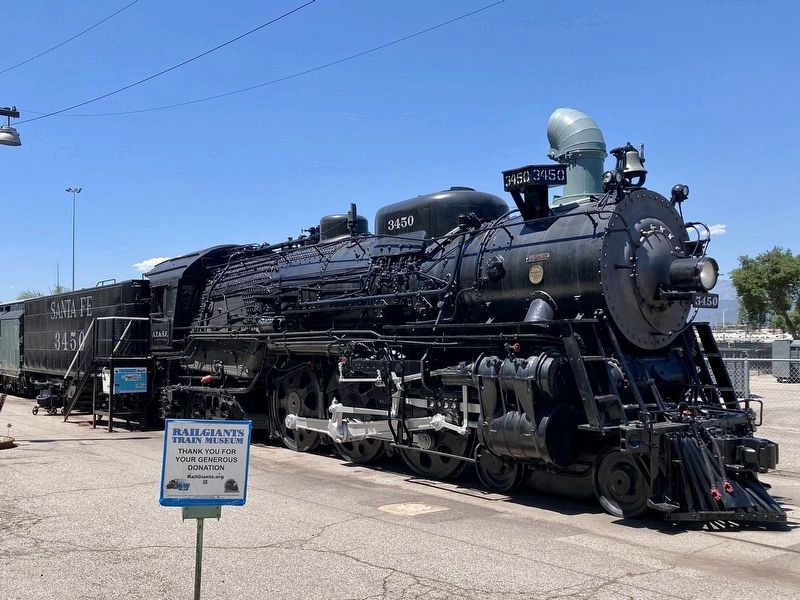
So, how does the modern steam locomotive work? To the right is a cut-away drawing of our AT&SF 3450 locomotive. The process starts with the train crew. Generally this is a two man team with a fireman and an engineer. The fireman's job is to generate and maintain steam pressure. This starts by the fireman stoking the fire in the firebox(1). In early steam locomotives this was done with wood or coal, in later locomotives, the fuel was oil. In a coal-fired system, there will be an arch(2) in the firebox. This arch supports a plate of firebrick that forces the burning coal gases to take a longer path to the flue tubes. This helps prevent unburned coal from being blown down the flue tubes. The hot gases vent through the smaller boiler tubes(3) and large flue tubes(4). The arch supports and these tubes can be seen when you look into the back of the firebox. The reason our 3450 has an arch even though it uses oil as a fuel is that originally it was a coal burning locomotive. It was converted to oil-burning in 1936. Around the
Photographed by Craig Baker, May 9, 2025
2. Steam Locomotives Marker
The locomotive is now moving. Directional control and efficient use of power are controlled by the engineer with a combination of the throttle lever(9) and the reversing lever(20). The more open the throttle is, the more steam goes through the system and the faster the locomotive then goes. The reversing lever(20), also known as the Johnson Bar, controls the direction and how efficiently the steam is applied to the piston. The action of the Johnson Bar is fairly complex and works through the action of the Walschaerts Gear. Moving the Johnson Bar forwards or backwards raises or lowers the radius arm(21) via the reach rod(22), the lifting arm - reversing arm combination(23) and the lifting link(24). This moves the spindle valve forward or backward as the radius arm slides up and down in the expansion link(25). This controls which side of the piston(14) is input and which is exhaust and this is the way that direction is determined. The amount of motion applied via the Johnson Bar determines how long the spindle valve is forwards or backwards with each stroke. The further forward the bar is, the more steam is input and the faster the piston goes. Pushing the Johnson Bar full forward may help the locomotive go faster, but it is not always the most efficient use of the steam power. Compare this to your car accelerator. Flooring the accelerator will make your car go faster quicker, but you will use more gas in doing so. Once you get up to speed, you usually ease back and feather the pedal to keep your car at the desired speed. The Johnson Bar is like this. The engineer will first push the bar fully forward to get the locomotive moving and then ease it back to optimize the steam power usage for the desired speed.
Now for the complicated part. How is the spindle valve controlled to put steam in alternating sides of the piston? The motion is controlled by two actions. The first comes from rotation of the eccentric crank(26). This pushes the eccentric rod(27) which then rocks the expansion link(25). This motion causes the radius arm(21) to move back and forth which moves the spindle valve. Countering this, the crosshead(16) moves with the piston. This pulls the union link(28) which rocks the combination level(29). The motion of the combination lever also affects the position of the spindle valve. In combination, these two actions set how long the steam is applied to each side of the piston.
These drawings are based on our Santa Fe 3450. You can look at the parts in the drawing and find the real components on the locomotive. Most steam locomotives work using this method. Some of the parts may be in a slight different configuration, but they are present. As you visit the other locomotives in our collection, try to find these parts to see how they are different and similar at the same time.
Want More?
Internet Access:
For more information on this locomotive and our exhibit, go to our website at www.raigiants.org
Erected by Rail Giants Train Museum.
Topics. This historical marker is listed in this topic list: Railroads & Streetcars.
Location. 34° 5.021′ N, 117° 46.219′ W. Marker is in Pomona, California, in Los Angeles County. It can be reached from McKinley Avenue near Fairplex Drive. Located at the Pomona fairgrounds. Touch for map. Marker is at or near this postal address: 1101 W McKinley Ave, La Verne CA 91750, United States of America. Touch for directions.

Regionally, this marker is in Greater Los Angeles and in the Transverse Ranges. It is also on the American Pacific Coast. Globally, it is in North America, on the Ring of Fire, on the Pacific Rim, in the Western Hemisphere, in the Western World, and in the Anglosphere. Historically, it finds itself in what was once New Spain and also Mexico’s Alta California.
Other nearby markers. At least 8 other markers are within one mile of this marker, measured as the crow flies: Santa Fe 3450 (a few steps from this marker); Santa Fe Station (within shouting distance of this marker); Johnstone Peak Fire Lookout (about 400 feet away, measured in a direct line); Pomona Assembly Center (approx. ¼ mile away); Millard Sheets Gallery (approx. 0.3 miles away); The Big Round (approx. 0.4 miles away); La Casa Primera (approx. 1.1 miles away); La Casa Primera Dedication (approx. 1.1 miles away). Touch for a list and map of all markers in Pomona.
Also see . . . Rail Giants Train Museum. The exhibits are open one weekend a month. (Submitted on May 21, 2025.)
Credits. This page was last revised on May 21, 2025. It was originally submitted on May 21, 2025, by Craig Baker of Sylmar, California. This page has been viewed 165 times since then and 36 times this year. Photos: 1, 2. submitted on May 21, 2025, by Craig Baker of Sylmar, California.
