Barrie in Simcoe County, Ontario — Central Canada (North America)
County Town
| — | Waterfront Heritage Trail | — |
Photographed by Cosmos Mariner, June 5, 2024
1. County Town Marker
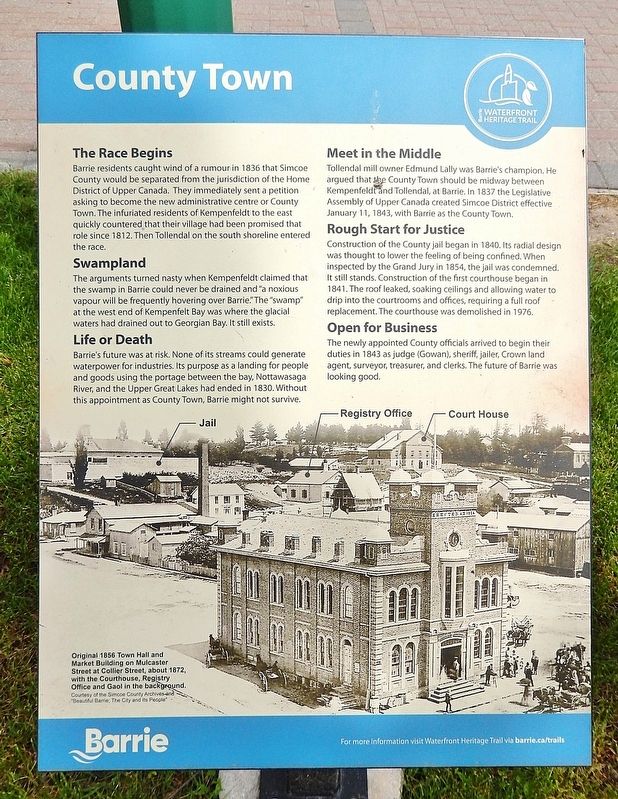
The Race Begins
Barrie residents caught wind of a rumour in 1836 that Simcoe County would be separated from the jurisdiction of the Home District of Upper Canada. They immediately sent a petition asking to become the new administrative centre or County Town. The infuriated residents of Kempenfeldt to the east quickly countered that their village had been promised that role since 1812. Then Tollendal on the south shoreline entered the race.
Swampland
The arguments turned nasty when Kempenfeldt claimed that the swamp in Barrie could never be drained and "a noxious vapour will be frequently hovering over Barrie." The "swamp" at the west end of Kempenfelt Bay was where the glacial waters had drained out to Georgian Bay. It still exists.
Life or Death
Barrie's future was at risk. None of its streams could generate waterpower for industries. Its purpose as a landing for people and goods using the portage between the bay, Nottawasaga River, and the Upper Great Lakes had ended in 1830. Without this appointment as County Town, Barrie might not survive.
Meet in the Middle
Tollendal mill owner Edmund Lally was Barrie's champion. He argued
this page online
Rough Start for Justice
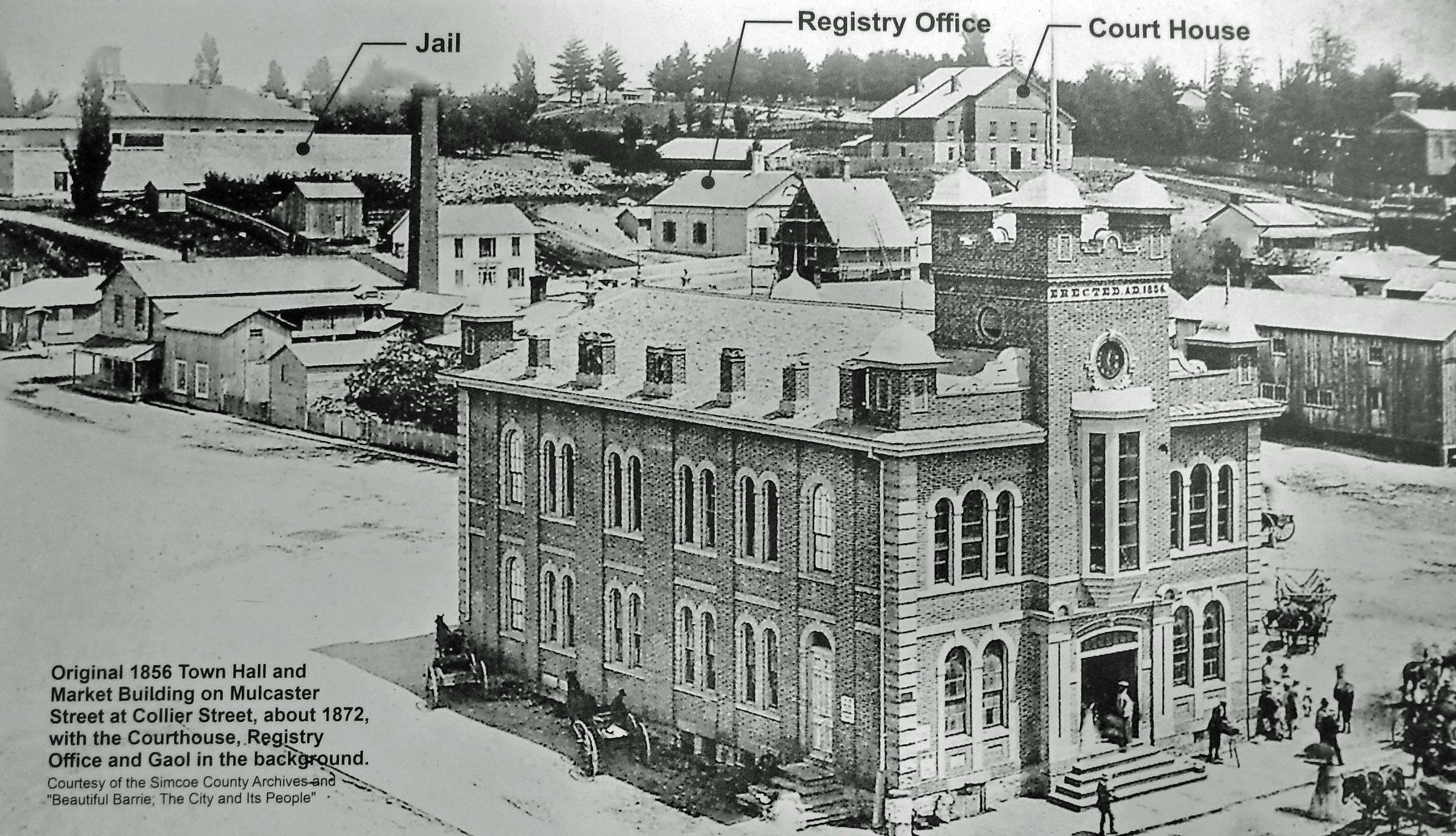
Construction of the County jail began in 1840. Its radial design was thought to lower the feeling of being confined. When inspected by the Grand Jury in 1854, the jail was condemned. It still stands. Construction of the first courthouse began in 1841. The roof leaked, soaking ceilings and allowing water to drip into the courtrooms and offices, requiring a full roof replacement. The courthouse was demolished in 1976.
Open for Business
The newly appointed County officials arrived to begin their duties in 1843 as judge (Gowan), sheriff, jailer, Crown land agent, surveyor, treasurer, and clerks. The future of Barrie was looking good.
Erected by Barrie Waterfront Heritage Trail.
Topics. This historical marker is listed in this topic list: Political Subdivisions. A significant historical date for this entry is January 11, 1843.
Location. 44° 23.304′ N, 79° 41.215′ W. Marker is in Barrie, Ontario, in Simcoe County.
Simcoe County Archives and "Beautiful Barrie; The City and Its People"
2. Marker detail: Original 1856 Town Hall and Market Building
On Mulcaster Street at Collier Street, about 1872, with the Courthouse, Registry Office and Gaol in the background.

Regionally, this marker is in Central Ontario Cottage Country and specifically in Georgian Bay Country. It is also in Central Canada. Globally, it is in North America, on the Great Lakes, in the Western Hemisphere, in the Western World, and in the Anglosphere. Historically, it finds itself in what was once a British colony, the Viceroyalty of New France, the Haudenosaunee (Iroquois) Confederacy, and Rupert’s Land.
Other nearby markers. At least 8 other markers are within walking distance of this marker: Lost Buildings (here, next to this marker); Market Hall (here, next to this marker); Birth of Barrie (here, next to this marker); Nine Mile Portage (here, next to this marker); Wharfs & Boatworks (here, next to this marker); Railway Watercraft (here, next to this
Photographed by Cosmos Mariner, June 5, 2024
3. County Town Marker
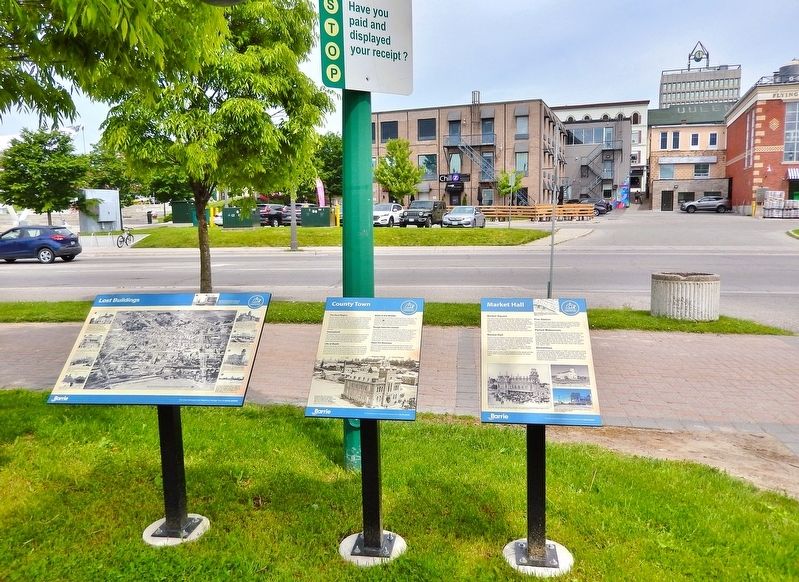
Looking north across Simcoe Street from Heritage Park. It is the center one of three interpretive panels in this photo.
Credits. This page was last revised on May 23, 2025. It was originally submitted on May 21, 2025, by Cosmos Mariner of Cape Canaveral, Florida. This page has been viewed 102 times since then and 10 times this year. Photos: 1, 2. submitted on May 22, 2025, by Cosmos Mariner of Cape Canaveral, Florida. 3. submitted on May 23, 2025, by Cosmos Mariner of Cape Canaveral, Florida.
