
Barrie in Simcoe County, Ontario — Central Canada (North America)
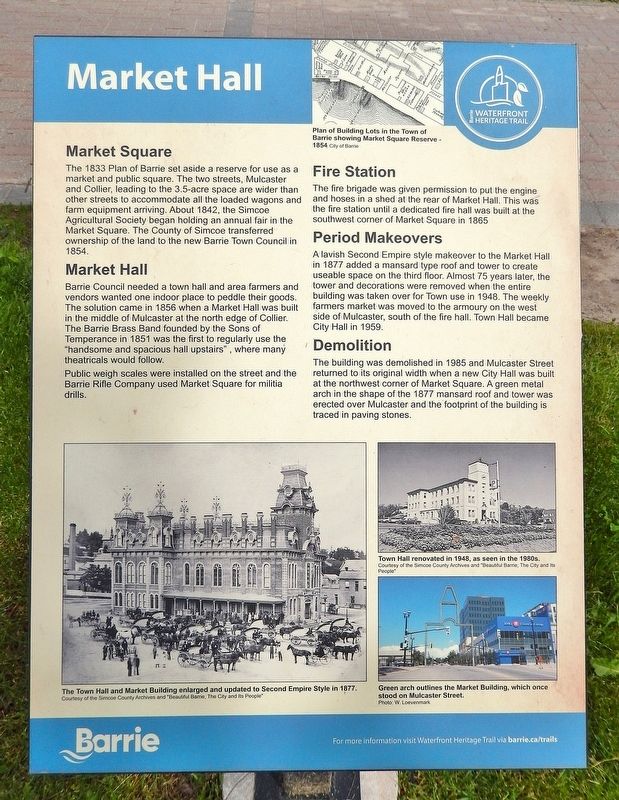
Market Hall
| — | Waterfront Heritage Trail | — |
Photographed by Cosmos Mariner, June 5, 2024
1. Market Hall Marker
Market Square
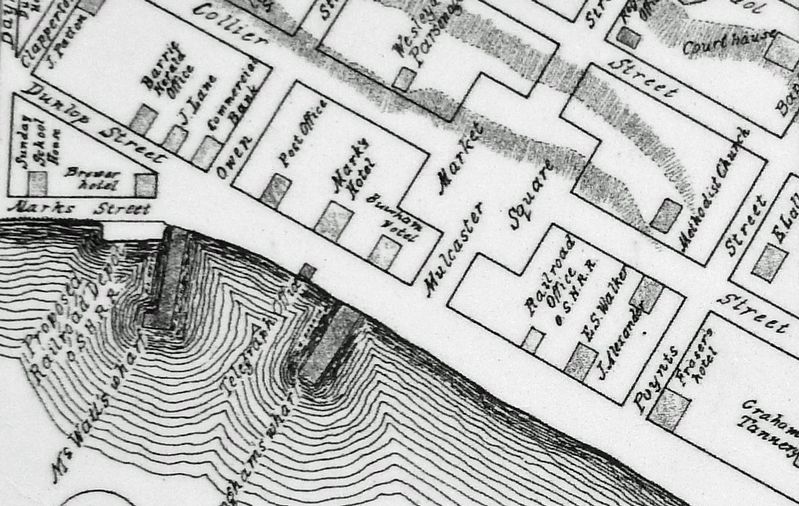
The 1833 Plan of Barrie set aside a reserve for use as a market and public square. The two streets, Mulcaster and Collier, leading to the 3.5-acre space are wider than other streets to accommodate all the loaded wagons and farm equipment arriving. About 1842, the Simcoe Agricultural Society began holding an annual fair in the Market Square. The County of Simcoe transferred ownership of the land to the new Barrie Town Council in 1854.
Market Hall
Barrie Council needed a town hall and area farmers and vendors wanted one indoor place to peddle their goods. The solution came in 1856 when a Market Hall was built in the middle of Mulcaster at the north edge of Collier. The Barrie Brass Band founded by the Sons of Temperance in 1851 was the first to regularly use the "handsome and spacious hall upstairs", where many theatricals would follow.
Public weigh scales were installed on the street and the Barrie Rifle Company used Market Square for militia drills.
Fire Station
The fire brigade was given permission to put the engine and hoses in a shed at the rear of Market Hall. This was the fire station until a dedicated fire
this page online
Period Makeovers
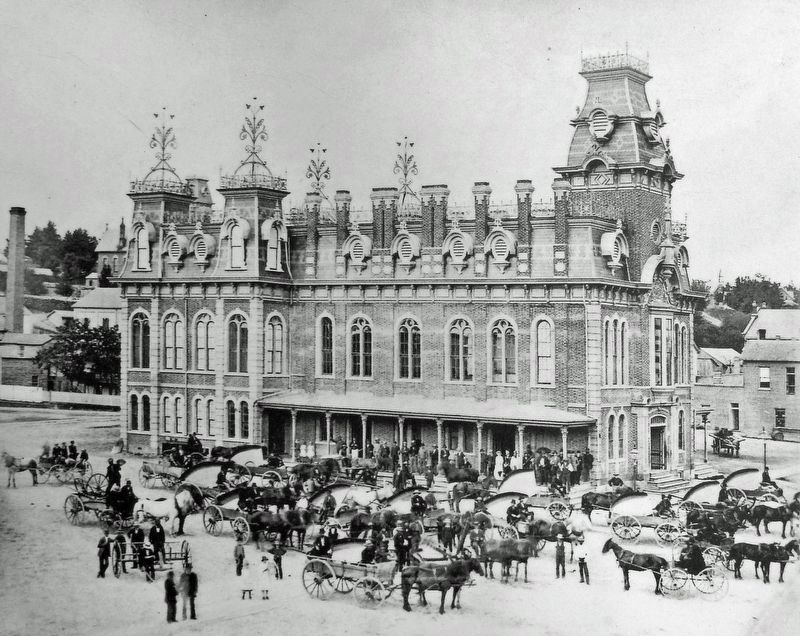
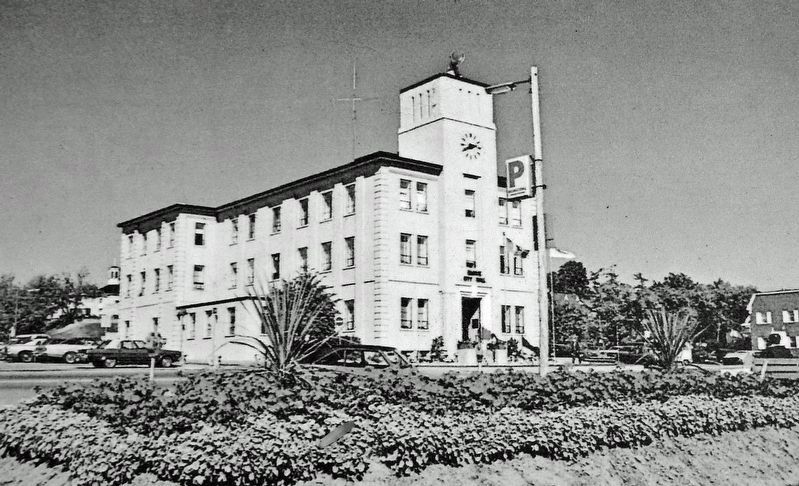
A lavish Second Empire style makeover to the Market Hall in 1877 added a mansard type roof and tower to create useable space on the third floor. Almost 75 years later, the tower and decorations were removed when the entire building was taken over for Town use in 1948. The weekly farmers market was moved to the armoury on the west side of Mulcaster, south of the fire hall. Town Hall became City Hall in 1959.
Demolition
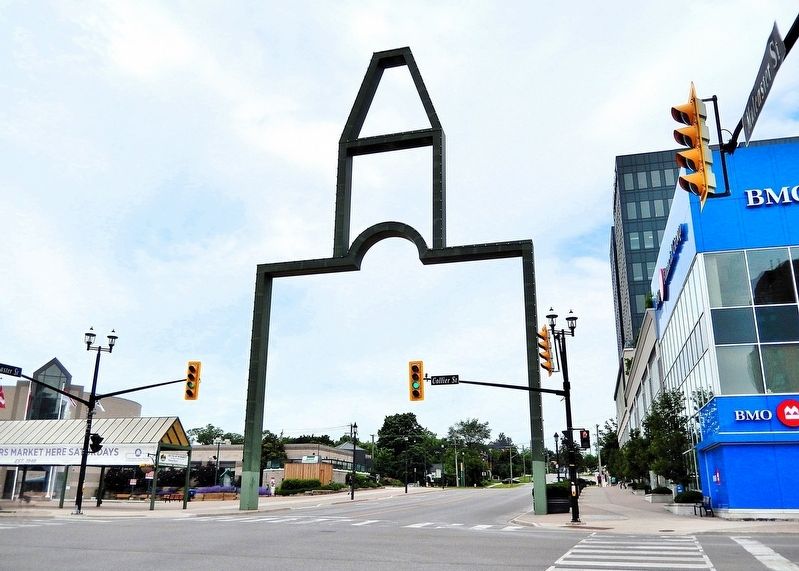
The building was demolished in 1985 and Mulcaster Street returned to its original width when a new City Hall was built at the northwest corner of Market Square. A green metal arch in the shape of the 1877 mansard roof and tower was erected over Mulcaster and the footprint of the building is traced in paving stones.
Erected by Barrie Waterfront Heritage Trail.
Topics. This historical marker is listed in these topic lists: Architecture • Industry & Commerce. A significant historical year for this entry is 1856.
Location. 44° 23.304′ N, 79° 41.214′ W. Marker is in Barrie, Ontario, in Simcoe County. It is at the intersection of Simcoe Street
Simcoe County Archives and "Beautiful Barrie; The City and Its People"
2. Marker detail: The Town Hall and Market Building enlarged and updated to Second Empire Style in 1877

Regionally, this marker is in Central Ontario Cottage Country and specifically in Georgian Bay Country. It is also in Central Canada. Globally, it is in North America, on the Great Lakes, in the Western Hemisphere, in the Western World, and in the Anglosphere. Historically, it finds itself in what was once a British colony, the Viceroyalty of New France, the Haudenosaunee (Iroquois) Confederacy, and Rupert’s Land.
Other nearby markers. At least 8 other markers are within walking distance of this marker: County Town (here, next to this marker); Lost Buildings (here, next to this marker); Birth of Barrie (here, next to this marker); Nine Mile Portage (here, next to this marker); Wharfs & Boatworks (here, next to this marker); Railway Watercraft (here, next to this marker); Memorial Square (here, next to this
Simcoe County Archives and "Beautiful Barrie; The City and Its People"
3. Marker detail: Marker detail: Town Hall renovated in 1948, as seen in the 1980s
Related markers. Click here for a list of markers that are related to this marker.
Also see . . . Market Square opened up new world to local farmers (Barrie Today).
(by Deb Exel, 12/29/2024) Excerpt: Mulcaster Street, one of Barrie’s original streets, was also known as Market Street in 1847, and the area where Mulcaster met Collier Street was known as Market Square.(Submitted on May 23, 2025, by Cosmos Mariner of Cape Canaveral, Florida.)
Town council engaged Toronto architect Joseph Sheard and local contractor Alexander Graham to design and build a proper structure on the former fairground. By 1856, council was holding its meetings in a grand new building in Market Square, on Collier Street, overlooking Market Street below.
In 1877, the market building was enlarged and given a stunning new Second Empire appearance, an update that added the extravagantly ornate cornices, friezes, ironwork cresting, splendid windows. It was a magnificent building with a commanding view of lower Mulcaster Street down to the bay.
Courtesy City of Barrie
4. Marker detail: Plan of Building Lots in Barrie showing Market Square Reserve, 1854
Photographed by Cosmos Mariner, June 5, 2024
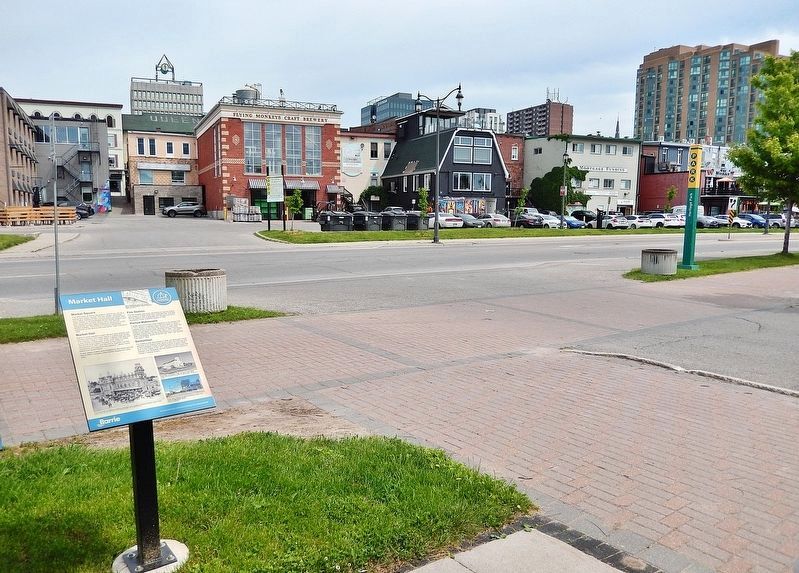
5. Market Hall Marker
Looking north across Simcoe Street from Heritage Park.
Photographed by Cosmos Mariner, June 5, 2024
6. Green metal arch outlines the Market Building, which stood on Mulcaster Street at Collier Street
A green metal arch in the shape of the 1877 mansard roof and tower was erected over Mulcaster and the footprint of the building is traced in paving stones.
Credits. This page was last revised on May 23, 2025. It was originally submitted on May 21, 2025, by Cosmos Mariner of Cape Canaveral, Florida. This page has been viewed 141 times since then and 23 times this year. Photos: 1, 2, 3, 4, 5, 6. submitted on May 23, 2025, by Cosmos Mariner of Cape Canaveral, Florida.
