Speyer, Rhineland-Palatinate, Germany — Central Europe
Standbilder der „Salier-Kaiser“
⎯⎯⎯
Statues of the "Salian Emperors"
Photographed by James Hulse, May 20, 2025
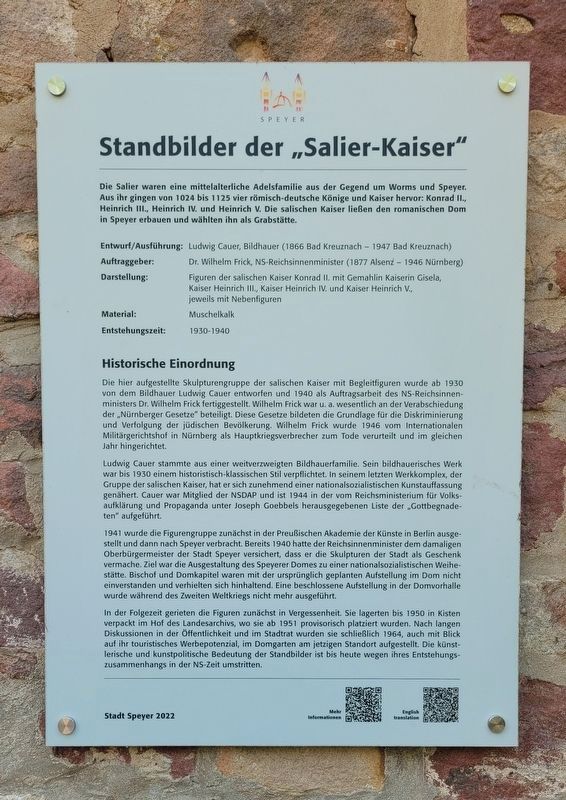
1. Standbilder der „Salier-Kaiser“ / Statues of the "Salian Emperors" Marker

Die Salier waren eine mittelalterliche Adelsfamilie aus der Gegend um Worms und Speyer. Aus ihr gingen von 1024 bis 1125 vier römisch-deutsche Könige und Kaiser hervor: Konrad II., Heinrich III., Heinrich IV. und Heinrich V. Die salischen Kaiser ließen den romanischen Dom in Speyer erbauen und wählten ihn als Grabstätte.
Entwurf/Ausführung: Ludwig Cauer, Bildhauer (1866 Bad Kreuznach - 1947 Bad Kreuznach)
Auftraggeber: Dr. Wilhelm Frick, NS-Reichsinnenminister (1877 Alsenz - 1946 Nürnberg)
Darstellung: Figuren der salischen Kaiser Konrad II. mit Gemahlin Kaiserin Gisela, Kaiser Heinrich III., Kaiser Heinrich IV. und Kaiser Heinrich V., jeweils mit Nebenfiguren
Material: Muschelkalk
Entstehungszeit: 1930-1940
Historische Einordnung
Die hier aufgestellte Skulpturengruppe der salischen Kaiser mit Begleitfiguren wurde ab 1930 von dem Bildhauer Ludwig Cauer entworfen und 1940 als Auftragsarbeit des NS-Reichsinnen-ministers Dr. Wilhelm Frick fertiggestellt. Wilhelm Frick war u. a. wesentlich an der Verabschiedung der „Nürnberger Gesetze" beteiligt. Diese Gesetze bildeten die Grundlage für die
this page online
Ludwig Cauer stammte aus einer weitverzweigten Bildhauerfamilie. Sein bildhauerisches Werk war bis 1930 einem historistisch-klassischen Stil verpflichtet. In seinem letzten Werkkomplex, der Gruppe der salischen Kaiser, hat er sich zunehmend einer nationalsozialistischen Kunstauffassung genähert. Cauer war Mitglied der NSDAP und ist 1944 in der vom Reichsministerium für Volksaufklärung und Propaganda unter Joseph Goebbels herausgegebenen Liste der „Gottbegnadeten" aufgeführt.
1941 wurde die Figurengruppe zunächst in der Preußischen Akademie der Künste in Berlin ausgestellt und dann nach Speyer verbracht. Bereits 1940 hatte der Reichsinnenminister dem damaligen Oberbürgermeister der Stadt Speyer versichert, dass er die Skulpturen der Stadt als Geschenk vermache. Ziel war die Ausgestaltung des Speyerer Domes zu einer nationalsozialistischen Weihestätte. Bischof und Domkapitel waren mit der ursprünglich geplanten Aufstellung

Photographed by James Hulse, May 20, 2025
2. The Statues of the "Salian Emperors" and Marker
In der Folgezeit gerieten die Figuren zunächst in Vergessenheit. Sie lagerten bis 1950 in Kisten verpackt im Hof des Landesarchivs, wo sie ab 1951 provisorisch platziert wurden. Nach langen Diskussionen in der Öffentlichkeit und im Stadtrat wurden sie schließlich 1964, auch mit Blick auf ihr touristisches Werbepotenzial, im Domgarten am jetzigen Standort aufgestellt. Die künstlerische und kunstpolitische Bedeutung der Standbilder ist bis heute wegen ihres Entstehungs-zusammenhangs in der NS-Zeit umstritten.
The Salians were a medieval noble family from the area around Worms and Speyer. Between 1024 and 1125, four Roman-German kings and emperors came from this dynasty: Conrad II, Henry III, Henry IV, and Henry V. The Salian emperors had the Romanesque cathedral in Speyer built and chose it as their burial site.
Design/Execution: Ludwig Cauer, sculptor (1866 Bad Kreuznach – 1947 Bad Kreuznach)
Client: Dr. Wilhelm Frick, Nazi Reich Minister

Photographed by James Hulse, May 20, 2025
3. Statues of the "Salian Emperors"
Depiction: Figures of the Salian emperors Conrad II with his consort Empress Gisela, Emperor Henry III, Emperor Henry IV, and Emperor Henry V, each accompanied by secondary figures.
Material: Shell limestone
Period of Origin: 1930–1940
Historical Context
This group of sculptures depicting the Salian emperors with accompanying figures was designed by sculptor Ludwig Cauer starting in 1930 and completed in 1940 as a commissioned work for Nazi Reich Minister of the Interior Dr. Wilhelm Frick. Wilhelm Frick was, among other things, heavily involved in the passing of the “Nuremberg Laws,” which laid the legal groundwork for the discrimination and persecution of the Jewish population. In 1946, Frick was sentenced to death by the International Military Tribunal in Nuremberg as a major war criminal and executed the same year.
Ludwig Cauer came from a widely connected family of sculptors. Up to 1930, his sculptural work was committed to a historicist-classical style. In his final group of works, the Salian emperors, he increasingly aligned with National Socialist artistic ideals.

Photographed by James Hulse, May 20, 2025
4. Statues of the "Salian Emperors"
In 1941, the group of figures was initially exhibited at the Prussian Academy of Arts in Berlin and then transferred to Speyer. As early as 1940, the Reich Minister of the Interior had assured the then-mayor of Speyer that he would gift the sculptures to the city. The goal was to transform Speyer Cathedral into a National Socialist ceremonial site. However, the bishop and cathedral chapter disagreed with the original plan to install them inside the cathedral and delayed the matter. A decided installation in the cathedral vestibule was ultimately not carried out during World War II.
Subsequently, the statues fell into obscurity. Until 1950, they remained packed in crates in the courtyard of the state archives, where they were provisionally placed from 1951 onward. After extended public and city council debates, they were finally installed in 1964 in the cathedral garden at their current location — partly with an eye on their tourism
Photographed by James Hulse, May 20, 2025
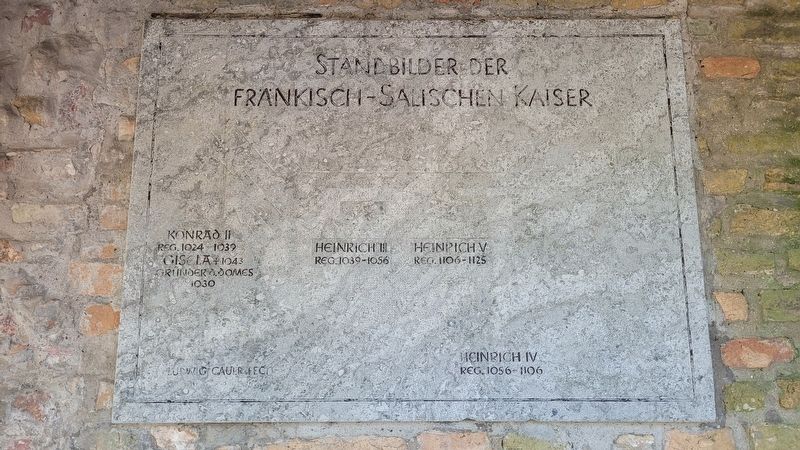
5. Additional Plaque
Erected 2022 by Stadt Speyer.
Topics. This historical marker is listed in these topic lists: Arts, Letters, Music • War, World II.
Location. 49° 18.976′ N, 8° 26.591′ E. Marker is in Speyer, Rheinland-Pfalz (Rhineland-Palatinate). It is on Domplatz just north of Klipfelsau. The marker is located along the pathway through the garden to the cathedral. Touch for map. Marker is at or near this postal address: Domplatz 6, Speyer RP 67346, Germany. Touch for directions.

Regionally, it is in Europe, the European Union, Atlantic Europe, Central Europe, the Schengen Area, Western Europe, and the Western World. Historically, it finds itself in what was once the Roman Empire and specifically also the Holy Roman Empire.
Other nearby markers. At least 8 other markers are within walking distance of this marker: Ölberg / Mount of Olives (about 90 meters away, measured in a direct line); Wiedervereinigung Deutschlands / Reunification of Germany

Photographed by James Hulse, May 20, 2025
6. The view of the Statues of the "Salian Emperors" along the walkway to the cathedral
Also see . . . Statues of the Salian Emperors. (Submitted on May 22, 2025, by James Hulse of Medina, Texas.)
Credits. This page was last revised on June 4, 2025. It was originally submitted on May 21, 2025, by James Hulse of Medina, Texas. This page has been viewed 468 times since then and 142 times this year. Photos: 1, 2, 3, 4, 5, 6. submitted on May 22, 2025, by James Hulse of Medina, Texas.
