
Crediton in Devon, England, United Kingdom — Northwestern Europe (the British Isles)
Joseph Locke 1805-1860

Photographed by Ray Gurganus, April 8, 2025
1. Joseph Locke 1805-1860 Marker
Topics. This historical marker is listed in this topic list: Railroads & Streetcars. A significant historical year for this entry is 1805.
Location. 50° 46.996′ N, 3° 38.804′ W. Marker is in Crediton, England, in Devon. It can be reached from Station Approach. On the platform at Crediton Station. Touch for map. Marker is at or near this postal address: 5 Station Approach, Crediton, England EX17 3FA, United Kingdom. Touch for directions.

Regionally, this marker is in South West England. Globally, it is on the Atlantic Ocean, in the North Atlantic Region, in Europe, in Atlantic Europe, on one of the British Isles, in the Western World, and in the Anglosphere. Historically, it finds itself in what was once the Roman Empire.
Other nearby markers. At least 8 other markers are within 11 kilometers of this marker, measured as the crow flies: The building and opening of the Crediton to Exeter trainline (a few steps from this marker); The Footbridge and the Creamery (a few steps from this marker); The Signal Box and No Signalman Token Remote System (a few steps from this marker); Crediton Station (a few steps from this marker); Alexander Cavalié Mercer (approx. 9.8 kilometers away); Catacomb (approx. 10.3 kilometers away); St Nicholas Priory (approx. 10.4 kilometers away); Exeter and the Wesleyan Revival (approx. 10.5 kilometers away). Touch for a list and map of all markers in Crediton.
Also see . . . Who was Joseph Locke? From birth of the railway to great legacy (Network Rail). Excerpt:
Joseph Locke was just 17 when he took part in pioneering work that set out the birth of the modern passenger railway.(Submitted on May 23, 2025.)
Locke was born into a family of collierymanagers on 9 August 1805.
Click or scan to see
this page online
His planning for the Stockton and Darlington Railway in the North of England – under the leadership of engineer George Stephenson – helped pave the way for passenger locomotives and what we consider the modern mainline railway.
This groundbreaking engineering put Locke in the history books alongside Stephenson’s son, Robert Stephenson, and Isambard Kingdom Brunel.
Together, they drove forward the construction and development of the railway, which had traditionally been used to transport goods by horse-drawn wagons.
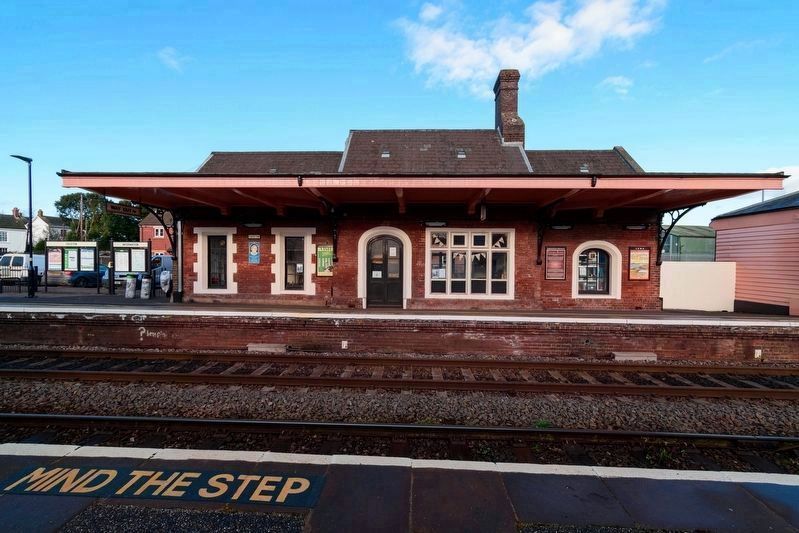
Photographed by Simon Cobb (via Wikimedia Commons under CC 1.0 license), January 2, 2023
2. Joseph Locke 1805-1860 marker - wide view
The marker is visible here between the two windows on the left.
Credits. This page was last revised on May 23, 2025. It was originally submitted on May 21, 2025, by Ray Gurganus of Washington, District of Columbia. This page has been viewed 182 times since then and 36 times this year. Photos: 1. submitted on May 21, 2025, by Ray Gurganus of Washington, District of Columbia. 2. submitted on May 23, 2025. • Andrew Ruppenstein was the editor who published this page.
