Bremen-Mitte in Mitte, Germany — Central Europe
Bismarck-Denkmal
⎯⎯⎯
Bismarck Monument
Photographed by Andrew Ruppenstein, May 18, 2025
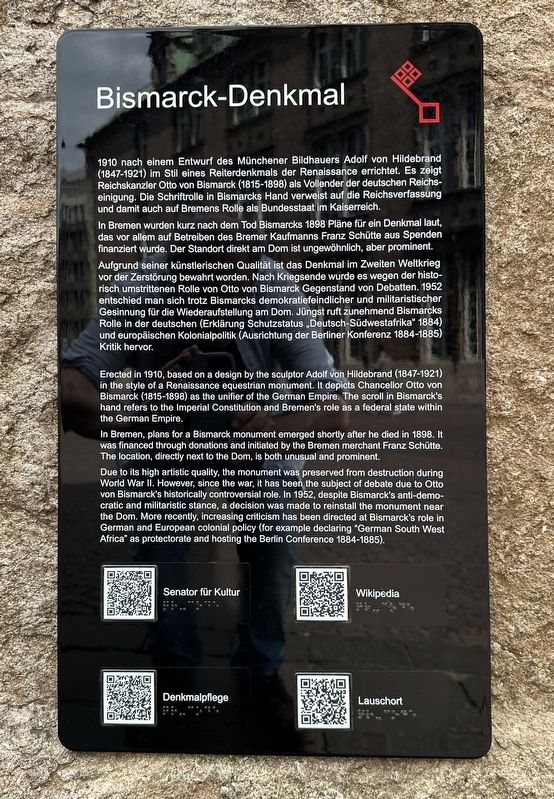
1. Bismarck-Denkmal / Bismarck Monument Marker

1910 nach einem Entwurf des Münchener Bildhauers Adolf von Hildebrand (1847-1921) im Stil eines Reiterdenkmals der Renaissance errichtet. Es zeigt Reichskanzler Otto von Bismarck (1815-1898) als Vollender der deutschen Reichs- einigung. Die Schriftrolle in Bismarcks Hand verweist auf die Reichsverfassung und damit auch auf Bremens Rolle als Bundesstaat im Kaiserreich.
In Bremen wurden kurz nach dem Tod Bismarcks 1898 Pläne für ein Denkmal laut, das vor allem auf Betreiben des Bremer Kaufmanns Franz Schütte aus Spenden finanziert wurde. Der Standort direkt am Dom ist ungewöhnlich, aber prominent.
Aufgrund seiner künstlerischen Qualität ist das Denkmal im Zweiten Weltkrieg vor der Zerstörung bewahrt worden. Nach Kriegsende wurde es wegen der histo- risch umstrittenen Rolle von Otto von Bismarck Gegenstand von Debatten. 1952 entschied man sich trotz Bismarcks demokratiefeindlicher und militaristischer Gesinnung für die Wiederaufstellung am Dom. Jüngst ruft zunehmend Bismarcks Rolle in der deutschen (Erklärung Schutzstatus „Deutsch-Südwestafrika" 1884) und europäischen Kolonialpolitik
this page online
Erected in 1910, based on a design by the sculptor Adolf von Hildebrand (1847-1921) in the style of a Renaissance equestrian monument. It depicts Chancellor Otto von Bismarck (1815-1898) as the unifier of the German Empire. The scroll in Bismarck's hand refers to the Imperial Constitution and Bremen's role as a federal state within the German Empire.
In Bremen, plans for a Bismarck monument emerged shortly after he died in 1898. It was financed through donations and initiated by the Bremen merchant Franz Schütte. The location, directly next to the Dom, is both unusual and prominent.
Due to its high artistic quality, the monument was preserved from destruction during World War II. However, since the war, it has been the subject of debate due to Otto von Bismarck's historically controversial role. In 1952, despite Bismarck's anti-democratic and militaristic stance, a decision was made to reinstall the monument near the Dom. More recently, increasing criticism has been directed at Bismarck's role in German and European colonial policy (for example

Photographed by Andrew Ruppenstein, May 18, 2025
2. Bismarck Monument and marker
Topics and series. This historical marker and monument is listed in these topic lists: Arts, Letters, Music • Government & Politics. In addition, it is included in the Bremen Red Key series list. A significant historical year for this entry is 1910.
Location. 53° 4.545′ N, 8° 48.513′ E. Marker is in Bremen, in Mitte. It is in Bremen-Mitte. It is at the intersection of Domshof and Sandstraße, on the left when traveling west on Domshof. Touch for map. Marker is at or near this postal address: Sandstraße 10-12, Bremen 28195, Germany. Touch for directions.

Regionally, it is in Europe, the European Union, Atlantic Europe, Central Europe, the Schengen Area, Western Europe, and the Western World. Historically, it finds itself in what was once the Holy Roman Empire.
Other nearby markers. At least 8 other markers are within walking distance of this marker: Neues Rathaus / New Town Hall (a few steps from this marker); Die Domportale mahnen uns / The Cathedral Doors Serve as a Reminder (within shouting distance of this marker); Börsenhof / Stock Exchange

Photographed by Andrew Ruppenstein, May 18, 2025
3. Bismarck Statue
Also see . . .
1. The Bremen Bismarck Monument (Der Senator für Kultur, Freie Hansestadt Bremen, German and English). A QR code on the marker leads to the Senator für Kultur‘s extensive German and English pages (with numerous illustrations) about the Bismarck Monument. Excerpt:
Imperial Chancellor Otto von Bismarck (1815-1898) was one of the most publicly revered figures in Germany for a long time due to his role in the formation of a German nation state. Countless memorials, monuments and buildings (for example Bismarck Towers) were created in his honour. The nationally-minded German middle classes in particular honoured Bismarck as the "forger of German unity" and as a national heroic figure.(Submitted on May 23, 2025.)
Just three years after Bismarck's death, 300 Bismarck associationsexisted in Germany, so that his person became virtually omnipresent in the public sphere as a result of the "monument mania" of the time. The Bismarck cult grew in the wake of nationalism right up to the First World War and reached its peak in 1915 in the middle of the war with the celebrations in honour of his 100th birthday. In Bremen, too, numerous celebrations were held on 27 March 1915 to mark the occasion, which were very lavish in view of the wartime situation.courtesy State Archive Bremen and Der Senator für Kultur (Freie Hansestadt Bremen), circa 19124. Postcard with the Bismarck monument

2. Bismarck-Denkmal & Reiterstandbild Otto von Bismarck (Landesamt für Denkmalpflege, in German). A QR code on the marker leads information and data on the monument. Excerpt (in translation):
Bronze equestrian statue on a high limestone pedestal, created in 1910 by Adolf von Hildebrand. Its monumental design is of spatial significance for the sequence of squares: the market square, the cathedral forecourt (formerly the Grasmarkt), and the cathedral courtyard. In 1904, a specially appointed monument commission selected the site at the southernmost point of the cathedral courtyard, on the steps of the cathedral, close to the tower and aligned parallel to the cathedral's longitudinal axis, facing the new town hall. By 1910, Adolf von Hildebrand had created the equestrian statue for this location on an unusually high pedestal, similar to those of Bartolomeo Colleoni in Venice (1481 by Andrea del Verrochio) and Gattamelata in Padua (1447 by Donatello). Both were important military leaders of Italian city-states during the Renaissance, and Gattamelata is considered the first equestrian statue since antiquity.(Submitted on May 23, 2025.)
Credits. This page was last revised on May 23, 2025. It was originally submitted on May 23, 2025, by Andrew Ruppenstein of Lamorinda, California. This page has been viewed 180 times since then and 37 times this year. Photos: 1, 2, 3, 4. submitted on May 23, 2025, by Andrew Ruppenstein of Lamorinda, California.
