Ogden in Weber County, Utah — The American Mountains (Southwest)
John Henry Weber (1779-1859)
Photographed by Jeremy Snow, May 20, 2025
1. John Henry Weber (1779-1859) Marker
Inscription.
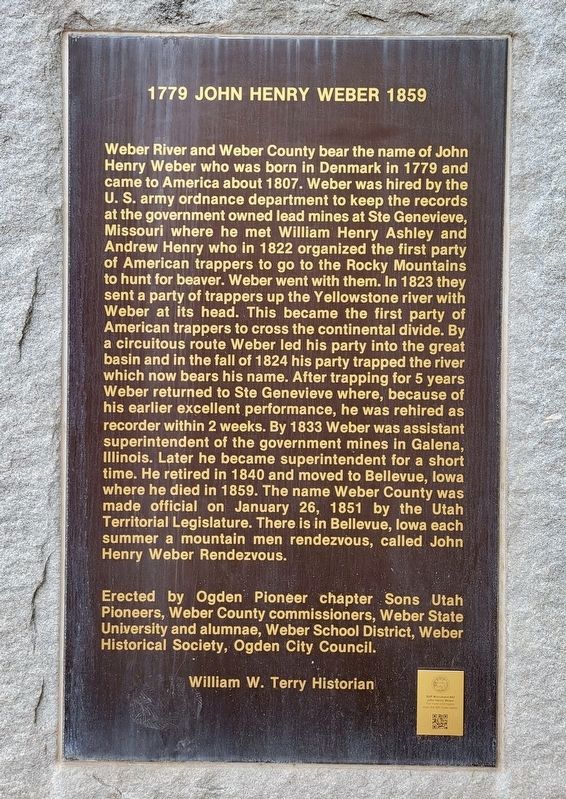
John Henry Weber (1779-1859). . Weber River and Weber County bear the name of John Henry Weber who was born in Denmark in 1779 and came to America about 1807. Weber was hired by the U. S. army ordnance department to keep the records at the government owned lead mines at Ste Genevieve, Missouri where he met William Henry Ashley and Andrew Henry who in 1822 organized the first party of American trappers to go to the Rocky Mountains to hunt for beaver. Weber went with them. In 1823 they sent a party of trappers up the Yellowstone river with Weber at its head. This became the first party of American trappers to cross the continental divide. By a circuitous route Weber led his party into the great basin and in the fall of 1824 his party trapped the river which now bears his name. After trapping for 5 years Weber returned to Ste Genevieve where, because of his earlier excellent performance, he was rehired as recorder within 2 weeks. By 1833 Weber was assistant superintendent of the government mines in Galena, Illinois. Later he became superintendent for a short time. He retired in 1840 and moved to Bellevue, Iowa where he died in 1859. The name Weber County was made official on January 26, 1851 by the Utah Territorial Legislature. There is in Bellevue, lowa each summer a mountain men rendezvous, called John Henry Weber Rendezvous. , Erected by Ogden Pioneer chapter Sons Utah Pioneers, Weber County commissioners, Weber State University and alumnae, Weber School District, Weber Historical Society, Ogden City Council. , William W. Terry Historian
Weber River and Weber County bear the name of John Henry Weber who was born in Denmark in 1779 and came to America about 1807. Weber was hired by the U. S. army ordnance department to keep the records at the government owned lead mines at Ste Genevieve, Missouri where he met William Henry Ashley and Andrew Henry who in 1822 organized the first party of American trappers to go to the Rocky Mountains to hunt for beaver. Weber went with them. In 1823 they sent a party of trappers up the Yellowstone river with Weber at its head. This became the first party of American trappers to cross the continental divide. By
a circuitous route Weber led his party into the great basin and in the fall of 1824 his party trapped the river which now bears his name. After trapping for 5 years Weber returned to Ste Genevieve where, because of his earlier excellent performance, he was rehired as recorder within 2 weeks. By 1833 Weber was assistant superintendent of the government mines in Galena, Illinois. Later he became superintendent for a short time. He retired in 1840 and moved to Bellevue, Iowa where he died in 1859. The name Weber County
Click or scan to see this page online
was made official on January 26, 1851 by the Utah Territorial Legislature. There is in Bellevue, lowa each summer a mountain men rendezvous, called John Henry Weber Rendezvous.
Erected by Ogden Pioneer chapter Sons Utah Pioneers, Weber County commissioners, Weber State University and alumnae, Weber School District, Weber Historical Society, Ogden City Council.
William W. Terry Historian
Erected by Sons of Utah Pioneers Ogden Pioneer Chapter. (Marker Number 42.)
Topics and series. This historical marker is listed in this topic list: Exploration. In addition, it is included in the Sons of Utah Pioneers series list. A significant historical year for this entry is 1823.
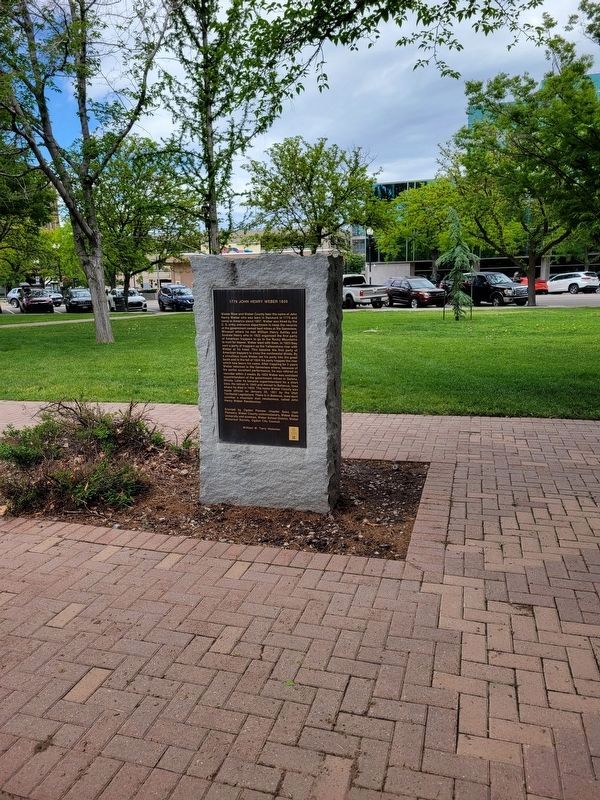
Location. 41° 13.214′ N, 111° 58.271′ W. Marker is in Ogden, Utah, in Weber County. It can be reached from Washington Boulevard. Located in the Odgen Park near the Firefighter display. Touch for map. Marker is in this post office area: Ogden UT 84401, United States of America. Touch for directions.
Regionally, this marker is in the Wasatch Front and in Greater Salt Lake. It is also in the American Mountain West and in Colorado Plateau. Globally, it is in
Photographed by Jeremy Snow, May 20, 2025
2. John Henry Weber (1779-1859) Marker
North America, the Rocky Mountains, the Western Hemisphere, the Western World, and the Anglosphere. Historically, it finds itself in what was once New Spain and also Mexico’s Alta California.
Credits. This page was last revised on May 24, 2025. It was originally submitted on May 23, 2025, by Jeremy Snow of Cedar City, Utah. This page has been viewed 221 times since then and 39 times this year. Photos:1, 2. submitted on May 23, 2025, by Jeremy Snow of Cedar City, Utah. • Andrew Ruppenstein was the editor who published this page.