Barrie in Simcoe County, Ontario — Central Canada (North America)
An Independent Village
| — | Barrie Waterfront Heritage Trail | — |
Photographed by Cosmos Mariner, June 5, 2024
1. An Independent Village Marker
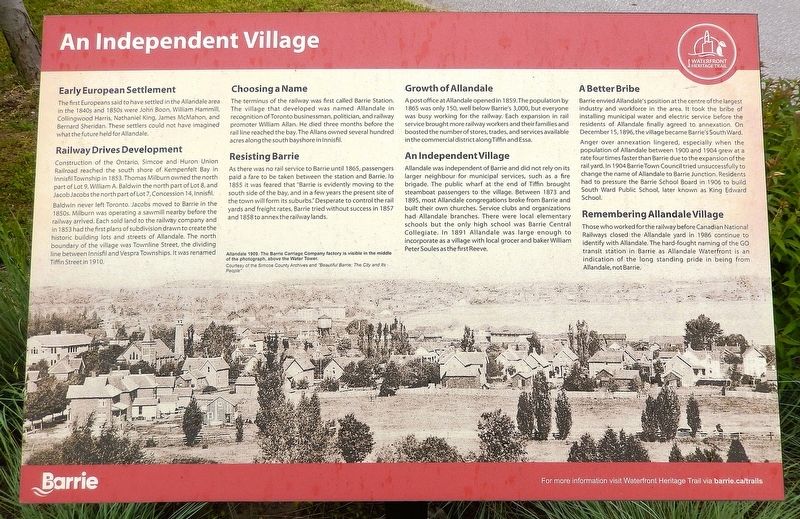
Early European Settlement
The first Europeans said to have settled in the Allandale area in the 1840s and 1850s were John Boon, William Hammill, Collingwood Harris, Nathaniel King, James McMahon, and Bernard Sheridan. These settlers could not have imagined what the future held for Allandale.
Railway Drives Development
Construction of the Ontario, Simcoe and Huron Union Railroad reached the south shore of Kempenfelt Bay in lnnisfil Township in 1853. Thomas Milburn owned the north part of Lot 9, William A. Baldwin the north part of Lot 8, and Jacob Jacobs the north part of Lot 7, Concession 14, Innisfil.
Baldwin never left Toronto. Jacobs moved to Barrie in the 1850s. Milburn was operating a sawmill nearby before the railway arrived. Each sold land to the railway company and in 1853 had the first plans of subdivision drawn to create the historic building lots and streets of Allandale. The north boundary of the village was Townline Street, the dividing line between Innisfil and Vespra Townships. It was renamed Tiffin Street in 1910.
Choosing a Name
The terminus of the railway was first called Barrie Station. The village that
this page online
Resisting Barrie
As there was no rail service to Barrie until 1865, passengers paid a fare to be taken between the station and Barrie. In 1855 it was feared that “Barrie is evidently moving to the south side of the bay, and in a few years the present site of the town will form its suburbs.” Desperate to control the rail yards and freight rates, Barrie tried without success in 1857 and 1858 to annex the railway lands.
Growth of Allandale
A post office at Allandale opened in 1859. The population by 1865 was only 150, well below Barrie's 3,000, but everyone was busy working for the railway. Each expansion in rail service brought more railway workers and their families and boosted the number of stores, trades, and services available in the commercial district along Tiffin and Essa.
An Independent Village
Allandale was independent of Barrie and did not rely on its larger neighbour for municipal
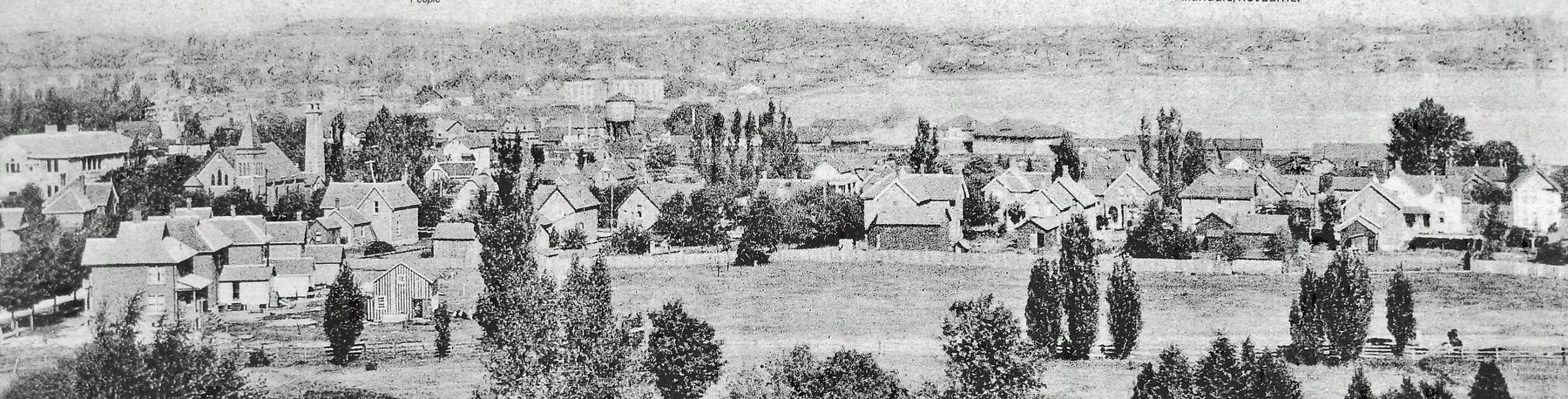
Simcoe County Archives and "Beautiful Barrie; The City and Its People"
2. Marker detail: Allandale, 1909
The Barrie Carriage Company factory is visible in the middle of the photograph, above the Water Tower.
A Better Bribe
Barrie envied Allandale's position at the centre of the largest industry and workforce in the area. It took the bribe of installing municipal water and electric service before the residents of Allandale finally agreed to annexation. On December 15, 1896, the village became Barrie's South Ward.
Anger over annexation lingered, especially when the population of Allandale between 1900 and 1904 grew at a rate four times faster than Barrie due to the expansion of the rail yard. In 1904 Barrie Town Council tried unsuccessfully to change the name of Allandale to Barrie Junction. Residents had to pressure the Barrie School Board in 1906 to
Photographed by Cosmos Mariner, June 5, 2024
3. An Independent Village Marker
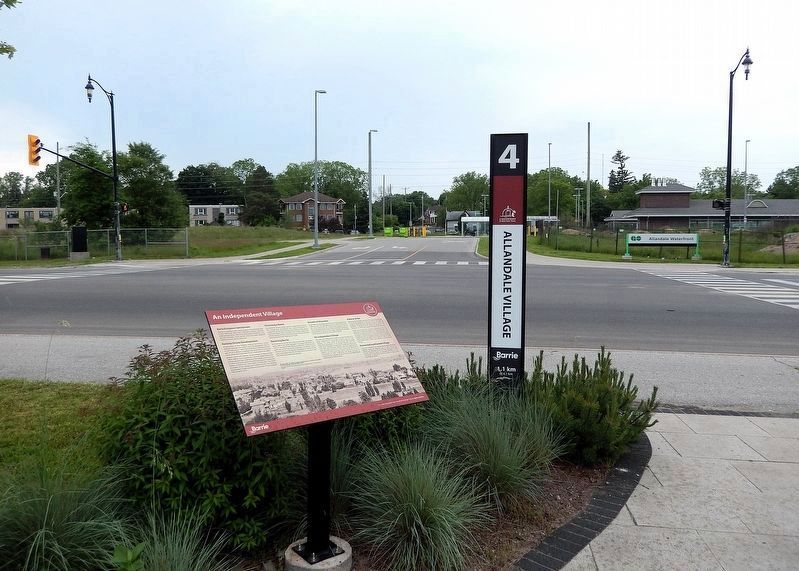
Looking south across Lakeshore Drive. It is one of six related interpretive panels at this location.
Remembering Allandale Village
Those who worked for the railway before Canadian National Railways closed the Allandale yard in 1986 continue to identify with Allandale. The hard-fought naming of the GO transit station in Barrie as Allandale Waterfront is an indication of the long standing pride in being from Allandale, not Barrie.
Erected by Barrie Waterfront Heritage Trail.
Topics. This historical marker is listed in these topic lists: Industry & Commerce • Railroads & Streetcars • Settlements & Settlers. A significant historical year for this entry is 1853.
Location. 44° 22.45′ N, 79° 41.112′ W. Marker is in Barrie, Ontario, in Simcoe County. It is on Lakeshore Drive 0.3 kilometers east of Tiffin Street, on the left when traveling east. The marker is on the Barrie Waterfront Heritage Trail at Station #4 (Allandale Village), in South Shore Park. Touch for map. Marker is at or near this postal address: 155 Lakeshore Drive, Barrie ON L4N 7Y9, Canada. Touch for directions.

Regionally, this marker is in Central Ontario Cottage Country and specifically in Georgian Bay Country. It is also in Central Canada. Globally, it is in North America, on the Great Lakes, in the Western Hemisphere, in the Western World, and in the Anglosphere. Historically, it finds itself in what was once a British colony, the Viceroyalty of New France, the Haudenosaunee (Iroquois) Confederacy, and Rupert’s Land.
Other nearby markers. At least 8 other markers are within walking distance of this marker: Train Town Kids (here, next to this marker); Living in a Company Town (here, next to this marker); Housing Shortages (here, next to this marker); Early Businesses (here, next to this marker); Allandale Railroad YMCA (a few steps from this marker); Allandale Railway Station (within shouting distance of this marker); Steamboating on Lake Simcoe / La navigation à vapeur sur le lac Simcoe (approx. 0.3 kilometers away); Steamboat J.C. Morrison (approx. 0.3 kilometers away). Touch for a list and map of all markers in Barrie.
Related markers. Click here for a list of markers that are related to this marker. Barrie Waterfront Heritage Trail Station #4 — Allandale Village
Credits. This page was last revised on May 28, 2025. It was originally submitted on May 24, 2025, by Cosmos Mariner of Cape Canaveral, Florida. This page has been viewed 117 times since then and 35 times this year. Photos: 1, 2, 3. submitted on May 28, 2025, by Cosmos Mariner of Cape Canaveral, Florida.
