Bremen-Mitte in Mitte, Germany — Central Europe
Ronning-Haus
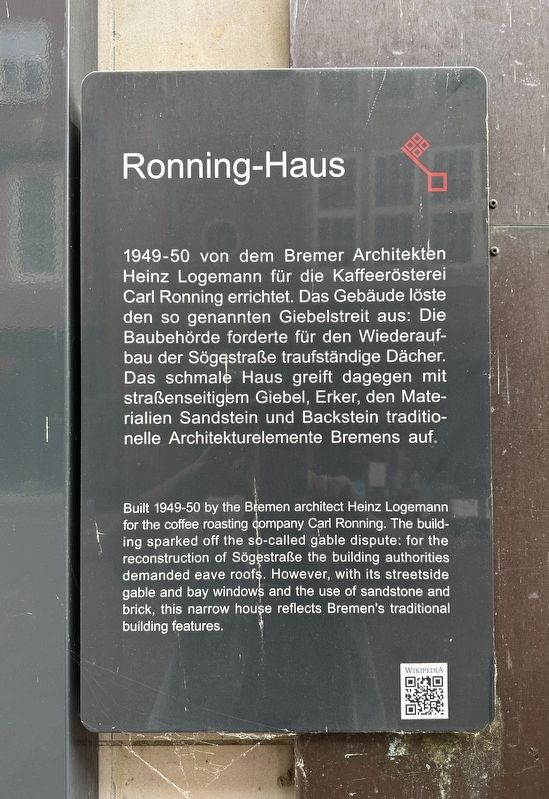
Photographed by Andrew Ruppenstein, May 18, 2025
1. Ronning-Haus Marker

Topics and series. This historical marker is listed in these topic lists: Architecture • Industry & Commerce. In addition, it is included in the Bremen Red Key series list.
Location. 53° 4.69′ N, 8° 48.484′ E. Marker is in Bremen, in Mitte. It is in Bremen-Mitte. It is on Sögestraße, on the right when traveling south. Touch for map. Marker is at or near this postal address: Sögestraße 54, Bremen 28195, Germany. Touch for directions.

Regionally, it is in Europe, the European Union, Atlantic Europe, Central Europe, the Schengen Area, Western Europe, and the Western World. Historically, it finds itself in what was once the Holy Roman Empire and also the former West Germany.
Other nearby markers. At least 8 other markers are within walking distance of this marker: Geschäftshaus / Business and Office Building (within shouting distance of this marker); Die Sögestrasse / “Sow” Street (within shouting distance of this marker); Dörrbecker Haus (within shouting distance
this page online
Also see . . . Ronning-Haus (Wikipedia, in German). Excerpt (in translation):
Sögestraße is a major shopping street in Bremen. It was almost completely destroyed in World War II, along with the shop of merchant and Bremen coffee roaster Carl Ronning. Reconstruction took place on Sögestraße from 1947 to the early 1950s.(Submitted on May 28, 2025.)
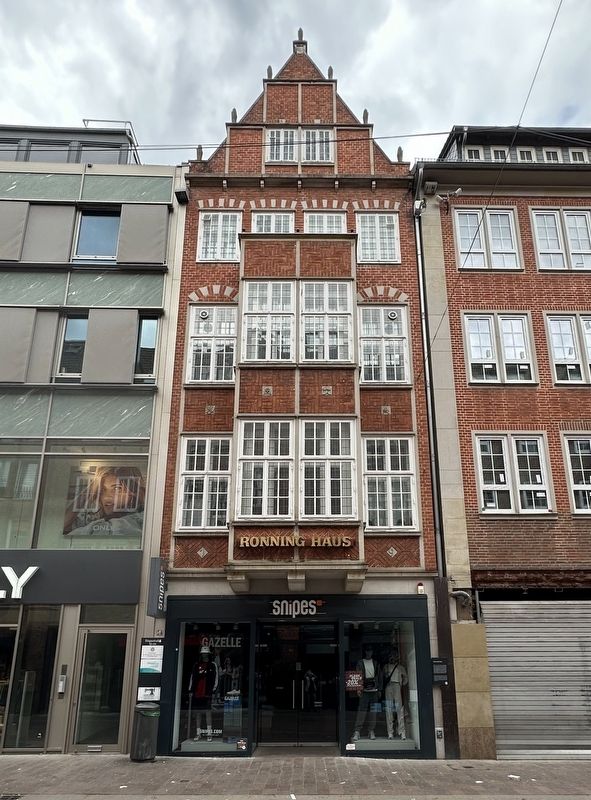
The narrow, gabled, four-story, four-axle Ronning House, made of brick with a two-story bay window, was built from 1949 to 1950 according to the plans of the architect Heinz Logemann. The striking ornamental gable sparked a heated debate in Bremen in 1950 about how buildings should be built in the old town. In the narrower Sögestraße, houses with a gable roof were required. However, the developer, Carl Ronning, and Logemann, builtthe gabled house, concealed behind tarpaulins and contrary to the building permit. The public debate led to a survey of the population, 98% of whom voted in favor of the gabled house. Senator Emil Theil (SPD) subsequently approved this form of the building. The outcome of the gable dispute was a first, important example of democracy in action in Bremen and changed the Bremen building authority's previously unchallenged, highly restrictive approval practices.Photographed by Andrew Ruppenstein, May 18, 20252. Ronning-Haus and Marker
Credits. This page was last revised on May 28, 2025. It was originally submitted on May 28, 2025, by Andrew Ruppenstein of Lamorinda, California. This page has been viewed 99 times since then and 12 times this year. Photos: 1, 2. submitted on May 28, 2025, by Andrew Ruppenstein of Lamorinda, California.
