Rankin in Allegheny County, Pennsylvania — The American Northeast (Mid-Atlantic)
The Carrie Deer
Photographed by Bradley Owen, May 25, 2025
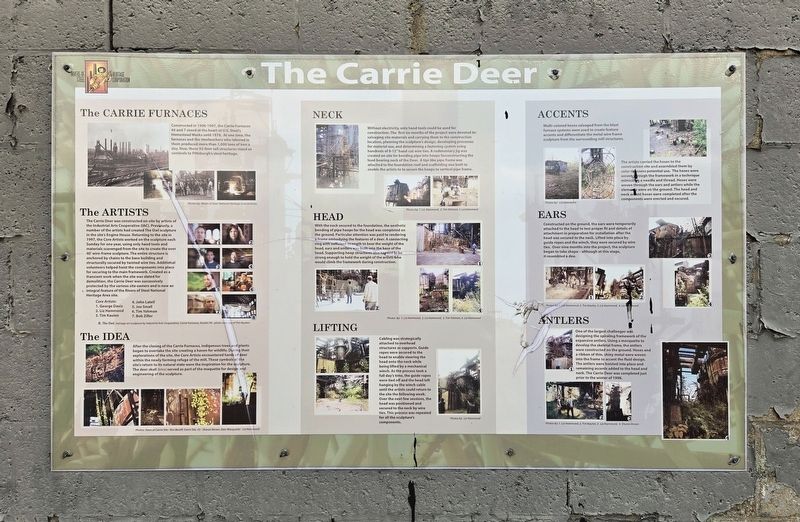
1. The Carrie Deer Marker
The Carrie Furnaces
Constructed in 1906-1907, the Carrie Furnaces #6 and 7 stood at the heart of U.S. Steel's Homestead Works until 1978. At one time, the furnaces and the steelworkers who labored in them produced more than 1,000 tons of iron a day. Now, these 92-foot-tall structures stand as sentinels to Pittsburgh's steel heritage.
The Artists
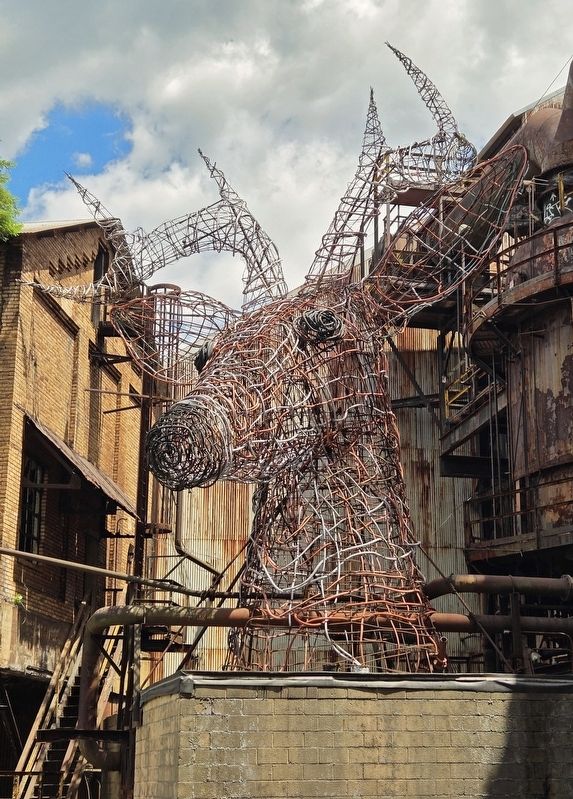
The Carrie Deer was constructed on-site by artists of the Industrial Arts Cooperative (IAC). Previously, a number of the artists had created The Owl sculpture in the site's Engine House. Returning to the site in 1997, the Core Artists worked on the sculpture each Sunday for one year, using only hand tools and materials scavenged from the site to create the over 40' wire-frame sculpture. The entire structure is anchored by chains to the base building and structurally secured by twisted wire ties. Additional volunteers helped hoist the components into place for securing to the main framework. Created as a transient work when the site was slated for demolition, the Carrie Deer was successively protected by the various site owners and is now an integral feature of the Rivers
this page online
Core Artists:
1. George Davis
2. Liz Hammond
3. Tim Kaulen
4. John Latell
5. Joe Small
6. Tim Yohman
7. Bob Ziller
8. The Owl (salvage art sculpture by Industrial Arts Cooperative, Carrie Furnaces, Rankin PA)
The Idea
After the closing of the Carrie Furnaces, indigenous trees and plants began to overtake the site creating a haven for wildlife. During their explorations of the site, the Core Artists encountered herds of deer within the newly forming refuge of the mill. These symbols of the site's return to its natural state were the inspiration for the sculpture. The deer skull (below) served as part of the maquette for design and engineering of the sculpture.
Neck
Without electricity, only hand tools could be used for construction. The first six months of the project were devoted to: salvaging site materials and carrying them to the construction location, planning the sculpture's design, developing processes for material use, and determining a fastening system using hundreds of 8-12" hand-cut wire ties. A rudimentary jig was created on site for bending pipe into hoops forconstructing
Photographed by Bradley Owen, May 25, 2025
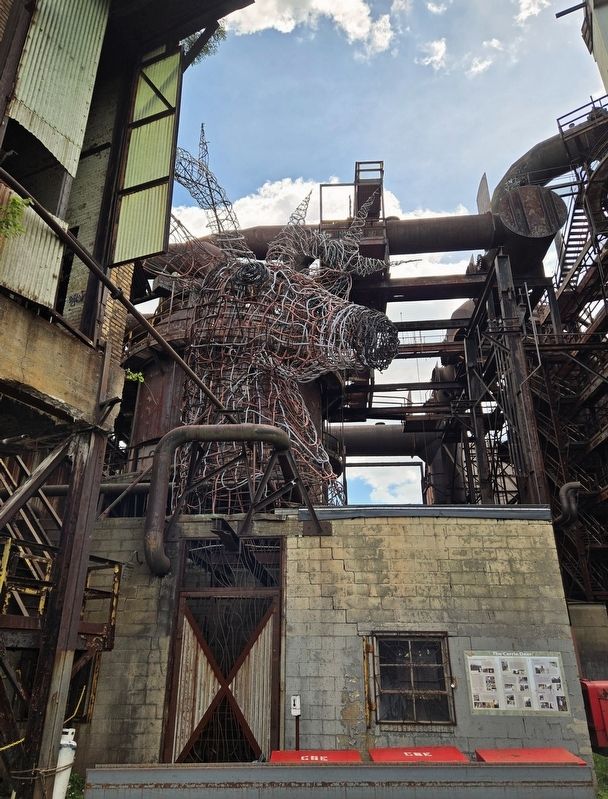
2. The Carrie Deer Marker
The Deer artwork is above and left of the marker.
Head
With the neck secured to the foundation, the aesthetic bending of pipe hoops for the head was completed on the ground. Particular attention was paid to rendering a frame embodying the features of a deer. A connecting ring with sufficient strength to bear the weight of the head, ears and antlers was bullt into the base of the head. Supporting hoop structures also needed to be strong enough to hold the weight of the artists who would climb the framework during construction.
Lifting
Cabling was strategically attached to overhead structures as supports. Guide ropes were secured to the head to enable steering the head onto the neck while being lifted by a mechanical winch. As the process took a full day's time, the guide ropes were tied off and the head left hanging by the winch cable until the artists could return to the site the following week. Over the next few sessions, the head was positioned and secured to the neck by wire ties.
Photographed by Bradley Owen, May 25, 2025
3. The Carrie Deer
Accents
Multi-colored hoses salvaged from the blast furnace systems were used to create feature accents and differentiate the metal wire frame sculpture from the surrounding mill structures.
The artists carried the hoses to the construction site and assembled them by color to assess potential use. The hoses were woven through the framework in a technique mimicking a needle and thread. Hoses were woven through the ears and antlers while the elements were on the ground. The head and neck accent hoses were completed after the components were erected and secured.
Ears
Constructed on the ground, the ears were temporarily attached to the head to test proper fit and details of attachment in preparation for installation after the head was secured to the neck. Lifted into place by guide ropes and the winch, they were secured by wire ties. Over nine months into the project, the sculpture began to take shape - although at this stage, it resembled a doe.
Antlers
One of the largest challenges was designing the spiraling framework of the expansive antlers. Using a macquette to develop the skeletal frame, the antlers were constructed on the ground. Hoses and a ribbon of thin, shiny metal were woven into the frame to accent the fluid design. The antlers were hoisted into place and remaining accents added to the head and neck. The Carrie Deer was completed just prior to the winter of 1998.
Photos by: Rivers of Steel National Heritage Area Archives, Tim Kaulen, Ron Baraff, Sharon Brown, Liz Hammond and Tim Yohman.
Erected by Rivers of Steel Heritage Corporation.
Topics. This historical marker is listed in these topic lists: Animals • Arts, Letters, Music • Industry & Commerce. A significant historical year for this entry is 1978.
Location. 40° 24.816′ N, 79° 53.408′ W. Marker is in Rankin, Pennsylvania, in Allegheny County. It can be reached from Carrie Furnace Boulevard 0.7 miles west of Kenmawr Avenue, on the left when traveling west. Marker is located on the grounds of Rivers of Steel: Carrie Blast Furnaces National Historic Landmark. Admission fee is required for entry. Touch for map. Marker is at or near this postal address: 801 Carrie Furnace Boulevard, Pittsburgh PA 15218, United States of America. Touch for directions.

Regionally, this marker is in Greater Pittsburgh. It is also in the American Northeast, in the Mid-Atlantic, in the Ohio River Valley, in Appalachia, and specifically in Northern Appalachia. Globally, it is in North America, the Western Hemisphere, the Western World, and the Anglosphere. Historically, it finds itself in what was once the Viceroyalty of New France, the Haudenosaunee (Iroquois) Confederacy, and one of the original Thirteen Colonies.
Other nearby markers. At least 8 other markers are within walking distance of this marker: B-BOY HeadSpinna & B-Boy Back Spinna (within shouting distance of this marker); River Ray Jack (within shouting distance of this marker); Leaverite Totem (about 300 feet away, measured in a direct line); Carrie Furnaces 6 and 7 (about 300 feet away); Bridge (about 300 feet away); Nobody's Perfect (about 300 feet away); Iron Man (about 300 feet away); Stan (about 500 feet away). Touch for a list and map of all markers in Rankin.
Regarding The Carrie Deer. Marker is transcribed as written including an error in the "Neck" paragraph where a space was left out between "for" and "constructing".
Credits. This page was last revised on May 28, 2025. It was originally submitted on May 28, 2025, by Bradley Owen of Morgantown, West Virginia. This page has been viewed 174 times since then and 43 times this year. Photos: 1, 2, 3. submitted on May 28, 2025, by Bradley Owen of Morgantown, West Virginia.
