South Glens Falls in Saratoga County, New York — The American Northeast (Mid-Atlantic)
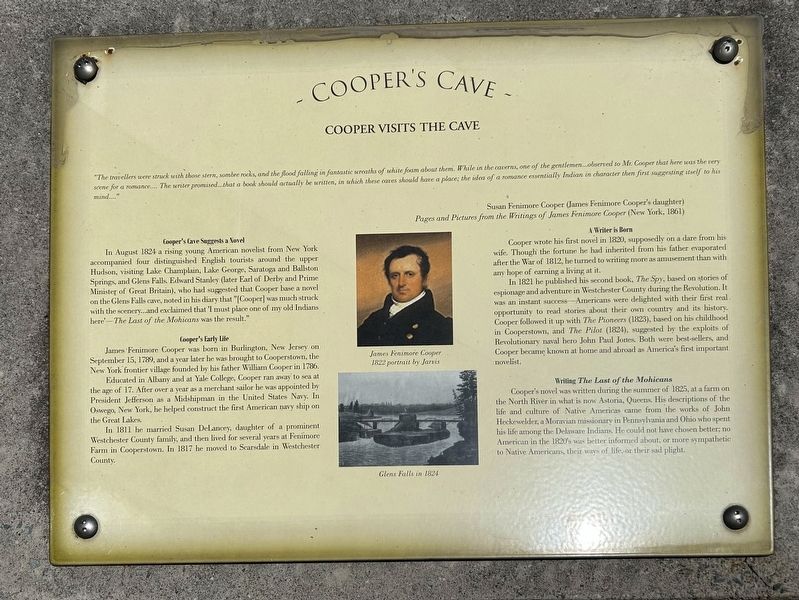
Cooper’s Cave
Cooper Visits the Cave
Photographed by Steve Stoessel, May 26, 2025
1. Cooper’s Cave Marker
"The travellers were struck with those stern, sombre rocks, and the flood falling in fantastic wreaths of white foam about them. While in the caverns, one of the gentlemen...observed to Mr. Cooper that here was the very scene for a romance.... The writer promised...that a book should actually be written, in which these caves should have a place; the idea of a romance essentially Indian in character then first suggesting itself to his mind...
Susan Fenimore Cooper (James Fenimore Cooner's daughter)
Pages and Pictures from the Writings of James Fenimore Cooper (New York, 1861)
Cooper's Cave Suggests a Novel
In August 1824 a rising young American novelist from New York accompanied four distinguished English tourists around the upper Hudson, visiting Lake Champlain, Lake George, Saratoga and Ballston Springs, and Glens Falls. Edward Stanley (later Earl of Derby and Prime Minister of Great Britain), who had suggested that Cooper base a novel on the Glens Falls cave, noted in his diary that "[Cooper] was much struck with the scenery...and exclaimed that'I must place one of my old Indians here'— The Last of the Mohicans
this page online
Cooper's Early Life
James Fenimore Cooper was born in Burlington, New Jersey on September 15, 1789, and a year later he was brought to Cooperstown, the New York frontier village founded by his father William Cooper in 1786.
Educated in Albany and at Yale College, Cooper ran away to sea at the age of 17. After over a year as a merchant sailor he was appointed by President Jefferson as a Midshipman in the United States Navy. In Oswego, New York, he helped construct the first American navy ship on the Great Lakes.
In 1811 he married Susan DeLancey, daughter of a prominent Westchester County family, and then lived for several years at Fenimore Farm in Cooperstown. In 1817 he moved to Scarsdale in Westchester County.
A Writer is Born
Cooper wrote his first novel in 1820, supposedly on a dare from his wife. Though the fortune he had inherited from his father evaporated after the War of 1812, he turned to writing more as amusement than with any hope of earning a living at it.
In 1821 he published his second book, The Spy, based on stories of espionage and adventure in Westchester County during the Revolution. It was
Photographed by Steve Stoessel, May 26, 2025
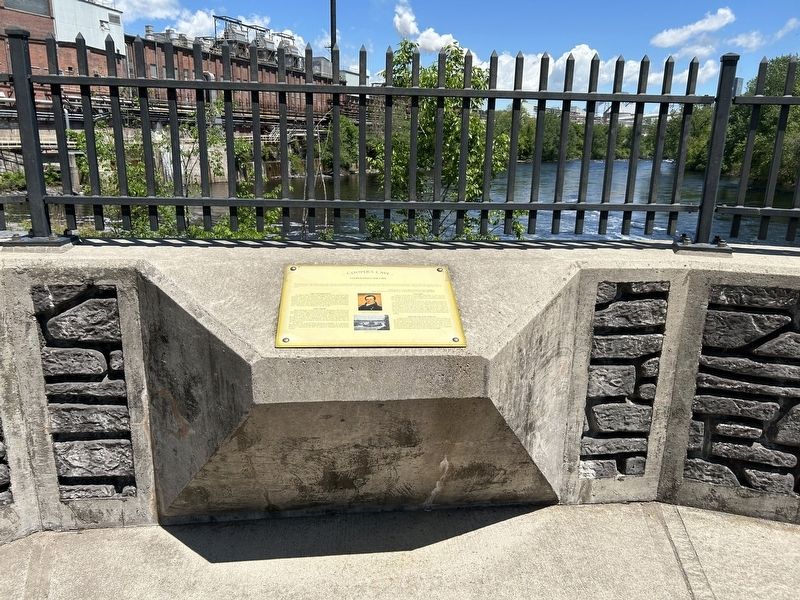
2. Cooper’s Cave Marker
Writing The Last of the Mohicans
Cooper's novel was written during the summer of 1825, at a farm on the North River in what is now Astoria, Queens. His descriptions of the life and culture of Native Americas came from the works of John Heckewelder, a Moravian missionary in Pennsylvania and Ohio who spent his life among the Delaware Indians. He could not have chosen better; no American in the 1820's was better informed about, or more sympathetic to Native Americans, their ways of life, or their sad plight.
Topics. This historical marker is listed in this topic list: Arts, Letters, Music. A significant historical month for this entry is August 1824.
Location. 43° 18.351′ N, 73° 38.437′ W. Marker is in South Glens Falls, New York,
Photographed by Steve Stoessel, May 26, 2025
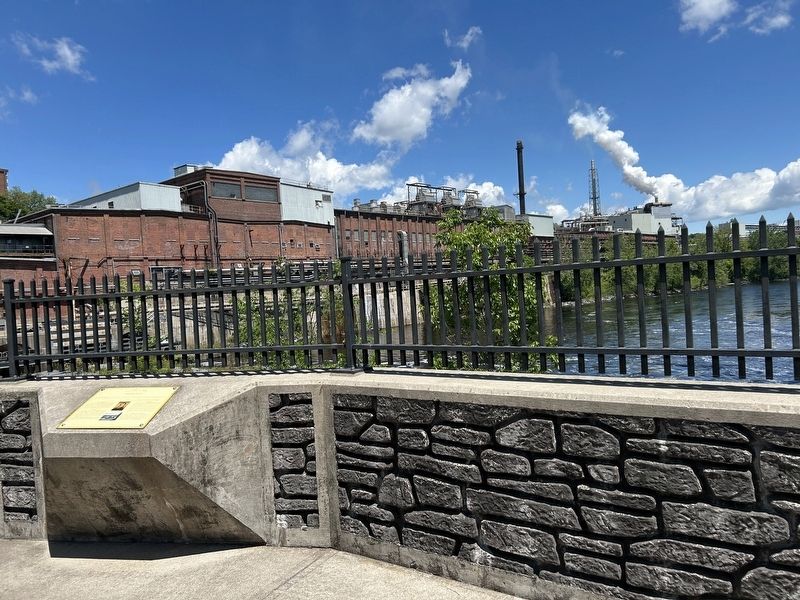
3. A View from the Overlook.

Regionally, this marker is in Upstate New York, in the Capital District, and in the Albany Metropolitan Area. It is also in the American Northeast and in the Mid-Atlantic. Globally, it is in North America, the Great North Woods, the Western Hemisphere, the Western World, and the Anglosphere. Historically, it finds itself in what was once New Netherland and also one of the original Thirteen Colonies.
Other nearby markers. At least 8 other markers are within walking distance of this marker: A different marker also named Cooper’s Cave (here, next to this marker); a different marker also named Cooper’s Cave (here, next to this marker); a different marker also named Cooper’s Cave (a few steps from this marker); a different marker also named Cooper’s Cave (a few steps from this marker); a different marker also named Cooper’s Cave (a few steps from this marker); Glens Falls and James Fenimore Cooper (within shouting distance of this marker); The Mohican Nation – Yesterday and Today (within shouting distance of this marker); a different marker also named Cooper’s Cave (within shouting distance of this marker). Touch for a list and map of all markers in South Glens Falls.
Also see . . . James Fenimore Cooper (Wikipedia). (Submitted on May 28, 2025, by Steve Stoessel of Niskayuna, New York.)
Credits. This page was last revised on May 28, 2025. It was originally submitted on May 28, 2025, by Steve Stoessel of Niskayuna, New York. This page has been viewed 123 times since then and 20 times this year. Photos: 1, 2, 3. submitted on May 28, 2025, by Steve Stoessel of Niskayuna, New York.
