Evanston in Cook County, Illinois — The American Midwest (Great Lakes)
The Battle Cloister
World War I

Photographed by Sean P. Flynn, May 25, 2025
1. The Battle Cloister
The stone in front of the cloister was dedicated nearby on Armistice Day 1921 in front of an elm tree dedicated to the church's World War I veterans.
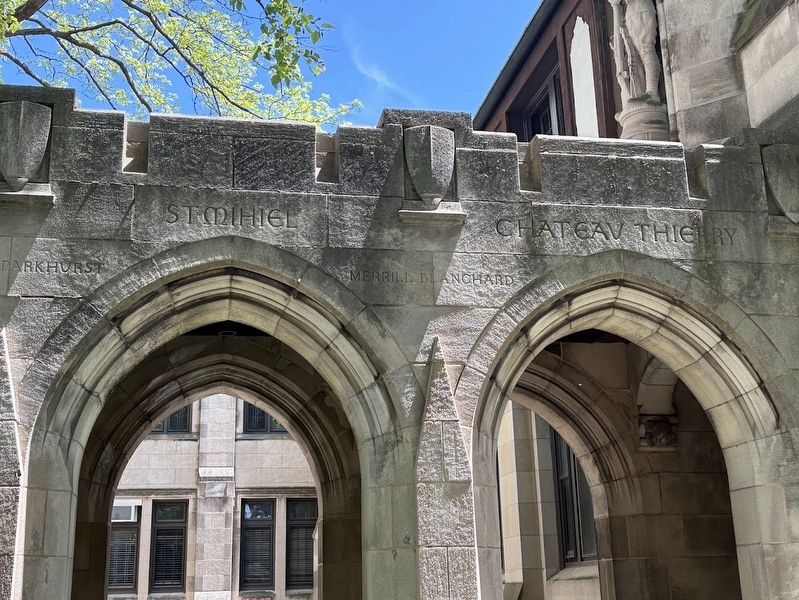
Catigny • Belleau • Argonne • St. Mihiel • Chateau Thierry
Warren C. Hauser • Francis Poole • Lawrence Tower • Frank B. Parkhurst • Merrill Blanchard
Erected 1920 by St. Luke's Episcopal Church.
Topics. This memorial is listed in these topic lists: Religion & Religious Structures • War, World I.
Location. 42° 2.118′ N, 87° 40.663′ W. Memorial is in Evanston, Illinois, in Cook County. It is on Hinman Avenue south of Lee Street, on the left when traveling south. The cloister extends south from the St. Luke's Epsicopal Church building. Touch for map. Memorial is at or near this postal address: 939 Hinman Avenue, Evanston IL 60202, United States of America. Touch for directions.

Regionally, this memorial is in Greater Chicago. It is also in the American Midwest. Globally, it is in North America, on the Great Lakes, in the Western Hemisphere, in the Western World, and in the Anglosphere. Historically, it finds itself in what was once the Viceroyalty of New France, the territory of the Mississippian Culture, and the Northwest Territory.
Other nearby markers. At
this page online
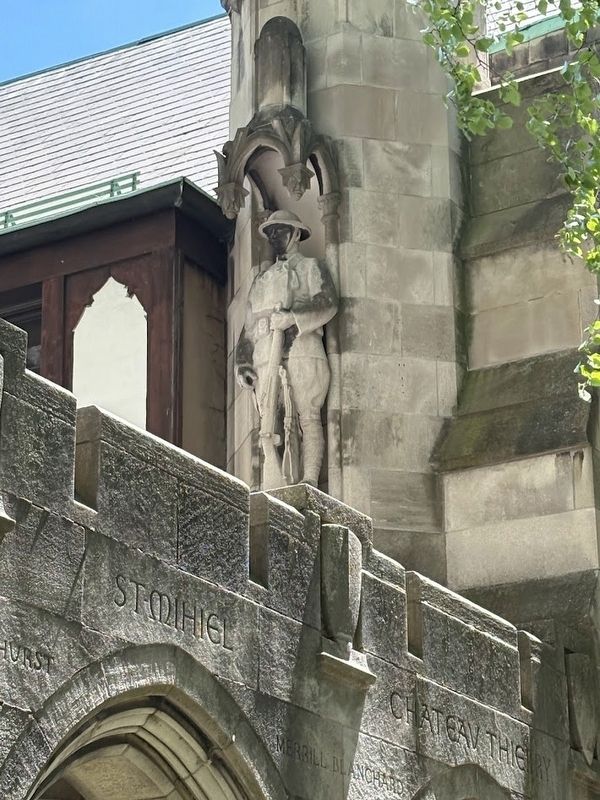
More about this memorial. According to the church, this "battle cloister" was designed by prominent Evanston-based architect Thomas Tallmadge in 1920. The names of the battles and war dead are etched into the top of the archway, which runs south from the main church building. Above the end of the archway is a statue of a World War I "doughboy" standing guard with a rifle at his foot, held by his left hand.
Also see . . . St. Luke's Evanston history.
Excerpt: “Based on designs in the English Gothic Revival style by architect John Sutcliffe, the church was built in stages beginning in 1906. The first(Submitted on May 29, 2025, by Sean P. Flynn of Oak Park, Illinois.)stage consisted of the foundations for the twelve piers of the nave, together with the walls and a low roof at ten feet. The second stage in 1909 added the chancel foundation (space around the altar, including the choir and the sanctuary), ten more feet to the walls, and the 'Lady Chapel' in the northwest corner. When the third stage in 1914 was completed, bringing the walls and piers to their present height, St. Luke’s became the largest church building in the diocese. Based on designs by architect Thomas Tallmadge, the 'Battle Cloister' (interior courtyard or Garth) and Parish House were built added in 1920.”Photographed by Sean P. Flynn, May 25, 20252. St. Luke's Episcopal and its "battle cloister"The "battle cloister" extends south from the main church building.
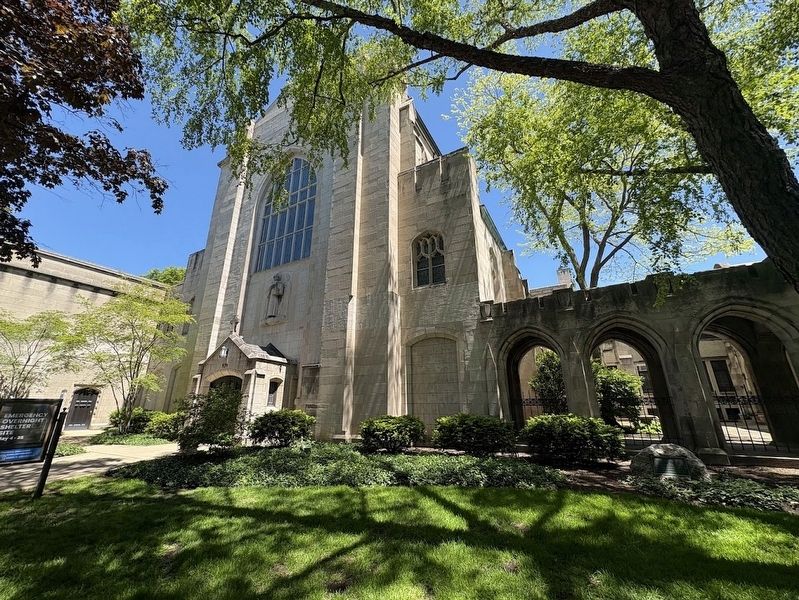
Photographed by Sean P. Flynn, May 25, 2025
3. The Battle Cloister's doughboy statue
A doughboy statue stands above the end of the cloister.
Photographed by Sean P. Flynn, May 25, 2025
4. The Battle Cloister
The names of the church's World War I dead are etched below the names of major WWI battles involving American troops.

Courtesy of Chicago History Museum
5. Warren C. Hauser (1890-1918)
Warren Hauser served as a private in Company A of the 27th Illinois Engineers during World War I. On his draft registration card filed in 1917, Hauser listed his home address as 722 Monroe in Evanston, about 6 blocks southwest of this church. However, he listed his job as "railroad construction" in Harrisburg, Illinois, a town about 315 miles south of Evanston. Hauser died in France on March 15, 1918, at the age of 27. According to a casualty list printed in the Chicago Tribune three days later, Hauser died of disease. Hauser was originally buried near where he died in France, but his body was later disinterred and reburied at Arlington National Cemetery. This image of Hauser is preserved by the Chicago History Museum in a collection of photographs of Chicago-area servicemembers who died in World War I.
Credits. This page was last revised on June 1, 2025. It was originally submitted on May 29, 2025, by Sean P. Flynn of Oak Park, Illinois. This page has been viewed 143 times since then and 26 times this year. Photos: 1, 2, 3, 4, 5. submitted on May 29, 2025, by Sean P. Flynn of Oak Park, Illinois.
