Odenton in Anne Arundel County, Maryland — The American Northeast (Mid-Atlantic)
At the End of the Road
A Look Back into African American History
Photographed by Pete Skillman, May 29, 2025
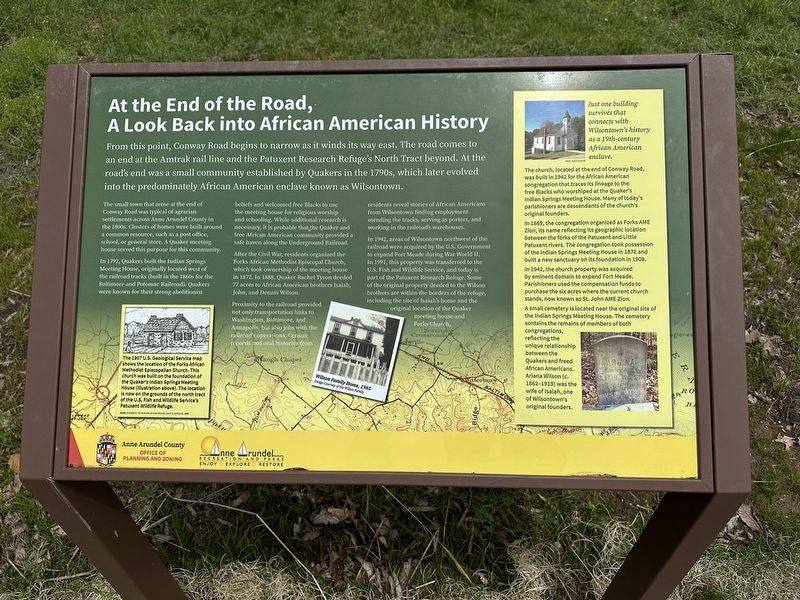
1. At the End of the Road Marker
From this point, Conway Road begins to narrow as it winds its way east. The road comes to an end at the Amtrak rail line and the Patuxent Research Refuge's North Tract beyond. At the road's end was a small community established by Quakers in the 1790s, which later evolved into the predominately African American enclave known as Wilsontown.
The small town that arose at the end of Conway Road was typical of agrarian settlements across Anne Arundel County in the 1800s. Clusters of homes were built around a common resource, such a post office, school, or general store. A Quaker meeting house served this purpose for this community.
In 1792, Quakers built the Indian Springs Meeting House, originally located west of the railroad tracks (built in the 1860s for the Baltimore and Potomac Railroad). Quakers were known for their strong abolitionist beliefs and welcomed free Blacks to use the meeting house for religious worship and schooling. While additional research is necessary, it is probable that the Quaker and free African American community provided a safe haven along the Underground Railroad.
After the Civil War,
this page online
Proximity to the railroad provided not only transportation links to Washington, Baltimore, and Annapolis, but also jobs with the railroad's operations. Census records and oral histories from residents reveal stories of African Americans from Wilsontown finding employment mending the tracks, serving as porters, and working in the railroad's warehouses.
In 1942, areas of Wilsontown northwest of the railroad were acquired by the U.S. Government to expand Fort Meade during World War II. In 1991, this property was transferred to the U.S. Fish and Wildlife Service, and today is part of the Patuxent Research Refuge. Some of the original property deeded to the Wilson brothers are within the borders of the refuge, including the site of Isaiah's home and the original location of the Quaker meeting house and Forks Church.
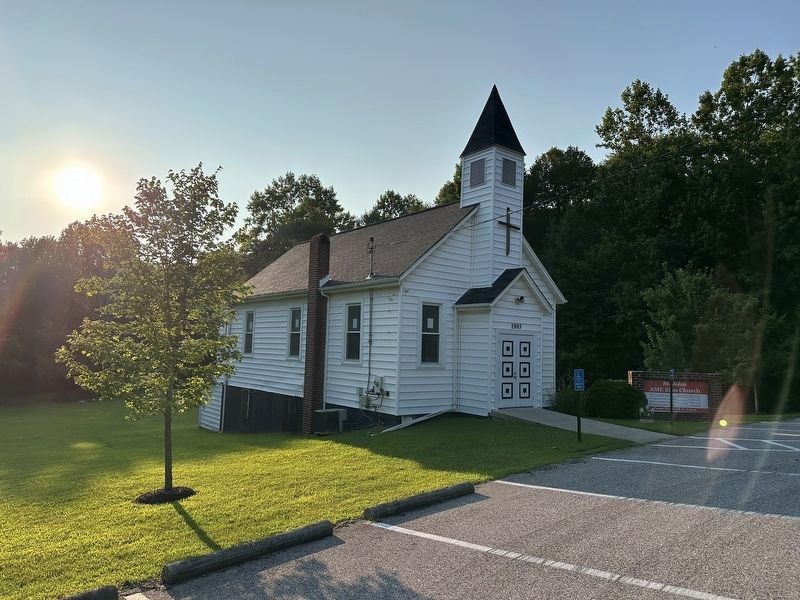
Just one building survives that connects with Wilsontown's history as a 19th-century African American enclave.
The
Photographed by Pete Skillman, May 29, 2025
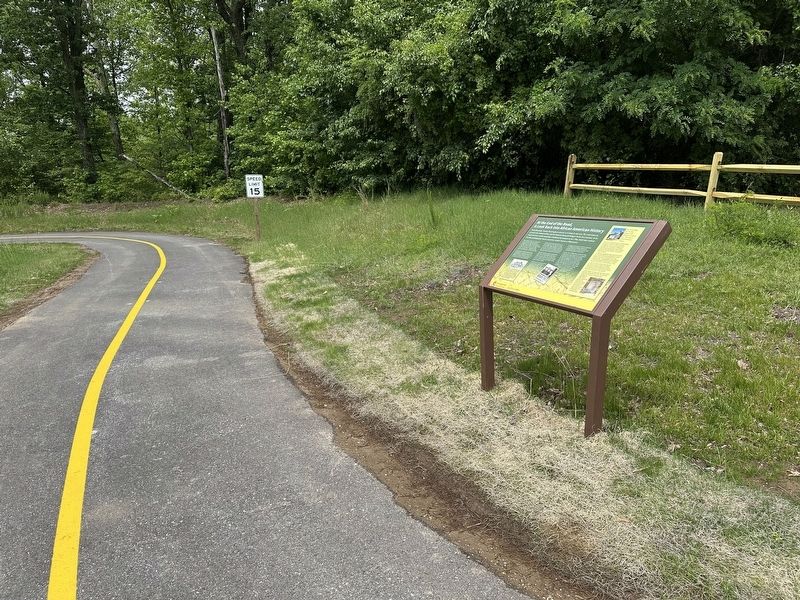
2. At the End of the Road Marker - wide view
In 1869, the congregation organized as Forks AME Zion, its name reflecting its geographic location between the forks of the Patuxent and Little Patuxent rivers. The congregation took possession of the Indian Springs Meeting House in 1872 and built a new sanctuary on its foundation in 1908.
In 1942, the church property was acquired by eminent domain to expand Fort Meade. Parishioners used the compensation funds to purchase the six acres where the current church stands, now known as St. John AME Zion.
A small cemetery is located near the original site of the Indian Springs Meeting House. The cemetery contains the remains of members of both congregations, reflecting the unique relationship between the Quakers and freed African Americans. Ariana Wilson (c. 1862-1919) was the wife of Isaiah, one of Wilsontown's original founders.
(Captions):
The 1907
Photographed by Pete Skillman, July 23, 2025
3. At the End of the Road Marker - St. John AME Zion Church
IMAGE: Quakers in the Founding of Anne Arundel County, Maryland, 1963
Wilson Family Home, 1965
Image Courtesy of the Wilson Family
Erected 2021 by Anne Arundel County Office of Planning and Zoning & Anne Arundel County Recreation and Parks.
Topics and series. This historical marker is listed in these topic lists: African Americans • Railroads & Streetcars • Religion & Religious Structures • Settlements & Settlers. In addition, it is included in the African Methodist Episcopal Zion (AME Zion) Church, and the Quakerism series lists. A significant historical year for this entry is 1792.
Location. 39° 1.804′ N, 76° 44.152′ W. Marker is in Odenton, Maryland, in Anne Arundel County. It is on Conway Road, on the left when traveling west. Touch for map. Marker is at or near this postal address: 2882 Conway Rd, Odenton MD 21113, United States of America. Touch for directions.

Regionally, this marker is in Central Maryland. It is also in the American Mid-Atlantic and on the Eastern Seaboard. Globally, it is in the North Atlantic Region, North America, the Western Hemisphere, the Western World, and the Anglosphere. Historically, it finds itself in what was once one of the original Thirteen Colonies and also the Antebellum South.
Other nearby markers. At least 8 other markers are within 4 miles of this marker, measured as the crow flies: Wilsontown (approx. ¾ mile away); Benjamin Banneker Hall / Benjamin Banneker (approx. 1½ miles away); Bowie State University (approx. 1.6 miles away); From Huntington to Bowie - The History (approx. 2.8 miles away); The Bowie Caboose (approx. 2.8 miles away); Bowie Railroad Station Museum (approx. 2.8 miles away); Sacred Heart Chapel - White Marsh (approx. 3.3 miles away); Birthplace of Johns Hopkins (approx. 3.3 miles away).
Other markers no longer nearby. The Bowie Caboose (was approx. 2.8 miles away but has been confirmed missing); Conservation Leaders (was approx. 3.3 miles away but has been confirmed missing).
Credits. This page was last revised on August 8, 2025. It was originally submitted on May 29, 2025, by Pete Skillman of Wilmington, Delaware. This page has been viewed 221 times since then and 40 times this year. Photos: 1, 2. submitted on May 29, 2025, by Pete Skillman of Wilmington, Delaware. 3. submitted on July 23, 2025, by Pete Skillman of Wilmington, Delaware.
