Bremen-Mitte in Mitte, Germany — Central Europe
Der Schütting
Photographed by Andrew Ruppenstein, May 18, 2025
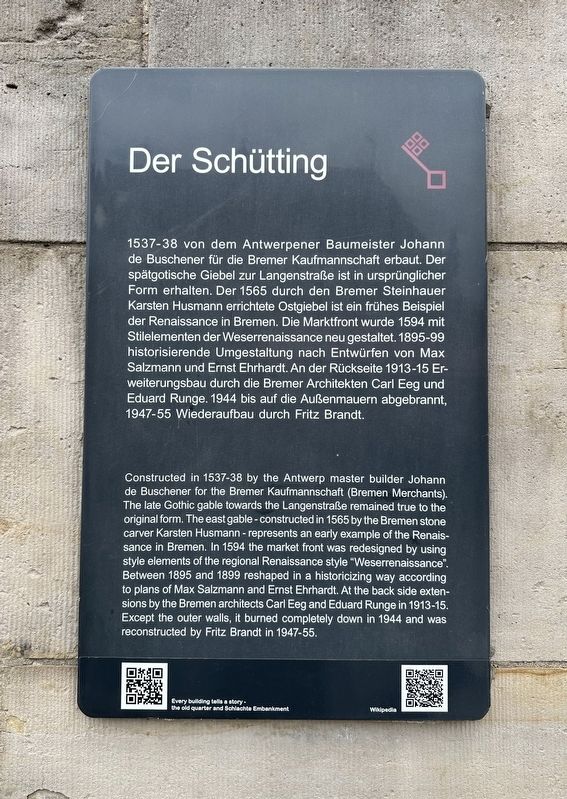
1. Der Schütting Marker

Constructed in 1537-38 by the Antwerp master builder Johann de Buschener for the Bremer Kaufmannschaft (Bremen Merchants). The late Gothic gable towards the Langenstraße remained true to the original form. The east gable-constructed in 1565 by the Bremen stone carver Karsten Husmann - represents an early example of the Renaissance in Bremen. In 1594 the market front was redesigned by using style elements of the regional Renaissance style "Weserrenaissance". Between 1895 and 1899 reshaped in a historicizing way according to plans of Max Salzmann and Ernst Ehrhardt. At the back
this page online
Topics and series. This historical marker is listed in these topic lists: Architecture • Industry & Commerce. In addition, it is included in the Bremen Red Key series list. A significant historical year for this entry is 1565.
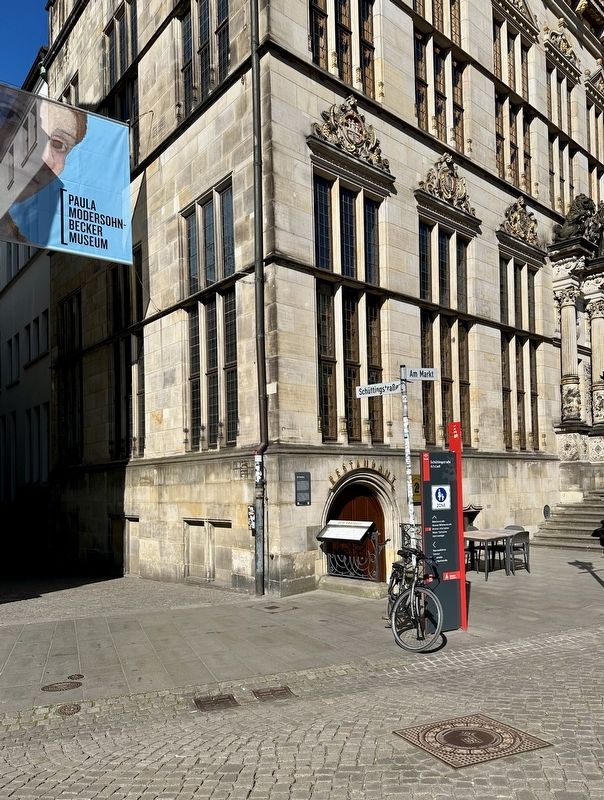
Location. 53° 4.535′ N, 8° 48.407′ E. Marker is in Bremen, in Mitte. It is in Bremen-Mitte. It is at the intersection of Am Markt and Schüttingstrasse on Am Markt. Touch for map. Marker is at or near this postal address: Am Markt 1, Bremen 28195, Germany. Touch for directions.

Regionally, it is in Europe, the European Union, Atlantic Europe, Central Europe, the Schengen Area, Western Europe, and the Western World. Historically, it finds itself in what was once the Holy Roman Empire.
Other nearby markers. At least 8 other markers are within walking distance of this marker: St. Petrus / Saint Peter (a few steps from this marker); Sparkasse am Markt / Savings Bank on Market Square (within shouting distance of this marker); Haus der Bürgerschaft / Parliament Building (within shouting distance of this marker); Spitzen Gebel / “Pointed Gable”
Photographed by Andrew Ruppenstein, May 19, 2025
2. Der Schütting Marker - wide view
Also see . . . Schütting (Bremen) (Wikipedia). Overview, wartime damage and repair, coffee:
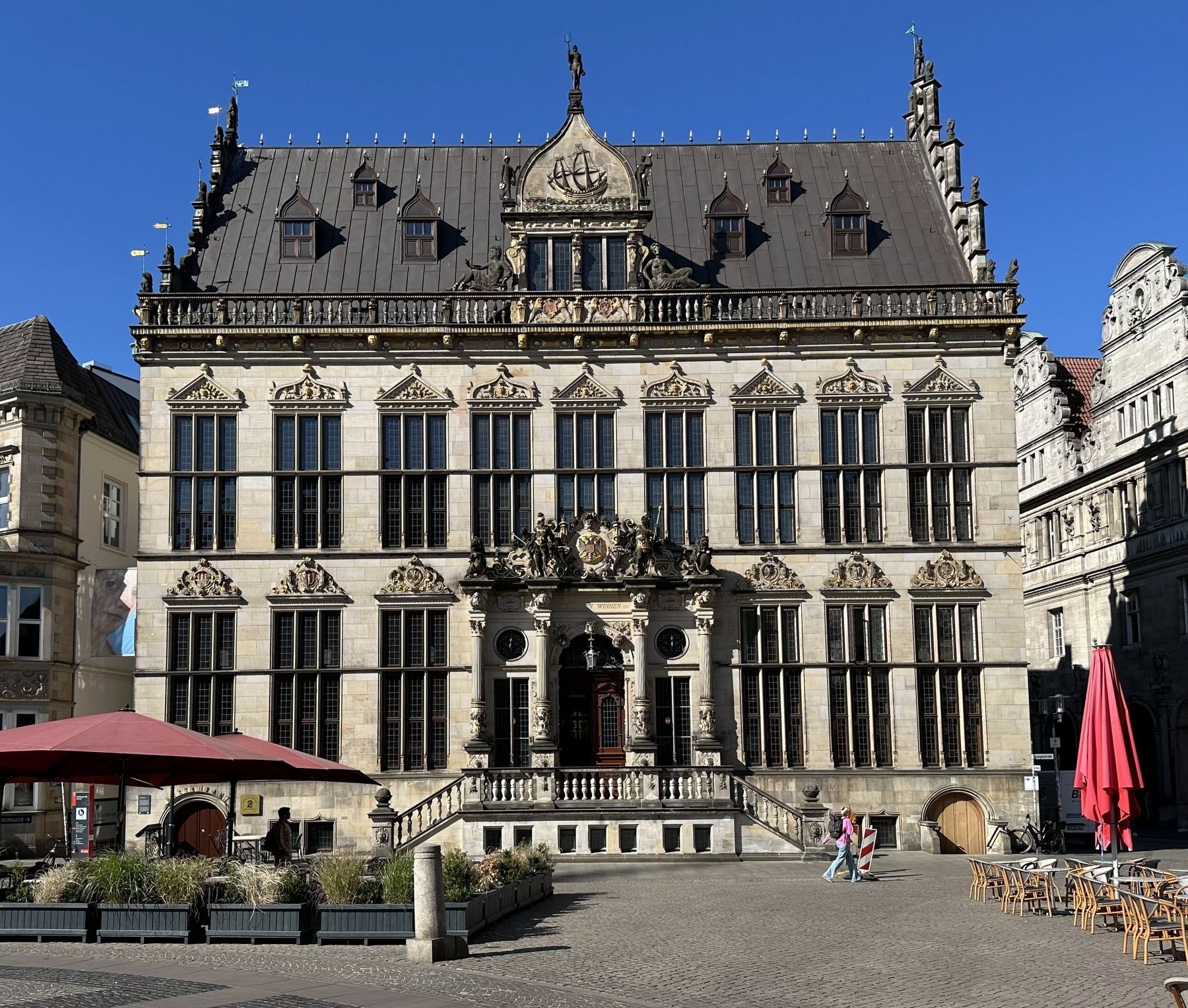
The Schütting, situated on the Marktplatz (market square) in Bremen, initially served the city's merchants and tradesmen as a guild house. In 1849, it became Bremen's chamber of commerce. Since 1973, it has been under monument protection. It lies on the south site of the Bremen marketplaces directly across from the town hall.(Submitted on May 30, 2025.)
The building with its magnificent interior and its valuable furnishings burnt to the ground on 6 October 1944. Reconstruction was completed in 1956. Except for the dormers on the façade overlooking the market square, the exterior was rebuilt, as it had been since 1899, while the interior was reconfigured. In 1951, the chamber of commerce moved into the ground floor. The second stage of the reconstruction took placeover the next five years, including the second floor interior. In 2009, the façade and copper-covered roof were repaired and the dormers were rebuilt. The firm which performed the work received an award in 2010 from the Landesamt für Denkmalspflege (State of Bremen office for the preservation of monuments and historic buildings).Photographed by Andrew Ruppenstein, May 19, 20253. Der Schütting and marker
The first coffee house in the German-speaking countries came into being in Bremen in 1673. Its exact location is not known, but from 1679 onwards, it was located in the Schütting.
Photographed by Andrew Ruppenstein, May 19, 2025
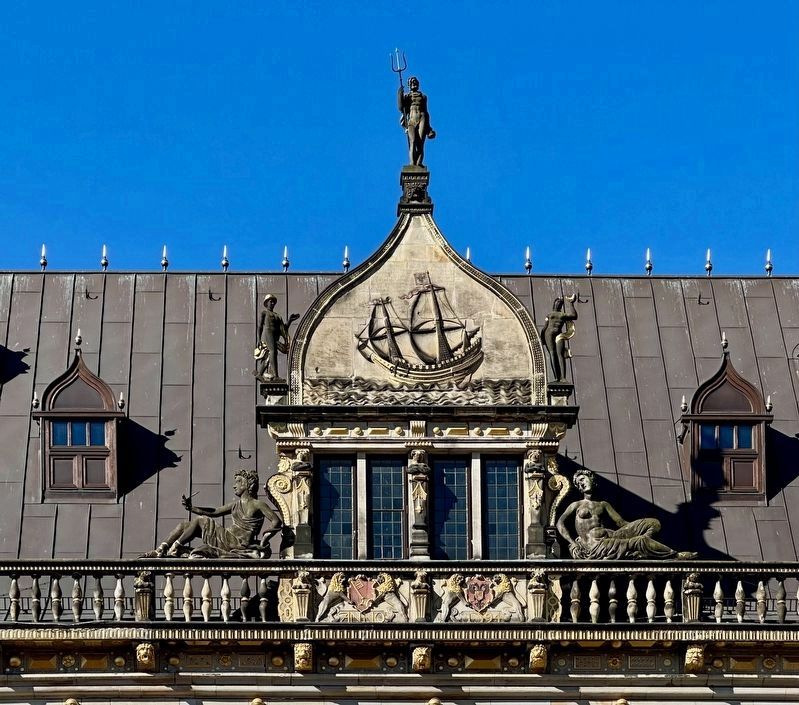
4. Der Schütting - maritime gable
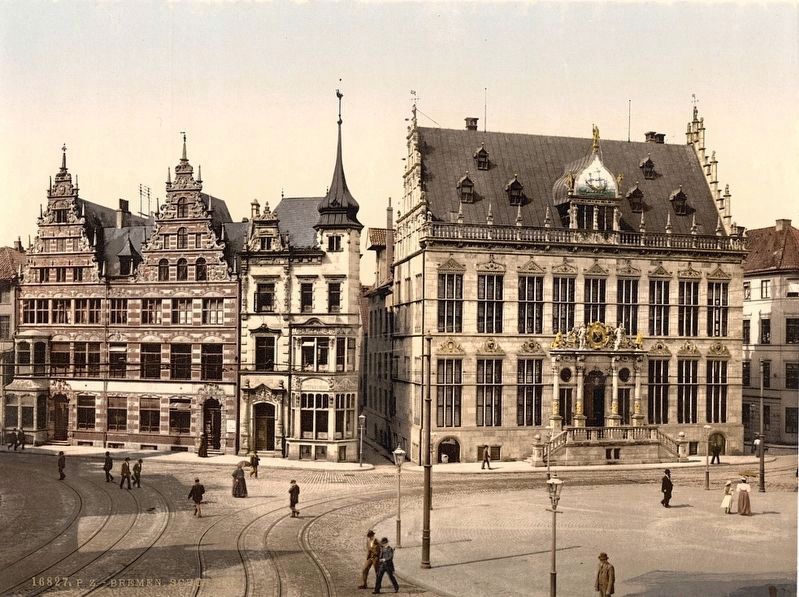
Detroit Publishing Co. (courtesy Library of Congress), circa 1900
5. Schutting, Bremen
Credits. This page was last revised on May 30, 2025. It was originally submitted on May 30, 2025, by Andrew Ruppenstein of Lamorinda, California. This page has been viewed 138 times since then and 26 times this year. Photos: 1, 2, 3, 4, 5. submitted on May 30, 2025, by Andrew Ruppenstein of Lamorinda, California.
