
Borden in Simcoe County, Ontario — Central Canada (North America)
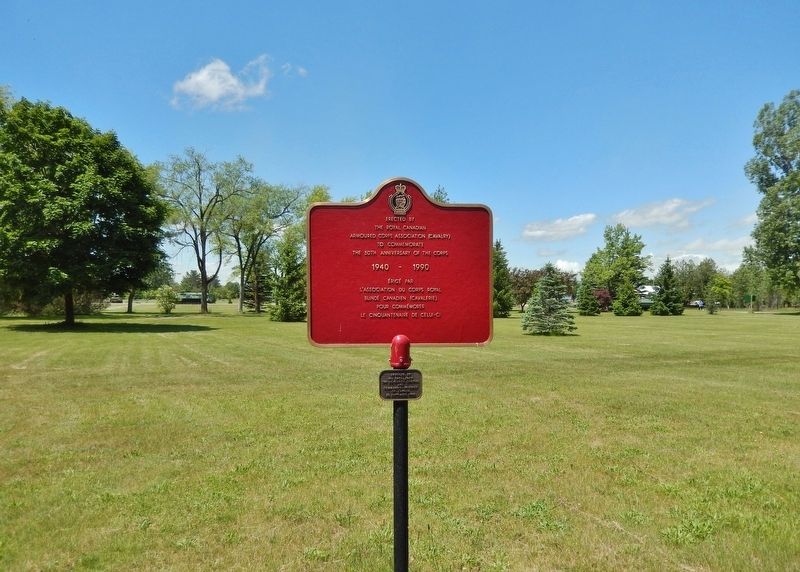
Canadian Armoured Corps 50th Anniversary
1940 — 1990

Photographed by Cosmos Mariner, June 6, 2024
1. Canadian Armoured Corps 50th Anniversary Marker

Erected 1990 by Royal Canadian Armoured Corps Association.
Topics. This historical marker is listed in this topic list: Military. A significant historical year for this entry is 1940.
Location. 44° 17.276′ N, 79° 53.487′ W. Marker is in Borden, Ontario, in Simcoe County. It can be reached from Dieppe Road just south of Gibraltar Road, on the right when traveling south. The marker is located near the northeast corner of Worthington Memorial Park at Canadian Forces Base Borden. Touch for map. Marker is in this post office area: Borden ON L0M 0B1, Canada. Touch for directions.

Regionally, this marker is in Central Ontario Cottage Country and specifically in Georgian Bay Country. It is also in Central Canada. Globally, it is in North America, on the Great Lakes, in the Western Hemisphere, in the Western World, and in the Anglosphere. Historically, it
this page online
Other nearby markers. At least 8 other markers are within walking distance of this marker: Canadian Tank School 50th Anniversary (a few steps from this marker); United States M5A1 "Stuart" Light Tank / Char léger américain M5A1 Stuart (within shouting distance of this marker); Worthington Park Memorial (within shouting distance of this marker); British Centurion MK5 Main Battle Tank / Char de combat principal britannique Centurion MK5 (within shouting distance of this marker); British Armoured Recovery Vehicle (ARV) MKII / Véhicule blindé de dépannage britannique (VBD) MKII (within shouting distance of this marker); Sherman Crab Mine Flail / Fléau de Déminage du Sherman Crab (within shouting distance of this marker); British Churchill Infantry Tank MK IV / Char d'infanterie britannique Churchill MK IV (about 90 meters away, measured in a direct line); Mine Plow / Charrue de Déminage (about 120 meters away). Touch for a list and map of all markers in Borden.
Also see . . .
1. Royal Canadian Armoured Corps (Wikipedia).

Photographed by Cosmos Mariner, June 6, 2024
2. Canadian Armoured Corps 50th Anniversary Marker
30 September 1990
Excerpt: The modern Canadian Armoured Corps began on 13 August 1940 with Major-General (then Colonel) F. F. Worthington as its first colonel-commandant. Over the course of the war from 1939 to 1944, the Armoured Corps gradually took over responsibilities from other corps, such as tank regiments all being converted to armoured regiments, the transition of infantry reconnaissance battalions to the Armoured Corps, as well as anti-armour responsibilities from the Artillery Corps. Towards the close of the Second World War, the corps was subsequently bestowed the honour of the “royal” designation by King George VI in 1945.(Submitted on May 31, 2025, by Cosmos Mariner of Cape Canaveral, Florida.)
Initially its equipment was 219 US M1917 tanks – a First World War design – obtained at scrap prices. They were sufficient for some training and familiarisation, but otherwise of very limited combat use. Events of the Second World War thrust Canada into large scale tank production with thousands of Valentine, Ram, and Grizzly (Sherman) tanks and their armoured variants being produced. Canada also went on to build modern armoured fighting vehicles that served during the Cold War, the War in Afghanistan and global peacekeepingoperations.Photographed by Cosmos Mariner, June 6, 20243. Canadian Armoured Corps 50th Anniversary MarkerLooking west across Worthington Park, Canadian Forces Base Borden.
2. Canadian Forces Base Borden (Wikipedia).
Excerpt: The historic birthplace of the Royal Canadian Air Force, CFB Borden is home to the largest training wing in the Canadian Armed Forces. At the height of the First World War, the Borden Military Camp opened at a location on a glacial moraine west of Barrie in 1916 to train units for the Canadian Expeditionary Force. During the inter-war period, the aerodrome was used for veteran pilot refresher training by the Canadian Air Force (CAF), a part-time, non-permanent air militia. This militia training scheme began in July 1920 and ended in March 1922. Although this training had ended, the CAF continued, reorganized, and eventually evolved into the Royal Canadian Air Force (RCAF). Camp Borden's training grounds were expanded in 1938 to house the Canadian Tank School. During the Second World War, both Camp Borden and RCAF Station Camp Borden became the most important training facility in Canada, housing both army training and flight training.(Submitted on May 31, 2025, by Cosmos Mariner of Cape Canaveral, Florida.)
Credits. This page was last revised on June 1, 2025. It was originally submitted on May 30, 2025, by Cosmos Mariner of Cape Canaveral, Florida. This page has been viewed 103 times since then and 23 times this year. Photos: 1, 2, 3. submitted on May 31, 2025, by Cosmos Mariner of Cape Canaveral, Florida.
