Preston in Lancashire, England, United Kingdom — Northwestern Europe (the British Isles)
Preston Station
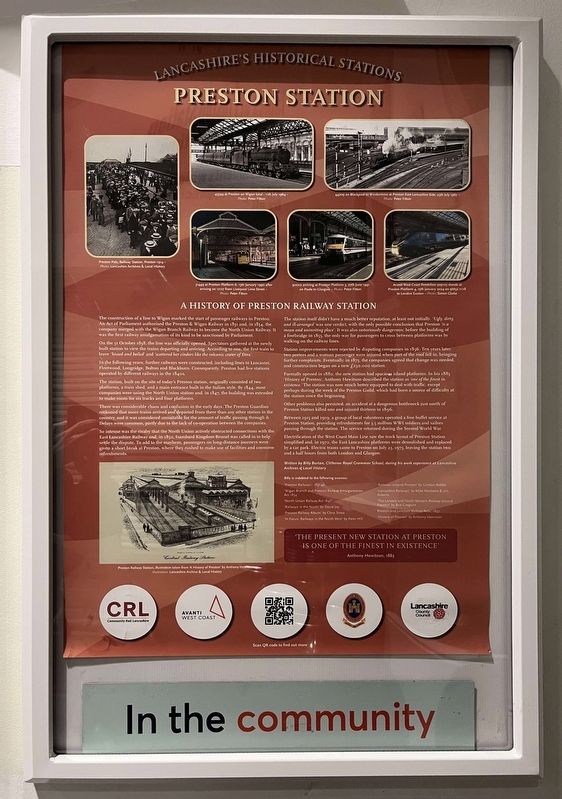
A History of Preston Railway Station
Photographed by Ray Gurganus, April 11, 2025
1. Preston Station Marker
On the 31 October 1838, the line was officially opened. Spectators gathered at the newly built station to view the trains departing and arriving. According to one, the first train to leave 'hissed and boiled' and 'scattered her cinders like the volcanic crater of Etna'.
In the following years, further railways were constructed. including lines to Lancaster. Fleetwood, Longridge, Bolton and Blackburn. Consequently, Preston had five stations operated by different railways in the 1840s.
The station, built on the site of today's Preston station, originally consisted of two platforms, a train shed, and a main entrance built in the Italian style. By 1844, most companies were using the North Union station and, in 1847, the building was extended to make room for six tracks and four platforms.
There
this page online
So intense was the rivalry that the North Union actively obstructed connections with the East Lancashire Railway and, in 1852, Isambard Kingdom Brunel was called in to help settle the dispute. To add to the mayhem, passengers on long-distance journeys were given a short break at Preston, where they rushed to make use of facilities and consume refreshments.
The station itself didn't have a much better reputation, at least not initially. 'Ugly, dirty, and ill-arranged' was one verdict, with the only possible conclusion that Preston is a mean and uninviting place. It was also notoriously dangerous; before the building of a footbridge in 1855, the only way for passengers to cross between platforms was by walking on the railway lines.
Station improvements were rejected by disputing companies in 1856.

Photographed by Ray Gurganus, April 11, 2025
2. Preston Railway Station
Formally opened in 1880. the new station had spacious island platforms. In his 1883 'History of Preston'. Anthony Hewitson described the station as 'one of the finest in existence.' The station was now much better equipped to deal with traffic, except perhaps during the week of the Preston Guild, which had been a source of difficulty at the station since the beginning.
Other problems also persisted; an accident at a dangerous bottleneck just north of Preston Station killed one and injured thirteen in 1896.
Between 1915 and 1919, a group of local volunteers operated a free buffet service at Preston Station, providing refreshments for 3.5 million WWI soldiers and sailors passing through the station. The service returned during the Second World War.
Electrification of the West Coast Main Line saw the track layout of Preston Station simplified and, in 1972, the East Lancashire platforms were demolished and replaced by a car park. Electric trains came to Preston on July 23, 1973, leaving the station two and a half hours from both London and Glasgow.
Topics. This historical marker is listed in this topic list: Railroads & Streetcars. A significant historical year for this entry is 1831.
Location. 53° 45.331′ N, 2° 42.44′ W. Marker is in Preston, England, in Lancashire. It can be reached from Butler Street. On the platform at the Preston railway station. Touch for map. Marker is at or near this postal address: 5 Butler Street, Preston, England PR1 8AP, United Kingdom. Touch for directions.

Regionally, this marker is in North West England. Globally, it is on the Atlantic Ocean, in the North Atlantic Region, in Europe, in Atlantic Europe, on one of the British Isles, in the Western World, and in the Anglosphere. Historically, it finds itself in what was once the Roman Empire.
Other nearby markers. At least 8 other markers are within walking distance of this marker: The Royal Naval Train "Jellicoe Express" (within shouting distance of this marker); Edith Rigby 1872-1950 (approx. 0.3 kilometers away); Holy Child Jesus Convent and School (approx. 0.3 kilometers away); The Swiss Chalet (approx. 0.4 kilometers away); South African War Memorial (approx. 0.4 kilometers away); Sikh Contribution to World War I and World War II (approx. 0.4 kilometers away); Derby Statue (approx. 0.4 kilometers away); Edmund Rice (approx. 0.4 kilometers away). Touch for a list and map of all markers in Preston.
Credits. This page was last revised on May 31, 2025. It was originally submitted on May 31, 2025, by Ray Gurganus of Washington, District of Columbia. This page has been viewed 125 times since then and 28 times this year. Photos: 1, 2. submitted on May 31, 2025, by Ray Gurganus of Washington, District of Columbia. • Andrew Ruppenstein was the editor who published this page.
Editor’s want-list for this marker. photo of the marker within its surroundings • Can you help?
