Preston in Lancashire, England, United Kingdom — Northwestern Europe (the British Isles)
The Royal Naval Train "Jellicoe Express"
Photographed by Ray Gurganus, April 11, 2025
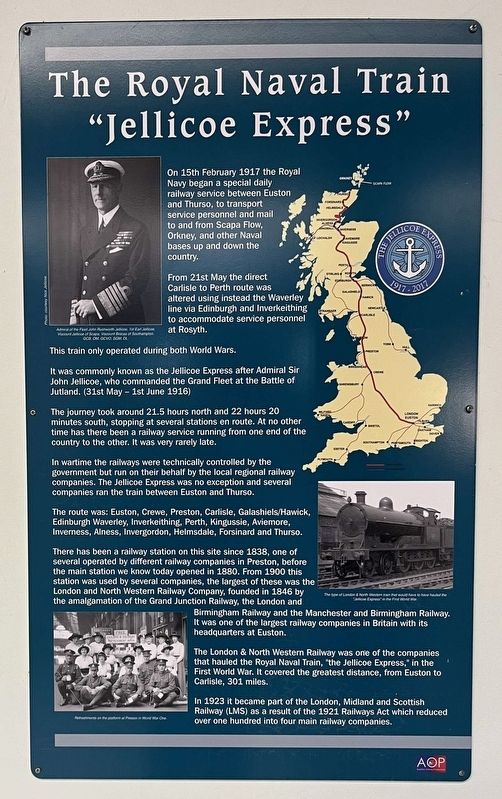
1. The Royal Naval Train "Jellicoe Express" Marker
From 21st May the direct Carlisle to Perth route was altered using instead the Waverley line via Edinburgh and Inverkeithing to accommodate service personnel at Rosyth.
This train only operated during both World Wars.
It was commonly known as the Jellicoe Express after Admiral Sir John Jellicoe, who commanded the Grand Fleet at the Battle of Jutland. (31st May - 1st June 1916)
The journey took around 21.5 hours north and 22 hours 20 minutes south, stopping at several stations en route. At no other time has there been a railway service running from one end of the country to the other. It was very rarely late.
In wartime the railways were technically controlled by the government but run on their behalf by the local regional railway companies. The Jellicoe Express was no exception and several companies ran the train between Euston and Thurso.
The route was: Euston, Crewe, Preston, Carlisle, Galashiels/Hawick, Edinburgh Waverley, Inverkeithing, Perth, Kingussie, Aviemore, Inverness, Alness, Invergordon, Helmsdale, Forsinard and Thurso.
There has been a railway station on this site since 1838, one of several operated by different railway companies in Preston, before the main station we know today opened in 1880. From 1900 this station was used by several companies, the largest of these was the London and North Western Railway Company, founded in 1846 by the amalgamation of the Grand Junction Railway, the London and Birmingham Railway and the Manchester and Birmingham Railway. It was one of the largest railway companies in Britain with its headquarters at Euston.
The London
this page online
In 1923 it became part of the London, Midland and Scottish Railway (LMS) as a result of the 1921 Railways Act which reduced over one hundred into four main railway companies.
Topics. This historical marker is listed in these topic lists: Railroads & Streetcars • War, World I. A significant historical date for this entry is February 15, 1917.
Location. 53° 45.347′ N, 2° 42.427′ W. Marker is in Preston, England, in Lancashire. It can be reached from Fishergate. On the Preston railway station platform. Touch for map. Marker is at or near this postal address: 2.6 Fishergate, Preston, England PR1 8HJ, United Kingdom. Touch for directions.

Regionally, this marker is in North West England. Globally, it is on the Atlantic Ocean, in the North Atlantic Region, in Europe, in Atlantic Europe, on one of the British Isles, in the Western World, and in the Anglosphere. Historically, it finds itself in what was once the Roman Empire.
Other nearby markers. At
Photographed by Ray Gurganus, April 11, 2025
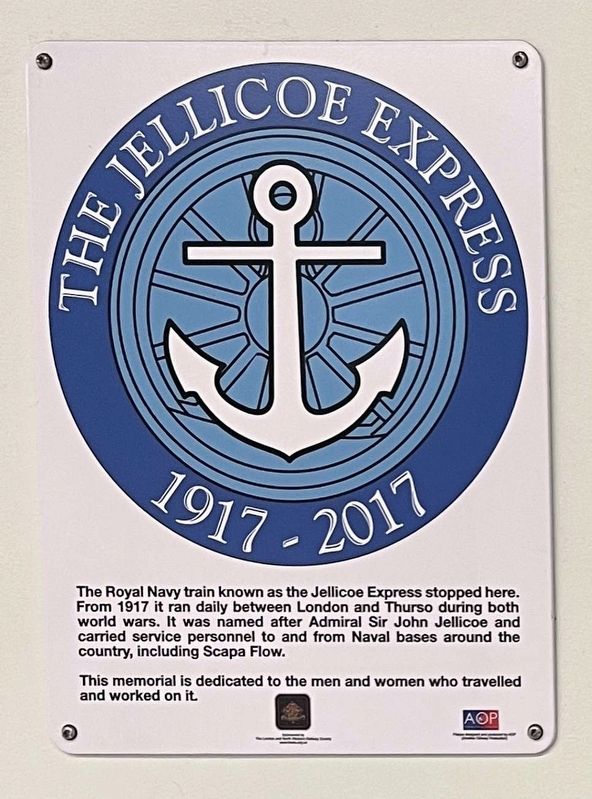
2. The Jellicoe Express
Credits. This page was last revised on May 31, 2025. It was originally submitted on May 31, 2025, by Ray Gurganus of Washington, District of Columbia. This page has been viewed 359 times since then and 162 times this year. Photos: 1, 2. submitted on May 31, 2025, by Ray Gurganus of Washington, District of Columbia. • Andrew Ruppenstein was the editor who published this page.
Editor’s want-list for this marker. photo of the marker within its surroundings • Can you help?
