Central Oklahoma City in Oklahoma County, Oklahoma — The American South (West South Central)
Saint Joseph Old Cathedral

Photographed by Duane and Tracy Marsteller
1. Saint Joseph Old Cathedral Marker
On May 5, 1889, a few days after Oklahoma City was born, a tent was raised on the raw prairie to serve as a grocery store. Under this canvas canopy on California Street, Rev. Nicholas F. Scallan celebrated what is believed to be the first public Mass in Oklahoma City. Two weeks later Father Scallan organized a meeting to establish a new parish, announcing that it would be placed under the patronage of Saint Joseph. Approximately fifty-five Catholic heads of families lived in Oklahoma City as well as a number of young men “without other connections” who settled in the city and
this page online
On May 27, Lots 12, 13 and 14 of block 29 of the original township were purchased on the northeast corner of Fourth Street, between Robinson and Harvey, to be the site for the first Catholic Church in Oklahoma City. On July 1st, the men of the fledgling parish began construction of a twenty-four by sixty-foot frame structure on the top of Blue Hill, so-named because of its famous mantle of small blue flowers. A 650-pound bell, purchased for $101 and still in use, stood on a temporary scaffold until August 2, 1889, when it was hung in the new church belfry. The first Saint Joseph Church, with its sixty-three foot high steeple, was dedicated on August 4, 1889.
Saint Joseph Parish and its booming city grew rapidly. On January 21.1894, the church trustees met with Bishop Theopile Meerschaert, the Vicar Apostolic
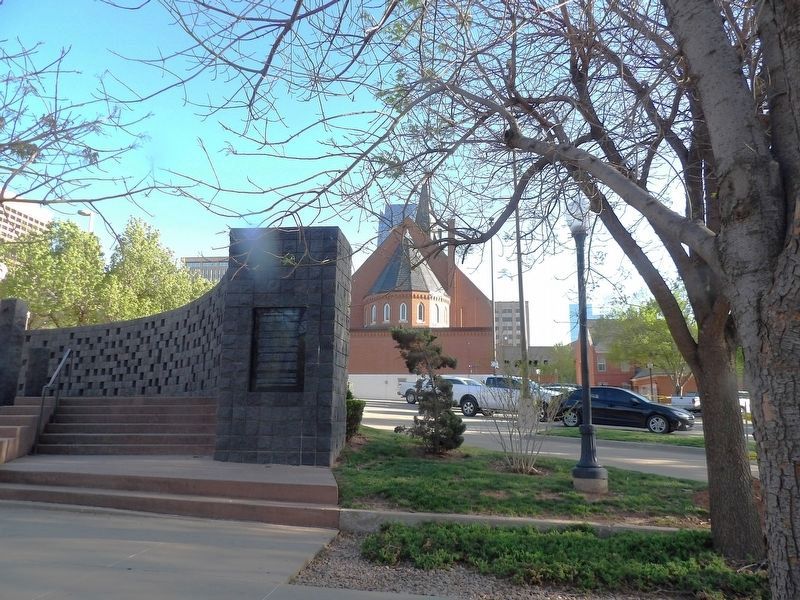
Photographed by Duane and Tracy Marsteller, April 10, 2025
2. Saint Joseph Old Cathedral Marker
The rear of the old cathedral is in the background.
Monsignor Gustave Depreitere, pastor from 1920 to 1951, remodeled the interior of Saint Joseph Cathedral and installed beautiful marble altars imported from Europe. In 1924, Oklahoma's first bishop died and was buried from Saint Joseph Cathedral. Most Reverend Francis C Kelley became the second Bishop of Oklahoma. On November 24, 1930, the Diocese of Oklahoma was renamed the Diocese of Oklahoma City and
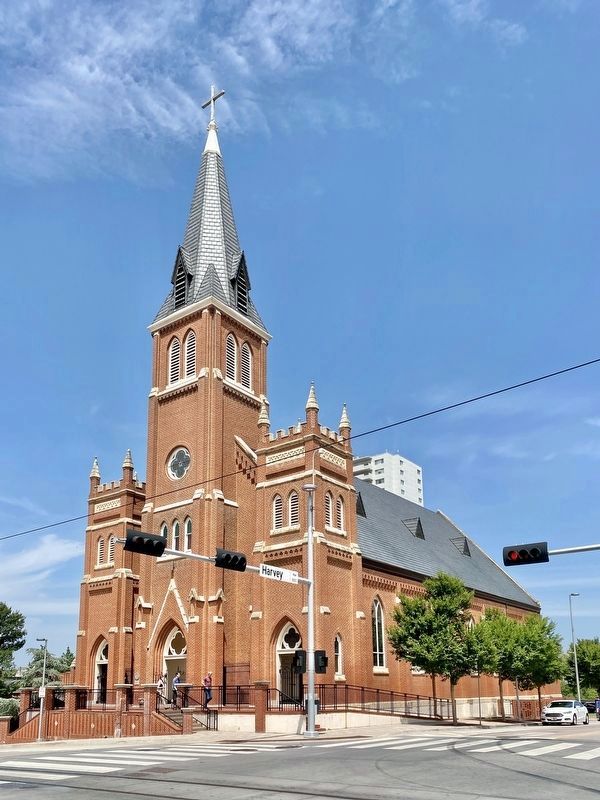
Warren LeMay via Wikimedia Commons (CC BY-SA 2.0), August 9, 2023
3. Saint Joseph Old Cathedral
It was a cathedral – a church that serves as the official seat of a bishop – from 1905 to 1930.
Most Reverend Eugene J. McGuiness became the third Bishop of Oklahoma City and Tulsa. He served the diocese from 1949 to 1957. On March 8, 1958, Most Reverend Victor J. Reed became the fourth Bishop. In 1972, during the pastorate of Monsignor Raymond Harkin, Saint Joseph Old Cathedral was declared a U.S. Historic site, guaranteeing its historic standing in downtown Oklahoma City. A year later, under the direction of Most Reverend John R. Quinn, the Church of Oklahoma was divided into the Archdiocese of Oklahoma City and the Diocese of Tulsa. Bishop Quinn became the first Archbishop of Oklahoma City. While Monsignor A.A. Isenhart was pastor, renovations to Saint Joseph Old Cathedral continued. In 1977, Most Reverend Charles A. Salatka, who served unil 1992, was appointed the second Archbishop of Oklahoma City.
in the early days of Saint Joseph Church, a parish school was established and staffed by Sisters of Mercy with twenty-six pupils in grades one through twelve. The Sisters of Mercy
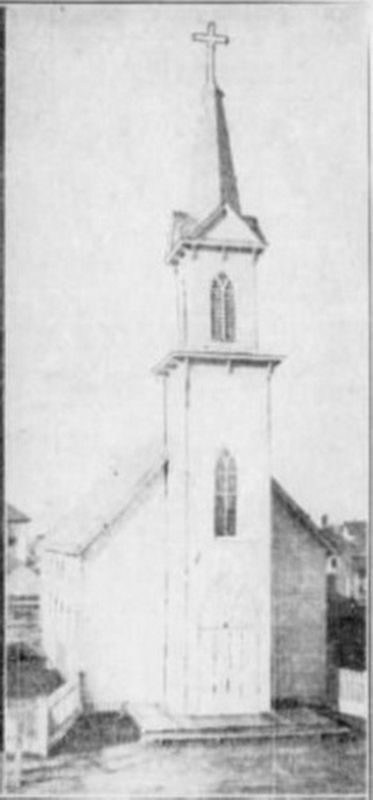
The Oklahoma News, Sept. 13, 1936 via Newspapers.com
4. The original Saint Joseph Church
It was razed in 1905 after the present church was built.
The April 19, 1995, bombing of the Alfred P. Murrah Building resulted in extensive damage to Saint Joseph Old Cathedral. Stained glass windows and many other precious works of art were destroyed or damaged but the standing crucifix on the east wall (dated 1909) withstood the devastating blast, Lesser damage was sustained in the basement museum and its memorial artifacts. The rectory adjacent to the Old Cathedral had to be demolished following the bombing.
Under the direction of Most Reverend Eusebius J. Beltran, the third Archbishop of Oklahoma City and the guidance of Reverend Louis J. Lamb, the pastor, the old cathedral and the office and conference building underwent extensive interior and exterior restoration. A now rectory was built. The cost of the restoration project was $3 million. The restored Saint Joseph Old Cathedral complex was rededicated on December 1, 1996.
This is hallowed ground where people have been publicly worshipping the Lord in the last century and throughout this century. May people of good will continue to worship Him here into the new millennium and in heaven forever!
Topics. This historical marker is listed in these topic lists: Disasters • Religion & Religious Structures • Settlements & Settlers. A significant historical date for this entry is May 5, 1889.
Location. 35° 28.375′ N, 97° 31.086′ W. Marker is in Oklahoma City, Oklahoma, in Oklahoma County. It is in Central Oklahoma City. It is at the intersection of Northwest 5th Street and North Harvey Avenue, on the right when traveling east on Northwest 5th Street. Touch for map. Marker is at or near this postal address: 310 NW 5th St, Oklahoma City OK 73102, United States of America. Touch for directions.

Regionally, this marker is in Central Oklahoma — Frontier Country. It is also in the American South, specifically on the prairies, and on the Southern Plains. Globally, it is in North America, the Western Hemisphere, the Western World, and the Anglosphere. Historically, it finds itself in what was once the territory of the Mississippian Culture and also the Louisiana Purchase.
Other nearby markers. At least 8 other markers are within walking distance of this marker: And Jesus Wept (a few steps from this marker); The Field of Empty Chairs (within shouting distance of this marker); The Fence (within shouting distance of this marker); St. Joseph's Cathedral (about 300 feet away, measured in a direct line); St. Joseph's Church (about 300 feet away); Rescuer Orchard (about 300 feet away); Journal Record Building South Wall (about 300 feet away); Building Occupants (about 300 feet away). Touch for a list and map of all markers in Oklahoma City.
Also see . . . St. Joseph's Church Linked Closely With Growth of City As Father Scallan …. Six o'clock, Deep and clear across the prairies rang the notes of a bell. The Angelus. The call to meditation and evening prayer. Catholic hearts were thrilled at the familiar sound they had not heard since leaving their homes in the spring. That bell which rang the first call to worship in the Oklahoma Territory оп Аug. 2, 1889, is the same bell which now sounds at intervals during the day from the belfry of St. Joseph's Cathedral. (Blanch C. Naylor, The Oklahoma News, Sept. 13, 1936; via Newspapers.com) (Submitted on June 1, 2025, by Duane and Tracy Marsteller of Murfreesboro, Tennessee.)
Credits. This page was last revised on June 1, 2025. It was originally submitted on May 31, 2025, by Duane and Tracy Marsteller of Murfreesboro, Tennessee. This page has been viewed 215 times since then and 71 times this year. Photos: 1, 2, 3. submitted on May 31, 2025, by Duane and Tracy Marsteller of Murfreesboro, Tennessee. 4. submitted on June 1, 2025, by Duane and Tracy Marsteller of Murfreesboro, Tennessee.
