Bremen-Mitte in Mitte, Germany — Central Europe
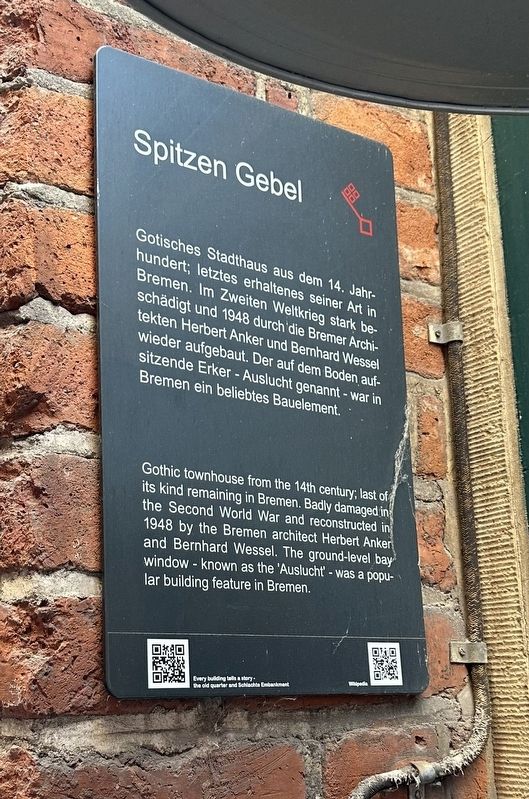
Spitzen Gebel
⎯⎯⎯
“Pointed Gable”
Photographed by Andrew Ruppenstein, May 19, 2025
1. Spitzen Gebel / “Pointed Gable” Marker

Gothic townhouse from the 14th century; last of its kind remaining in Bremen. Badly damaged in the Second World War and reconstructed in 1948 by the Bremen architect Herbert Anker and Bernhard Wessel. The ground-level bay window-known as the 'Auslucht' - was a popular building feature in Bremen.
Topics and series. This historical marker is listed in this topic list: Architecture. In addition, it is included in the Bremen Red Key series list. A significant historical year for this entry is 1948.
Location. 53° 4.509′ N, 8° 48.397′ E. Marker is in Bremen, in Mitte. It is in Bremen-Mitte. It is on Hinter dem Schütting, on the right when traveling north. Touch for map. Marker is at or near this postal address: Hinter dem Schütting 1, Bremen 28195, Germany. Touch for directions.

Regionally, it is in Europe, the European Union, Atlantic Europe, Central Europe, the Schengen Area, Western Europe, and the Western World. Historically, it finds itself in what was once the Holy Roman Empire.
Other nearby markers. At least 8 other markers are within walking distance of this marker: Die Balge / The Balge (here, next to this marker); Paula Becker-Modersohn Haus / Paula Becker-Modersohn House (within shouting distance of this marker); St. Petrus / Saint Peter (within shouting distance of this marker); Haus der Sieben Faulen / House of the Seven Lazy Brothers (within shouting distance of this marker); Haus der Bürgerschaft / Parliament Building (within shouting distance of this marker); Der Schütting
this page online
Also see . . . Spitzen Gebel (Wikipedia). History:
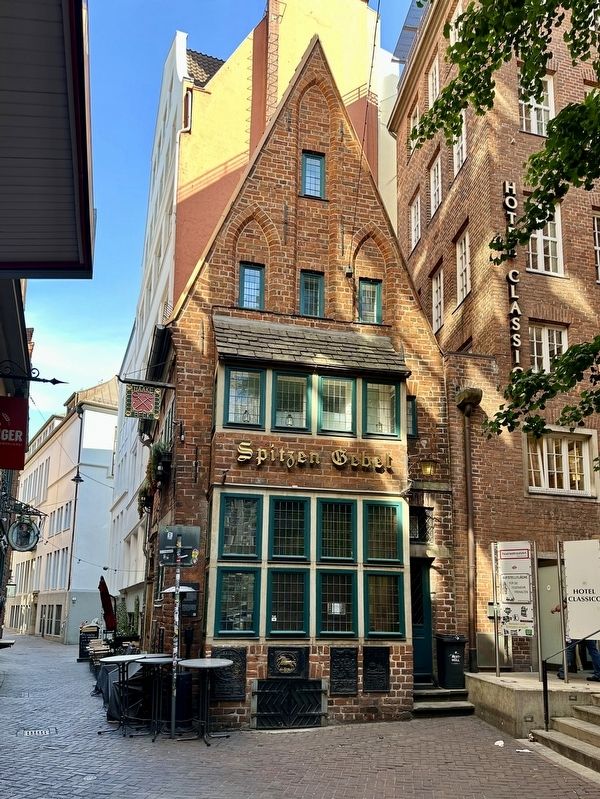
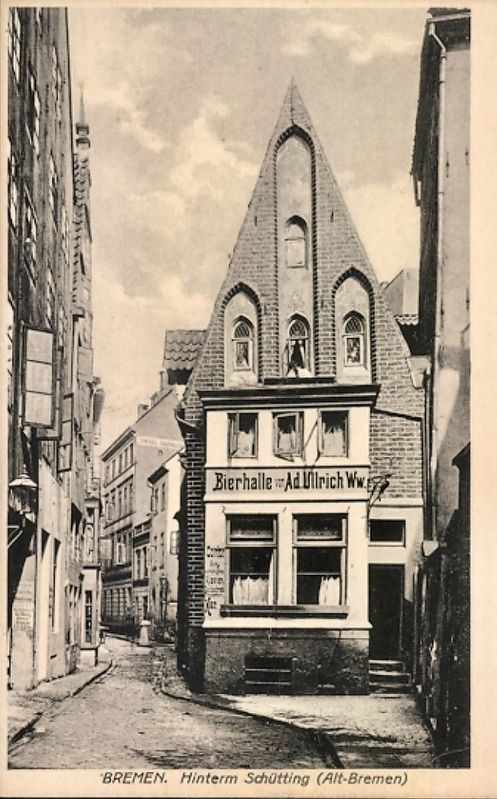
Dating from the time around 1400, the Spitzen Gebel is the oldest town house and the last of its kind in Bremen. The building has served as both a shop and a private residence over the centuries. Its Low German name stems from the pointed gable crowning its facade. It was a wine house, a butcher's shop and a tavern until in 1913 it became an office for the Vereinigten Klavierträger (united piano movers). As a result, the older residents of Bremen still remember it as the Klavierträgerhaus (piano movers' house).(Submitted on June 1, 2025.)
Photographed by Andrew Ruppenstein, May 19, 2025
2. Spitzen Gebel / “Pointed Gable” building and marker
The marker is visible here on the corner of the building it. At times, access to the marker may be impeded by tables.
Photographed by Verlag v. Alb. Rosenthal, Bremen, circa 1910
3. Spitzen Gebel / “Pointed Gable” building
Credits. This page was last revised on June 1, 2025. It was originally submitted on June 1, 2025, by Andrew Ruppenstein of Lamorinda, California. This page has been viewed 96 times since then and 16 times this year. Photos: 1, 2, 3. submitted on June 1, 2025, by Andrew Ruppenstein of Lamorinda, California.
