Workington in Cumberland, England, United Kingdom — Northwestern Europe (the British Isles)
Remembering World War I
Photographed by Ray Gurganus, April 11, 2025
1. Remembering World War I Marker
Dignitaries
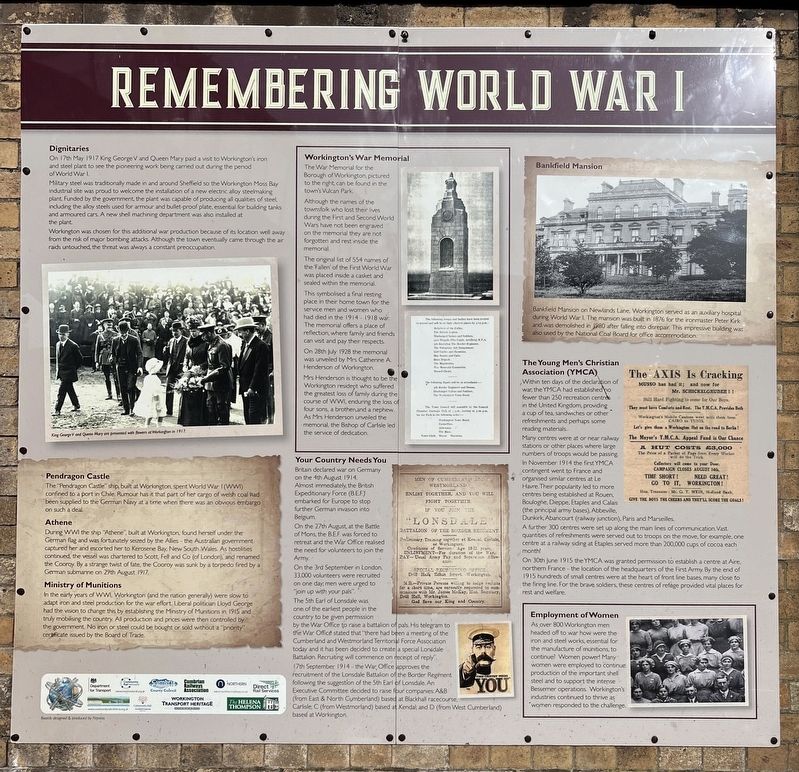
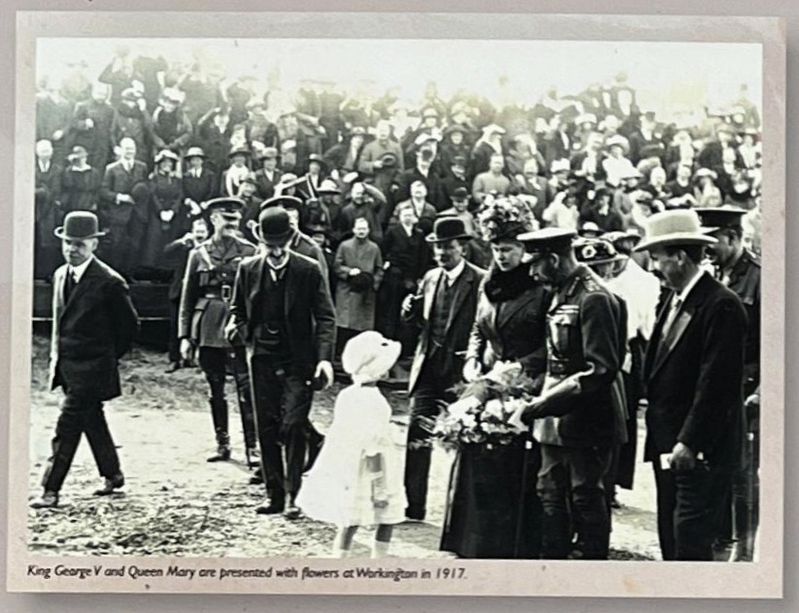
On 17th May 1917 King George V and Queen Mary paid a visit to Workington's iron and steel plant to see the pioneering work being carried out during the period of World War I.
Military steel was traditionally made in and around Sheffield so the Workington Moss Bay industrial site was proud to welcome the installation of a new electric alloy steelmaking plant. Funded by the government, the plant was capable of producing all qualities of steel including the alloy steels used for armour and bullet-proof plate, essential for building tanks and armoured cars. A new shell machining department was also installed at the plant.
Workington was chosen for this additional war production because of its location well away from the risk of major bombing attacks. Although the town eventually came through the air raids untouched the threat was always a constant preoccupation.
Pendragon Castle
The Pendragon Castle ship built at Workington spent World War (WWI) confined to a port in Chile. Rumour has it that part of her cargo of welsh coal had been supplied to the German Navy at a time when there was an obvious embargo
this page online
Athene
During WWI the ship "Athene", built at Workington found herself under the German flag and was fortunately seized by the Allies - the Australian government captured her and escorted her to Kerosene Bay, New South Wales. As hostilities continued the vessel was chartered to Scott, Fell and Co (of London) and renamed the Cooroy. By a strange twist of fate, the Cooroy was sunk by a torpedo fired by a German submarine on 27th August 1917.
Ministry of Munitions
In the early years of WWI Workington (and the nation generally) were slow to adapt iron and steel production for the war effort, Liberal politician Lloyd George had the vision to change this by establishing the Ministry of Munitions in 1915 and truly mobilising the country All production and prices were then controlled by the government. No iron or steel could be bought or sold without a "priority" certificate issued by the Board of Trade.
Workington's War Memorial
The War Memorial for the Borough of Workington pictured to the right can be found in the town's Vulcan Park.
Although the names of the townsfolk who lost their lives during the first
Photographed by Ray Gurganus, April 11, 2025
2. King George V and Queen Mary are presented with flowers at Workington in 1917.
The original list of 554 names of the fallen of the First World War was placed inside a casket and sealed within the memorial.
This symbolised a final resting place in their home town for the service men and women who had died in the 1914-1918 war The memorial offers a place of reflection, where family and friends can visit and pay their respects.
On 28th July 1928 the memorial was unveiled by Mrs Catherine A. Henderson of Workington.
Mrs Henderson is thought to be the Workington resident who suffered the greatest loss of family during the course of WWI, enduring the loss of four sons, a brother and a nephew. As Mrs Henderson unveiled the memorial, the Bishop of Carlisle led the service of dedication.
Your Country Needs You
Britain declared war on Germany on the 4th August 1914 Almost immediately the Brotisserie Expeditionary Force (BEF) embarked for Europe to stop further German invasion into Belgium.
On the 27th August at the Battle of Mons, the B.E.F. was forced to retreat and the War Office realised
Photographed by Ray Gurganus, April 11, 2025
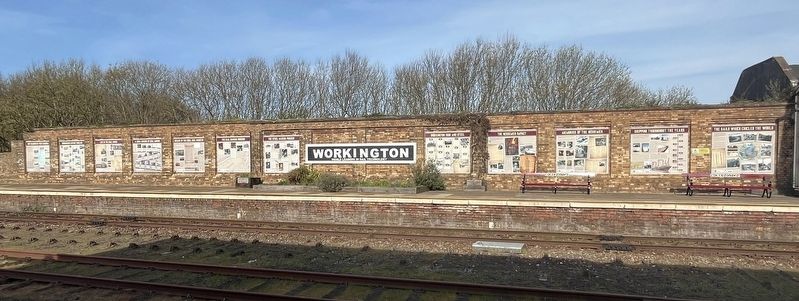
3. Some of the historical markers at the Workington rail station.
On the 3rd September in London 33,000 volunteers were recruited on one day; men were urged to "join up with your pals." The 5th Earl of Lonsdale was one of the earliest people in the country to be given permission by the War Office to raise a battalion of pals. His telegram to de War Office stated that "there had been a meeting of the Cumberland and Westmorland Territorial Force Association today and it has been decided to create a special Lonsdale Battalion. Recruiting will commence on receipt of reply."
17th September 1914 - the War Office approves the recruitment of the Lonsdale Battalion of the Border Regiment following the suggestion of the 5th Earl of Lonsdale. An Executive Committee decided to raise four companies A&B (from East & North Cumberland) based at Blackhall racecourse, Carlisle; C (hom Westmorland) based at Kendal and D (from West Cumberland) based at Workington.
Bankfield Mansion
Barkfield Mansion on Newlands Lane, Workington served as an auxiliary hospital during World War I. The mansion was built in 1876 for the ironmaster Peter Kirk and was demolished in 1980 after falling into disrepair. This impressive building was also used by the National Coal Board for office accommodation.
The Young Men's Christian Association (YMCA)
Within ten days of the declaration of war, the YMCA had established no fewer than 250 recreation centres in the United Kingdom, providing a cup of tea, sandwiches or other refreshments and perhaps some reading materials.
Many centres were at or near railway stations or other places where large numbers of troops would be passing. In November 1914 the first YMCA contingent went to France and organised similar centres at Le Havre. Their popularity led to more centres being established at Rouen, Boulogne, Dieppe, Etaples and Calas (the principal army bases) Abbeville, Dunkirk, Abancourt (railway junction), Paris and Marseilles. A further 300 centres were set up along the man lines of communication. Vast quantities of refreshments were served out to troops on the move, for example, one centre at a railway siding at Etaples served more than 200,000 cups of cocoa each month!
On 30th June 1915 the YMCA was granted permission to establish a centre at Aire, northern France - the location of the headquarters of the first Army. By the end of 1915 hundreds of small centres were at the heart of front line bases, many close to the firing line. For the brave soldiers, these centres off refuge provided vital places for rest and welfare.
Employment of Women
As over 800 Workington men headed off to war, how were the iron and steel works, essential for the manufacture of munitions to continue? Women power! Many women were employed to continue production of the important shell steel and to support the intense Bessemer operations. Workington's industries continued to thrive as women responded to the challenge.
Erected by Cumbria County Council.
Topics. This historical marker is listed in this topic list: War, World I.
Location. 54° 38.718′ N, 3° 33.523′ W. Marker is in Workington, England, in Cumberland. It can be reached from Falcon Street. On the platform at the Workington train station. Touch for map. Marker is at or near this postal address: 3 Falcon Street, Workington, England CA14 2XD, United Kingdom. Touch for directions.

Regionally, this marker is in North West England. Globally, it is on the Atlantic Ocean, in the North Atlantic Region, in Europe, in Atlantic Europe, on one of the British Isles, in the Western World, and in the Anglosphere. Historically, it finds itself in what was once the Roman Empire.
Other nearby markers. At least 8 other markers are within walking distance of this marker: A History of Workington Station (here, next to this marker); Remembering World War II (here, next to this marker); The Helena Thompson Museum (here, next to this marker); The Rails Which Circled the World (within shouting distance of this marker); a different marker also named The Rails Which Circled the World (within shouting distance of this marker); James Alexander Smith (within shouting distance of this marker); Workington Station (within shouting distance of this marker); Shipping Throughout the Years (within shouting distance of this marker). Touch for a list and map of all markers in Workington.
Credits. This page was last revised on June 28, 2025. It was originally submitted on June 1, 2025, by Ray Gurganus of Washington, District of Columbia. This page has been viewed 256 times since then and 152 times this year. Photos: 1, 2, 3. submitted on June 1, 2025, by Ray Gurganus of Washington, District of Columbia. • Andrew Ruppenstein was the editor who published this page.
