Bremen-Mitte in Mitte, Germany — Central Europe
Landherrnamt
⎯⎯⎯
Landherrn Administrative Building
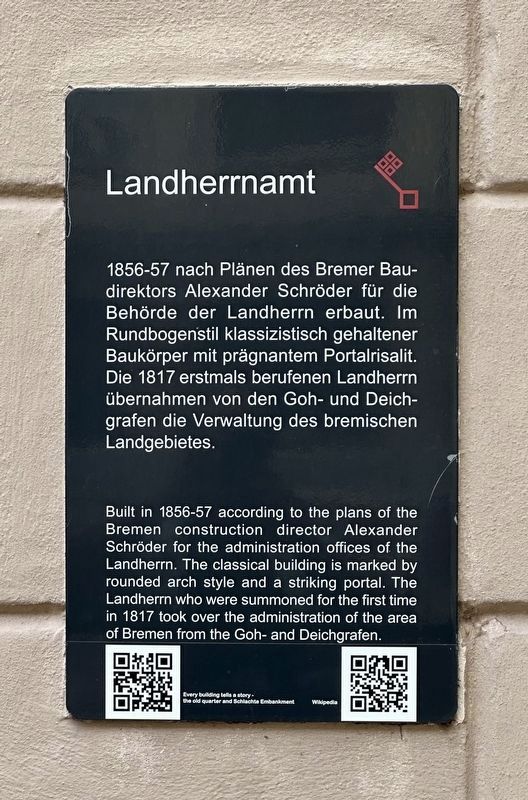
Photographed by Andrew Ruppenstein, May 18, 2025
1. Landherrnamt / Landherrn Administrative Building Marker

Topics and series. This historical marker is listed in this topic list: Government & Politics. In addition, it is included in the Bremen Red Key series list. A significant historical year for this entry is 1817.
Location. 53° 4.433′ N, 8° 48.54′ E. Marker is in Bremen, in Mitte. It is in Bremen-Mitte. It is at the intersection of Dechanatstraße and Am Landherrnamt, on the right when traveling east on Dechanatstraße. Touch for map. Marker is at or near this postal address: Dechanatstraße 11, Bremen 28195, Germany. Touch for directions.

Regionally, it is in Europe, the European Union, Atlantic Europe, Central Europe, the Schengen Area, Western Europe, and the Western World. Historically, it finds itself in what was once the Holy Roman Empire.
Other nearby markers. At least 8 other markers are within walking distance of this marker: Bremen Kristalnacht Victims Memorial (a few steps from this marker); Birgittenkloster / Bridgettine Convent (within shouting distance of this marker); Propsteikirche St. Johann / St. John Provost Church (within shouting distance of this marker); Bremen Synagoge / Bremen Synagogue (within shouting distance of this marker); Der Fries / This Frieze (within shouting distance of this marker); Birgittenkloster / St. Birgitta Convent (within
this page online
Also see . . . Landherrnamt (Wikipedia). History:
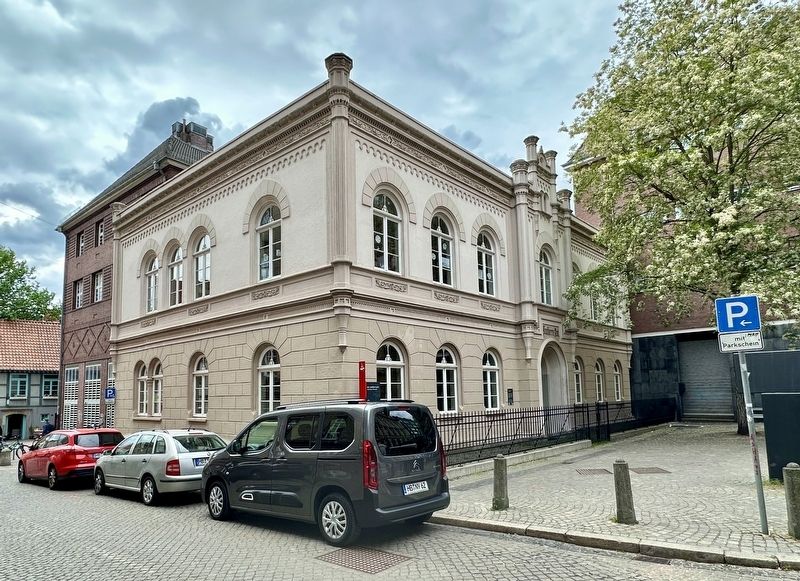
The building was designed by Bremen's planning director, Alexander Schröder (1806–1877), who planned several buildings in the city including the St-Jürgen Clinique. His style embraced Neoclassisism and Romanesque Revival architecture. The building initially housed the offices of the Landherrn who administered the State of Bremen from 1850. Until the end of the Second World War it accommodated the police and administrative services as well as the dike authorities. After the war, with its 1,000 m2 (11,000 sq ft) of floor space, it was used as a welfare centre for the severely disabled as well as the headquarters of the Bremen Dike Authority. In 1964, the Catholic Church took the building over as a nunnery but later used it to accommodate classes from the St. Johannis School. In 2011, major repairs were carried out to improve conditions for the schoolchildren. The 150-year-old facade was also renovated, the former pink finish being(Submitted on June 2, 2025.)removed to reveal the natural colour of the sandstone.Photographed by Andrew Ruppenstein, May 18, 20252. Landherrnamt / Landherrn Administrative Building Marker - wide view
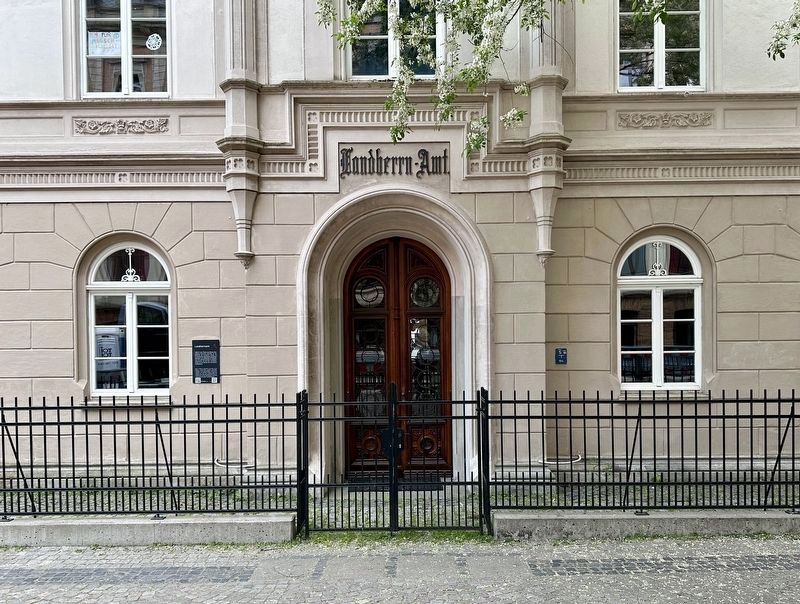
Photographed by Andrew Ruppenstein, May 18, 2025
3. Landherrnamt / Landherrn Administrative Building Marker
Credits. This page was last revised on June 2, 2025. It was originally submitted on June 2, 2025, by Andrew Ruppenstein of Lamorinda, California. This page has been viewed 112 times since then and 13 times this year. Photos: 1, 2, 3. submitted on June 2, 2025, by Andrew Ruppenstein of Lamorinda, California.
