Strathroy in Middlesex County, Ontario — Central Canada (North America)
General Sir Arthur William Currie 1875-1933
⎯⎯⎯
Le Général Sir Arthur William Currie (1875-1933)
Photographed by Tim Boyd, May 30, 2025
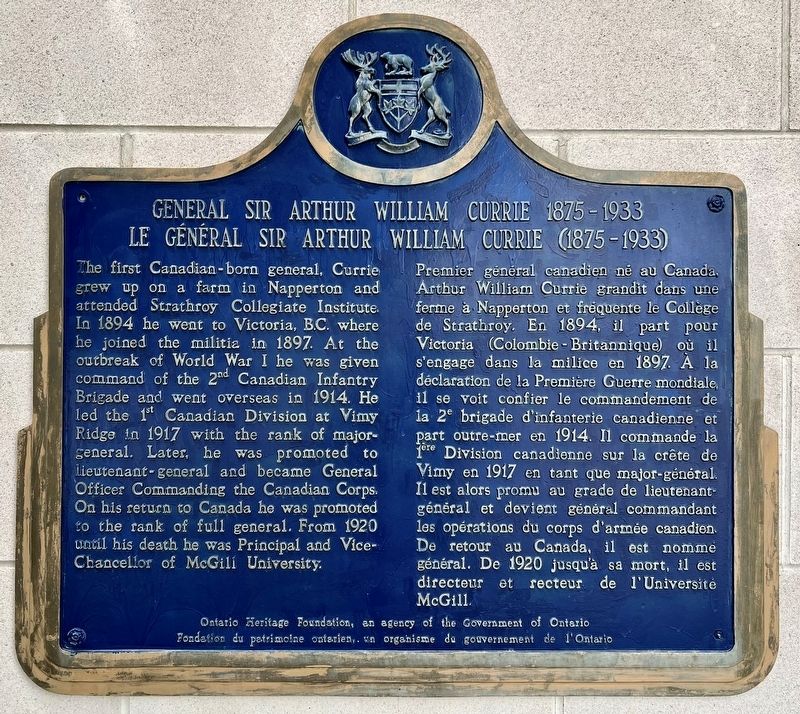
1. General Sir Arthur William Currie 1875-1933/ Le Général Sir Arthur William Currie (1875-1933) Marker

The first Canadian-born general, Currie grew up on a farm in Napperton and attended Strathroy Collegiate Institute. In 1894 he went to Victoria, B.C. where he joined the militia in 1897. At the outbreak of World War I he was given command of the 2nd Canadian Infantry Brigade and went overseas in 1914. He led the 1st Canadian Division at Vimy Ridge in 1917 with the rank of major-general. Later, he was promoted to lieutenant-general and became General Officer Commanding the Canadian Corps. On his return to Canada he was promoted to the rank of full general. From 1920 until his death he was Principal and Vice- Chancellor of McGill University.
Premier général canadien né au Canada, Arthur William Currie grandit dans une ferme à Napperton et fréquente le Collège de Strathroy. En 1894, il part pour Victoria (Colombie-Britannique) où il s'engage dans la milice en 1897. À la déclaration de la Première Guerre mondiale, il se voit confier le commandement de la 2e brigade d'infanterie canadienne et part
this page online
Erected by Ontario Heritage Foundation.
Topics and series. This historical marker is listed in these topic lists: Military • War, World I. In addition, it is included in the Canada, Ontario Heritage Trust series list. A significant historical year for this entry is 1894.
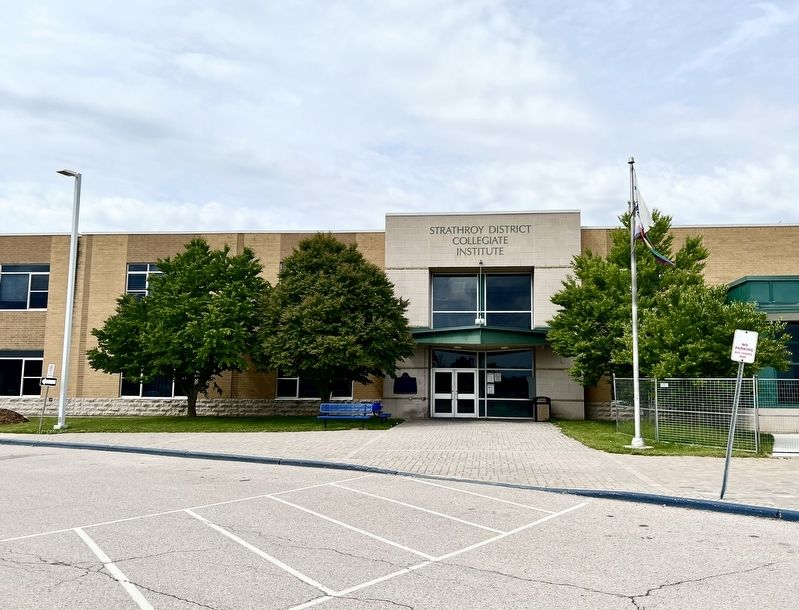
Location. 42° 58.877′ N, 81° 36.432′ W. Marker is in Strathroy, Ontario, in Middlesex County. It is at the intersection of Second Street and Adair Boulevard, on the right when traveling west on Second Street. The marker is at the main entrance of Strathroy District Collegiate Institute, accessible from the entrance on Second Street or Adair Boulevard. Touch for map. Marker is at or near this postal address: 361 Second Street, Strathroy ON N7G 4J8, Canada. Touch for directions.

Regionally, this
Photographed by Tim Boyd, May 30, 2025
2. General Sir Arthur William Currie 1875-1933/ Le Général Sir Arthur William Currie (1875-1933) Marker
At the left of the entrance
Other nearby markers. At least 8 other markers are within 13 kilometers of this marker, measured as the crow flies: Founding of Strathroy (approx. 3.1 kilometers away); Strathroy Cenotaph (approx. 3.1 kilometers away); General Sir Arthur William Currie (approx. 3.1 kilometers away); The Hon. Edward Blake (approx. 3.1 kilometers away); Strathroy United Church (approx. 3.2 kilometers away); McTaggart Cemetery (approx. 11.9 kilometers away); a different marker also named McTaggart Cemetery (approx. 11.9 kilometers away); East Williams Baptist Church and Cemetery (approx. 12.2 kilometers away). Touch for a list and map of all markers in Strathroy.
Also see . . .
1. Sir Arthur Currie (Canadian War Museum). In April 1917, Currie was appointed in June to head the Canadian
1920
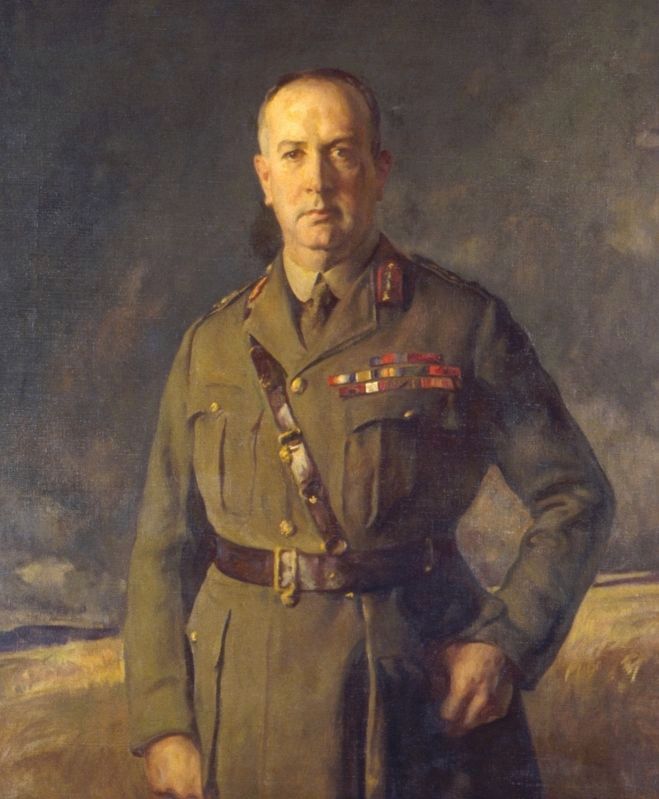
3. General Sir Arthur Currie, 1920
Source: Wikipedia (Smithsonian Art Museum). Public domain
2. The Canadian Expeditionary Force (Canadian War Museum).
The growing size and complexity of Canadian forces overseas led in September 1915 to the creation of the Canadian Corps, an operational and administrative grouping of most Canadian fighting units and their supporting services.(Submitted on June 2, 2025, by Tim Boyd of Hamilton, Ontario.)
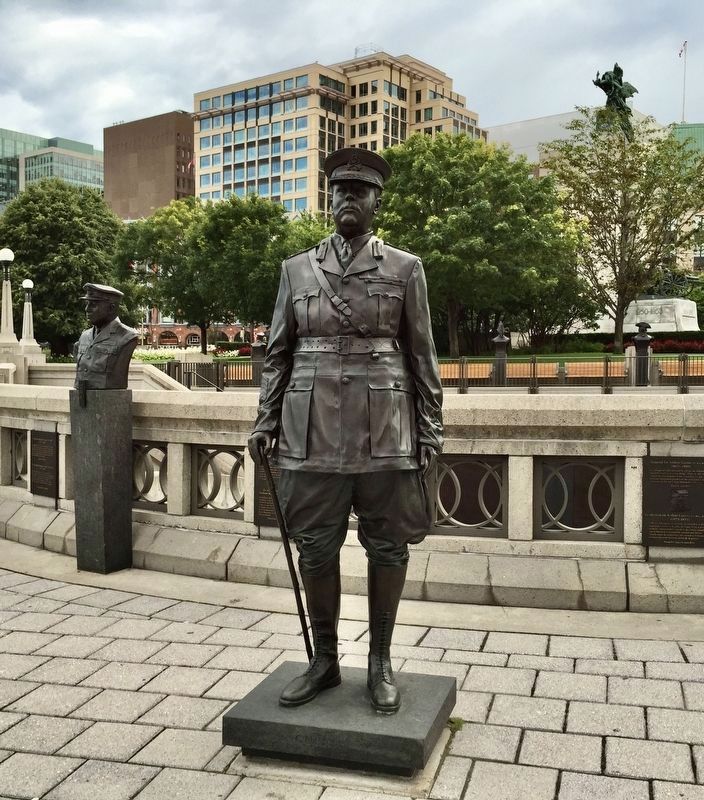
At first commanded by British Lieutenant-General Sir E.A.H. Alderson and, from May 1916 to June 1917, by British Lieutenant-General Sir Julian Byng, the Corps grew from an initial establishment of two divisions with approximately 35,000troops to a powerful striking force of four divisions with 100,000 troops by early 1917.Photographed by Tim Boyd, August 24, 20154. General Sir Arthur Currie statue in Ottawa
From June 1917, the Canadians were led by Lieutenant-General Sir Arthur Currie, a Canadian militia officer who rose during the war from command of a brigade to command of the entire Corps. Currie, who remained in command until 1919, is widely considered one of the war’s most capable generals.
Credits. This page was last revised on June 2, 2025. It was originally submitted on June 2, 2025, by Tim Boyd of Hamilton, Ontario. This page has been viewed 103 times since then and 17 times this year. Photos: 1, 2, 3, 4. submitted on June 2, 2025, by Tim Boyd of Hamilton, Ontario. • Andrew Ruppenstein was the editor who published this page.
