Near Selma in Dallas County, Alabama — The American South (East South Central)
The De Soto Trail
| — | Alabama De Soto Trail | — |
Photographed by Mark Hilton, June 1, 2025
1. The Desoto Trail Marker
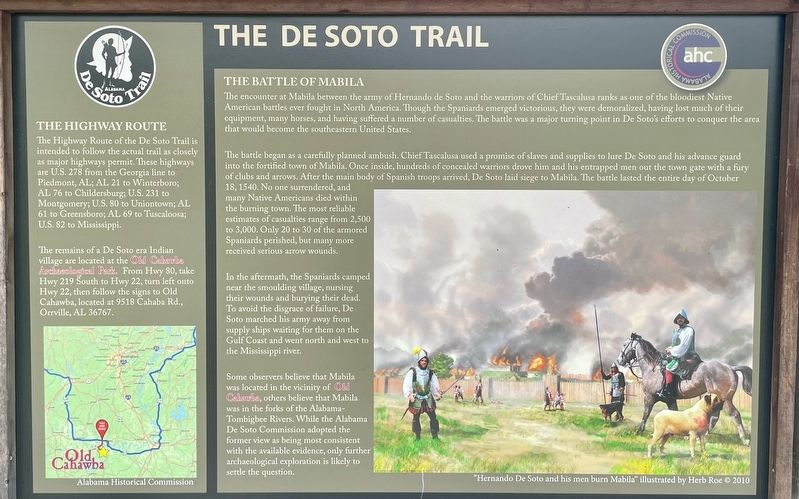
The Battle of Mabila
The encounter at Mabila between the army of Hernando de Soto and the warriors of Chief Tascalusa ranks as one of the bloodiest Native American battles ever fought in North America. Though the Spaniards emerged victorious, they were demoralized, having lost much of their equipment, many horses, and having suffered a number of casualties. The battle was a major turning point in De Soto's efforts to conquer the area that would become the southeastern United States.
The battle began as a carefully planned ambush. Chief Tascalusa used a promise of slaves and supplies to lure De Soto and his advance guard into the fortified town of Mabila. Once inside, hundreds of concealed warriors drove him and his entrapped men out the town gate with a fury of clubs and arrows. After the main body of Spanish troops arrived, De Soto laid siege to Mabila. The battle lasted the entire day of October 18, 1540. No one surrendered, and many Native Americans died within the burning town. The most reliable estimates of casualties range from 2,500 to 3,000. Only 20 to 30 of the armored Spaniards perished, but many more received
this page online
In the aftermath, the Spaniards camped near the smoulding village, nursing their wounds and burying their dead. To avoid the disgrace of failure, De Soto marched his army away from supply ships waiting for them on the Gulf Coast and went north and west to the Mississippi river.
Some observers believe that Mabila was located in the vicinity of Old Cahawba, others believe that Mabila was in the forks of the Alabama-Tombigbee Rivers. While the Alabama De Soto Commission adopted the former view as being most consistent with the available evidence, only further archaeological exploration is likely to settle the question.
The Highway Route
The Highway Route of the De Soto Trail is intended to follow the actual trail as closely as major highways permit. These highways are U.S. 278 from the Georgia line to Piedmont, AL; AL 21 to Winterboro; AL 76 to Childersburg; U.S. 231 to Montgomery; U.S. 80 to Uniontown; AL 61 to Greensboro; AL 69 to Tuscaloosa; U.S. 82 to Mississippi.
The remains of a De Soto era Indian village are located at the Old Cahawba Archaeological Park. From Hwy
Photographed by Mark Hilton, June 1, 2025
2. The De Soto Trail Marker
[Caption] "Hernando De Soto and his men burn Mabila" illustrated by Herb Roe © 2010
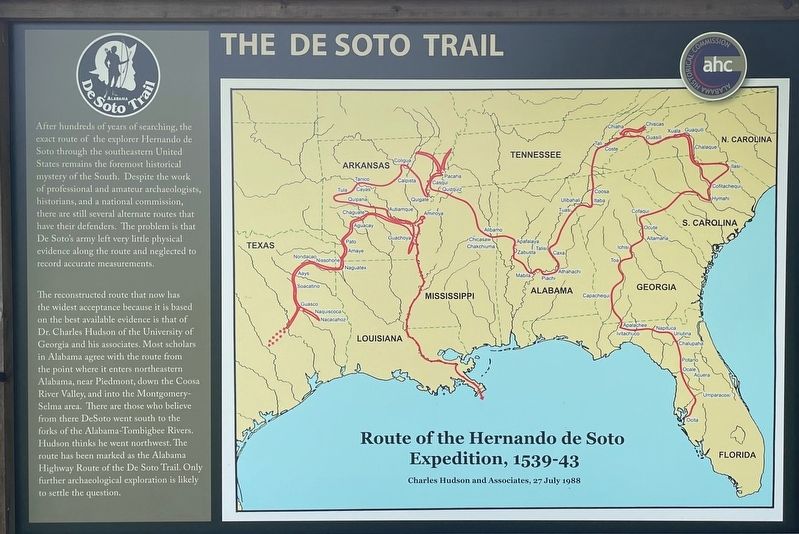
After hundreds of years of searching, the exact route of the explorer Hernando de Soto through the southeastern United States remains the foremost historical mystery of the South. Despite the work of professional and amateur archaeologists, historians, and a national commission, there are still several alternate routes that have their defenders. The problem is that De Soto's army left very little physical evidence along the route and neglected to record accurate measurements.
The reconstructed route that now has the widest acceptance because it is based on the best available evidence is that of Dr. Charles Hudson of the University of Georgia and his associates. Most scholars in Alabama agree with the route from the point where it enters northeastern Alabama, near Piedmont, down the Coosa River Valley, and into the Montgomery- Selma area. There are those who believe from there
Photographed by Mark Hilton, June 1, 2025
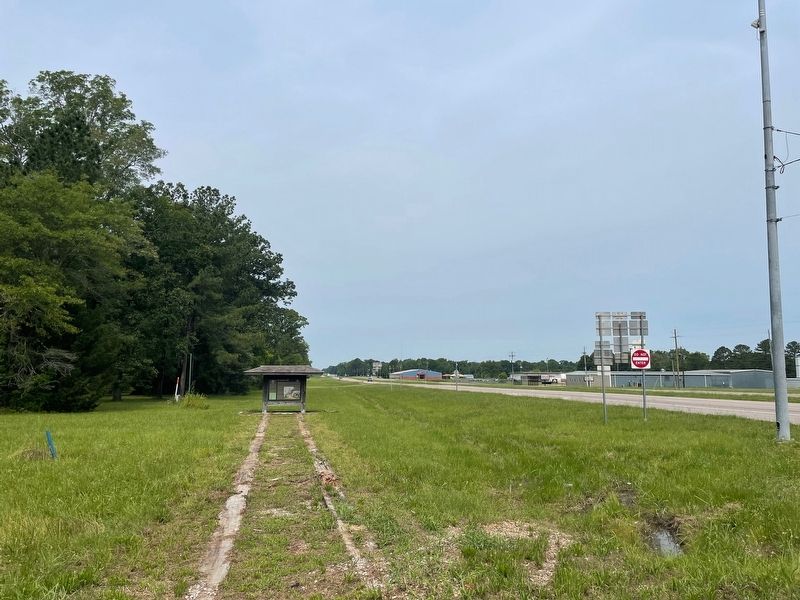
3. The De Soto Trail Marker looking west.
Erected 2020 by the Alabama Historical Commission.
Topics. This historical marker is listed in this topic list: Exploration. A significant historical date for this entry is October 18, 1540.
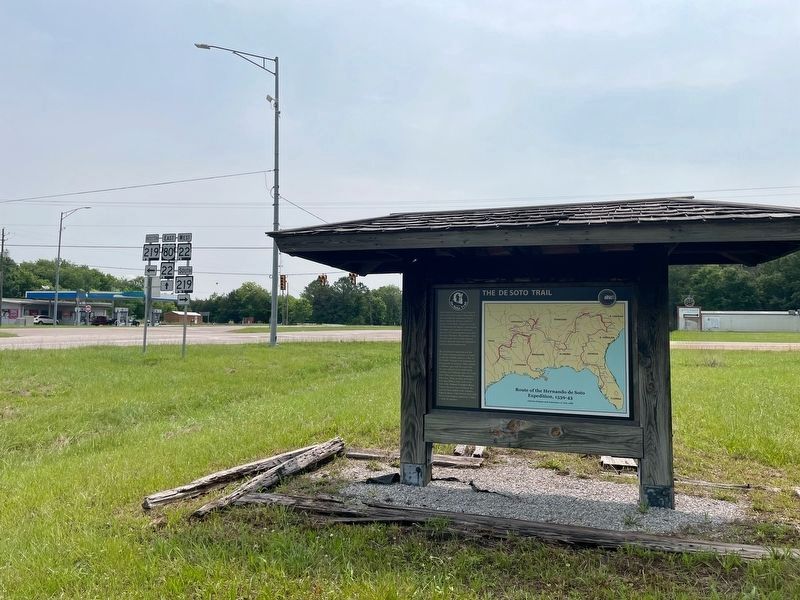
Location. 32° 26.127′ N, 87° 5.036′ W. Marker is near Selma, Alabama, in Dallas County. It is at the intersection of U.S. 80 and State Route 219, on the right when traveling east on U.S. 80. Touch for map. Marker is in this post office area: Selma AL 36701, United States of America. Touch for directions.

Regionally, this marker is in the American South, specifically in the Deep South, and in the Black Belt. Globally, it is in North America, a Gulf of Mexico state, the Western Hemisphere, the Western World, and the Anglosphere. Historically, it finds itself in what was once New Spain, the territory of the Mississippian Culture, one of the Confederate States of America, and the Antebellum South.
Photographed by Mark Hilton, June 1, 2025
4. Reverse side of "The De Soto Trail" marker looking East towards City of Selma.
Other nearby markers. At least 8 other markers are within 4 miles of this marker, measured as the crow flies: Chalmers Attacks (approx. 3.1 miles away); R.B. Hudson High School (approx. 3.2 miles away); Dallas County Vietnam Memorial (approx. 3.2 miles away); Take Her Down (approx. 3.2 miles away); Dallas County World Wars Memorial (approx. 3.2 miles away); Memorial Stadium (approx. 3.2 miles away); Dallas County Korean War Memorial (approx. 3.2 miles away); White - Force Cottage (approx. 3½ miles away). Touch for a list and map of all markers in Selma.
Other markers no longer nearby. Union Troops Charge (was approx. 3 miles away but has been confirmed missing); Redoubt No. 15 (was approx. 3.1 miles away but has been confirmed missing); Interior Redoubt No. III (was approx. 3.3 miles away but has been permanently removed).
Also see . . . The Great Chief, Tuscaloosa - 1540 (Heritage History). Chief Tuskaloosa (less commonly spelled as Tuskalusa, Tastaluca, Tuskaluza). (Submitted on June 2, 2025, by Mark Hilton of Montgomery, Alabama.)
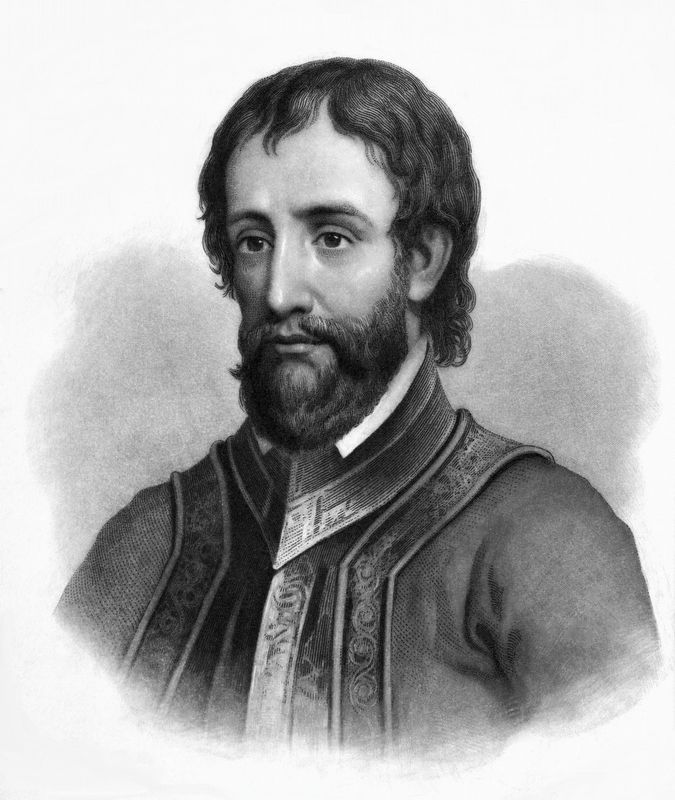
Public Domain (Engraved prior to 1858)
5. Hernando de Soto (c. 1497 – 21 May 1542)
Credits. This page was last revised on June 5, 2025. It was originally submitted on June 2, 2025, by Mark Hilton of Montgomery, Alabama. This page has been viewed 574 times since then and 280 times this year. Photos: 1, 2, 3, 4, 5. submitted on June 2, 2025, by Mark Hilton of Montgomery, Alabama.
