Lucan in Middlesex County, Ontario — Central Canada (North America)
Wilberforce Colony
| — | Middlesex Heritage Trail | — |

Photographed by Tim Boyd, May 30, 2025
1. Wilberforce Colony Marker
Among the first residents of Biddulph Township were free blacks from Cincinnati, Ohio who settled in the area in the fall of 1829. They were welcomed after Ontario's Lieutenant-Governor, Mr. John Colborne stated that Ontarians "do not know men by their colour" and that "they would be entitled to all the privileges of His Majesty's subjects".
A Colonization Committee successfully negotiated for the purchase of 800 acres (Lots 2, 3 and 5 north and south of the Proof Line Road as well as Lot 8 north of the proof line road and lot 11 south of the proof line road. About 150-200 people moved here and began the arduous task of clearing the land for agricultural purposes. In 1831 the settlement that arose was called Wilberforce.
Despite any early progress, Wilberforce began to steadily decline in the late 1830's. Some settlers died. Some decided that they didn't like farming and sold off to the incoming Irish settlers while still others moved to the urban centres with a larger black population.
In 1840 as the Wilberforce Colony dwindled and the number of Irish immigrants increased, a formal land survey was completed by
this page online
Donald left for Toronto and was later appointed a Senator while John became the first sheriff of Huron County. Before Donald left for Toronto and John for Goderich they renamed the hamlet "Marystown" in honour of John's wife, Mary.
Marystown was re-named Lucan in 1860 because of duplication of the name Marystown on postal lists. The name Lucan was suggested by Thomas (Dublin) Hodgins who had served two years as Reeve of Biddulph and who had served as a coachman to Lord Lucan in Ireland.
(Marker Number 5.)
Topics. This historical marker is listed in these topic lists: African Americans • Settlements & Settlers. A significant historical year for this entry is 1829.
Location. 43° 11.275′ N, 81° 24.199′ W. Marker is in Lucan, Ontario, in Middlesex County. It is at the intersection of Main Street and William Street, on the right when traveling east on Main Street. Touch for map.
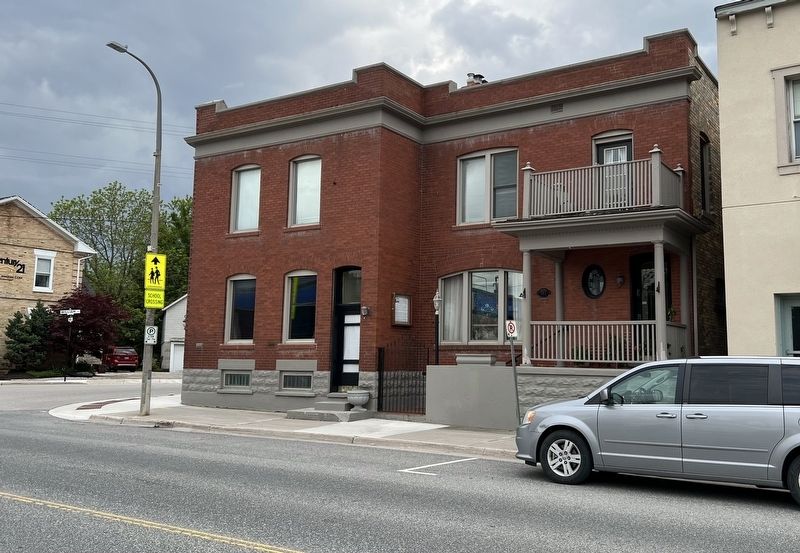
Photographed by Tim Boyd, May 30, 2025
2. Wilberforce Colony Marker (centre of photo)

Regionally, this marker is in the Southwest Ontario Area and in Southwestern Ontario. It is also in Central Canada. Globally, it is in North America, the Western Hemisphere, the Western World, and the Anglosphere. Historically, it finds itself in what was once a British colony, the Viceroyalty of New France, the Haudenosaunee (Iroquois) Confederacy, and Rupert’s Land.
Other nearby markers. At least 8 other markers are within 3 kilometers of this marker, measured as the crow flies: The Founding of Lucan (about 90 meters away, measured in a direct line); C. Frederick McLean 1875-1942 (about 90 meters away); The Ivan Hearn Barn (about 90 meters away); The “Donnelly” Log Cabin (about 90 meters away); The Wilberforce Settlement / L’Établissement Wilberforce (about 90 meters away); Sauble Hill - Wilberforce Cemetery (approx. 2.2 kilometers away); St. James Anglican Church & Cemetery (approx. 2.9 kilometers away); Lieut-Col. James Hodgins (approx. 2.9 kilometers away). Touch for a list and map of all markers in Lucan.
More about this marker. The marker is number 5 in the Middlesex Heritage Heritage series
Also see . . . How we misremember Free Black history at the Wilberforce Colony (activehistory.ca).
Because Wilberforce’s history refutes several stories we like to tell ourselves about Canadian history, the way the colony was formed has been largely misunderstood or misrepresented in our public imagination.(Submitted on June 2, 2025, by Tim Boyd of Hamilton, Ontario.)
For instance, it may surprise some to learn that the settlement was built by free Black people, not Freedom Seekers escaping enslavement. Although there were race riots in Cincinnati in 1829 that hastened movements to leave, plans for the Wilberforce colony preceded this direct violence by several years. The Wilberforce colonists considered themselves emigrants leaving the USA on their own terms, not refugees escaping American violence for Canadian peace. Their choice to come to Canada had far more to do with where they were able to legally obtain land than the side of the border said land fell.
Credits. This page was last revised on June 3, 2025. It was originally submitted on June 2, 2025, by Tim Boyd of Hamilton, Ontario. This page has been viewed 155 times since then and 26 times this year. Photos: 1, 2. submitted on June 2, 2025, by Tim Boyd of Hamilton, Ontario. • Andrew Ruppenstein was the editor who published this page.
