Bremen-Mitte in Mitte, Germany — Central Europe
Neues Rathaus
⎯⎯⎯
New Town Hall
Photographed by Andrew Ruppenstein, May 18, 2025
1. Neues Rathaus / New Town Hall Marker

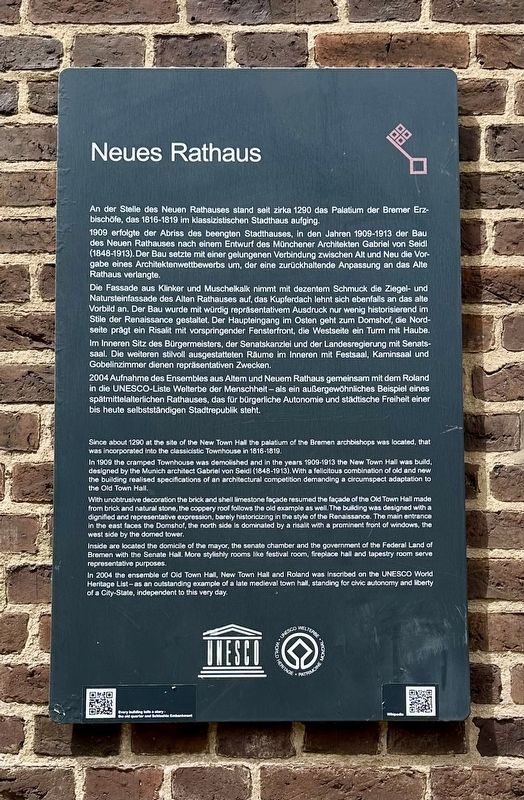
Die Fassade aus Klinker und Muschelkalk nimmt mit dezentem Schmuck die Ziegel- und Natursteinfassade des Alten Rathauses auf, das Kupferdach lehnt sich ebenfalls an das alte Vorbild an. Der Bau wurde mit würdig repräsentativem Ausdruck nur wenig historisierend im Stile der Renaissance gestaltet. Der Haupteingang im Osten geht zum Domshof, die Nordseite prägt ein Risalit mit vorspringender Fensterfront, die Westseite ein Turm mit Haube. Im Inneren Sitz des Bürgermeisters, der Senatskanzlei und der Landesregierung mit Senatssaal. Die weiteren stilvoll ausgestatteten Räume im Inneren mit Festsaal, Kaminsaal und Gobelinzimmer dienen repräsentativen Zwecken.
2004 Aufnahme des Ensembles aus Altem und Neuem Rathaus gemeinsam mit dem Roland in die UNESCO-Liste Welterbe der Menschheit-als ein außergewöhnliches Beispiel eines spätmittelalterlichen Rathauses, das für bürgerliche Autonomie und städtische Freiheit einer bis heute selbstständigen Stadtrepublik steht.
Since about 1290 at the site of the New Town Hall the palatium of the Bremen archbishops was located, that was incorporated into the classicistic Townhouse in 1816-1819. In 1909 the cramped Townhouse was demolished and in the years 1909-1913 the New Town Hall was build, designed by the Munich architect Gabriel von Seidl (1848-1913). With a felicitous
this page online
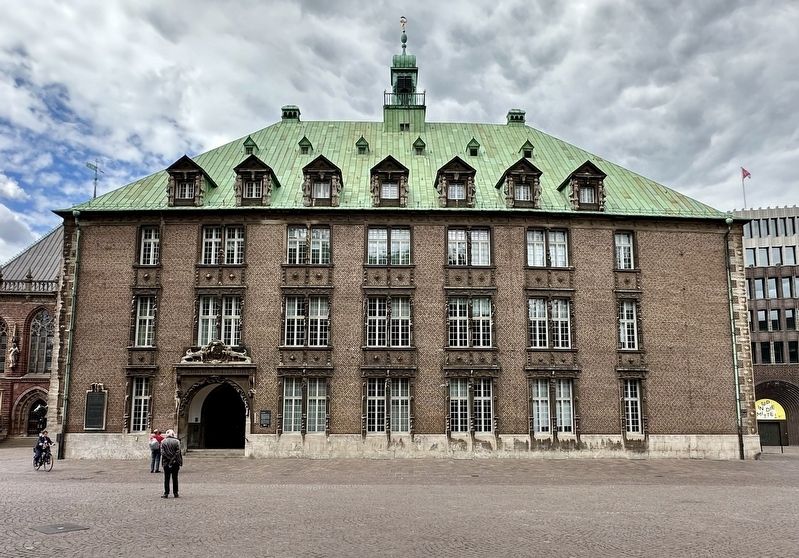
With unobtrusive decoration the brick and shell limestone façade resumed the façade of the Old Town Hall made from brick and natural stone, the coppery roof follows the old example as well. The building was designed with a dignified and representative expression, barely historicizing in the style of the Renaissance. The main entrance in the east faces the Domshof, the north side is dominated by a risalt with a prominent front of windows, the west side by the domed tower.
Inside are located the domicile of the mayor, the senate chamber and the government of the Federal Land of Bremen with the Senate Hall. More stylishly rooms like festival room, fireplace hall and tapestry room serve representative purposes.
In 2004 the ensemble of Old Town Hall, New Town Hall and Roland was inscribed on the UNESCO World Heritage List-as an outstanding example of a late medieval town hall, standing for civic autonomy and liberty of a City-State, independent to this very day.
Topics and series.

Photographed by Andrew Ruppenstein, May 18, 2025
2. Neues Rathaus / New Town Hall Marker - wide view
Location. 53° 4.554′ N, 8° 48.504′ E. Marker is in Bremen, in Mitte. It is in Bremen-Mitte. It is on Domshof, on the left when traveling north. Touch for map. Marker is at or near this postal address: Domshof 8-12, Bremen 28195, Germany. Touch for directions.

Regionally, it is in Europe, the European Union, Atlantic Europe, Central Europe, the Schengen Area, Western Europe, and the Western World. Historically, it finds itself in what was once the Holy Roman Empire.
Other nearby markers. At least 8 other markers are within walking distance of this marker: Bismarck-Denkmal / Bismarck Monument (a few steps from this marker); Die Domportale mahnen uns / The Cathedral Doors Serve as a Reminder (within shouting distance of this marker); Börsenhof / Stock Exchange (about 90 meters away, measured in a direct line); Deutsches Haus (about 90 meters away); Haus der Bürgerschaft / Parliament Building (about 90 meters away); Unser Lieben Frauen / Church of Our Lady
Photographed by Andrew Ruppenstein, May 18, 2025
3. Neues Rathaus / New Town Hall and marker
Also see . . . New Town Hall (Bremen) (Wikipedia). Overview:
The New Town Hall (German: Neues Rathaus) has stood on the Domshof in the centre of Bremen, Germany since 1913. Located behind the Unser-Lieben-Frauen-Kirchhof cemetery, it is adjacent to the older section of the Town Hall with which it forms a harmonious ensemble. Among its sumptuous rooms decorated with local artefacts, the New Town Hall houses the Senate Chamber used by the Senate for its regular meetings and the Great Hall, a venue for official receptions. In 2004, Bremen Town Hall was listed as a UNESCO World Heritage Site, together with the Roland of Bremen, because of its outstanding architecture and testimony to the development of civic autonomy during the Holy Roman Empire.(Submitted on June 4, 2025.)

circa 1925
4. Neues Rathaus
Credits. This page was last revised on June 4, 2025. It was originally submitted on June 4, 2025, by Andrew Ruppenstein of Lamorinda, California. This page has been viewed 113 times since then and 13 times this year. Photos: 1, 2, 3, 4. submitted on June 4, 2025, by Andrew Ruppenstein of Lamorinda, California.
