Las Colinas in Irving in Dallas County, Texas — The American South (West South Central)
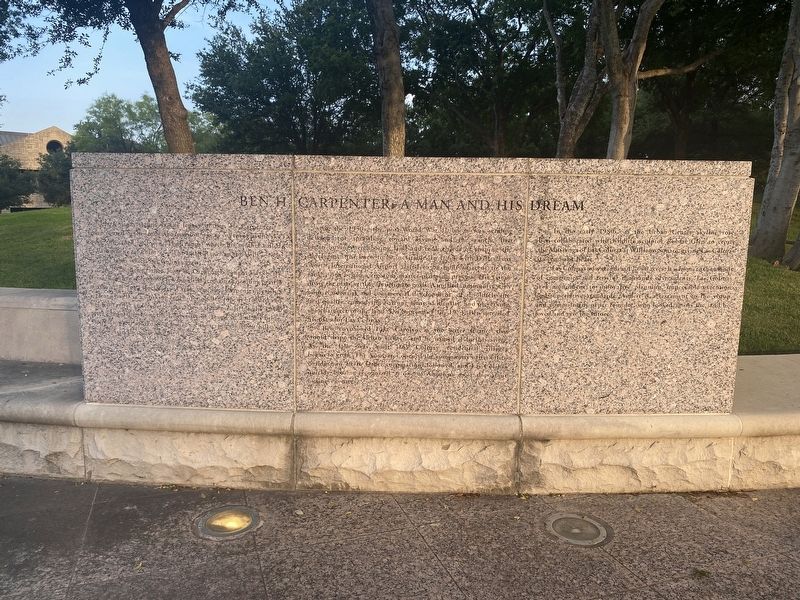
Ben H. Carpenter: A Man and His Dream
Photographed by Morgan Petermann, June 5, 2025
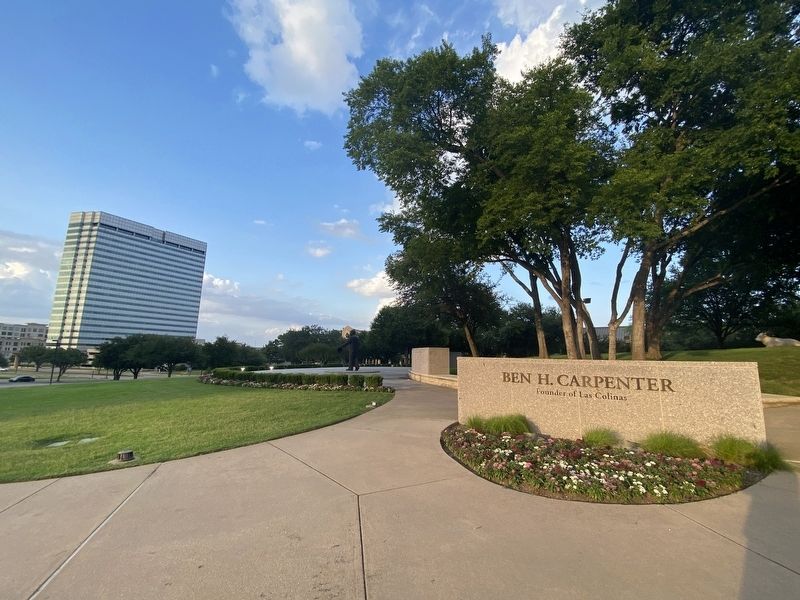
1. Ben H. Carpenter Marker
Inscription.
Las Colinas stands as the legacy of Ben H. Carpenter, a Texan rooted in the land, whose vision was as sweeping as the sky above the ranch he loved. That ranch, which his mother called "El Ranchito de las Colinas" -- The Little Ranch in the Hills -- was the seed from which Las Colinas grew.
In 1928, Ben's father, John W. Carpenter bought Hackberry Creek Ranch, a spread of a few hundred acres on the rolling prairie north of Irving. Hackberry Creek was the Carpenter family's retreat, as well as a working ranch. Young Ben roped, branded, and herded cattle and rode horses across the open fields. In 1948, after graduating from the University of Texas, he and his bride, Betty Dupree, moved to a house on the ranch's highest hill and there raised five children.
By the 1950s, the post World War II boom was sending development sprawling toward Irving and the ranch. Ben began buying neighboring land and took charge of shaping the development he knew to be inevitable. In 1968, with Dallas-Fort Worth International Airport slated to be built adjacent to the ranch, Ben began a rigorous master-planning process. His vision drove the
Click or scan to see this page online
plan, setting its ultimate goals: A united community with both residential and commercial development, of absolutely the best quality, embodying a strong sense of identity, and preserving the character of the land. On September 14, 1973, Ben unveiled his plan for Las Colinas.
Ben envisioned Lake Carolyn as the water feature that would shape the Urban Center, and he named it for his sister. As the lake was built, Las Colinas residential villages began to grow. The Associates opened the community's first office building in 1976. Other corporations followed and Las Colinas quickly became recognized as one of America's most important business centers.
In the early 1980s, as the Urban Center skyline rose, Ben collaborated with wildlife sculptor Robert Glen to create the Mustangs of Las Colinas at Williams Square, giving Las Colinas its symbolic heart.
Las Colinas now stands at 12,000 acres. It is home to thousands of companies and tens of thousands of residents. Las Colinas is a monument to innovative planning, impeccable execution, and superlative standards. And it is a testament to the vision and commitment of its founder who
Photographed by Morgan Petermann, June 5, 2025
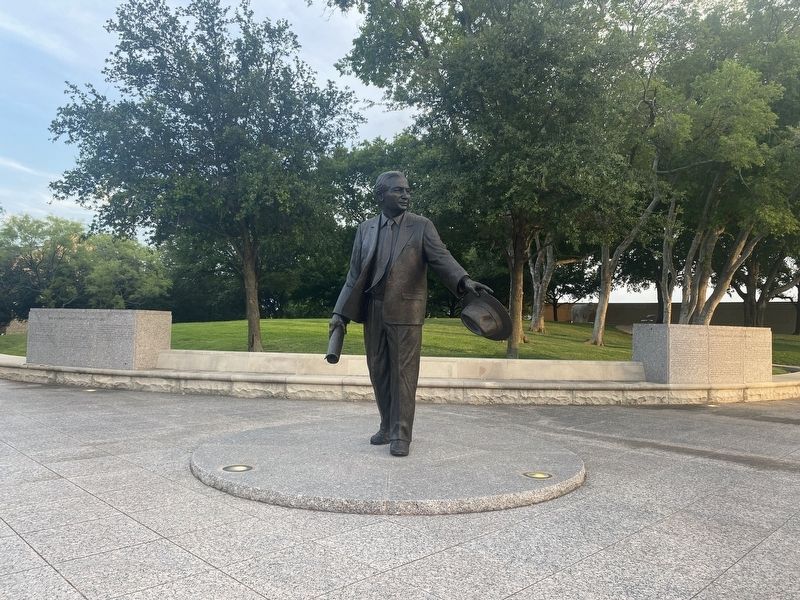
2. Ben H. Carpenter: A Man and His Dream Marker
Marker is on the right-hand side of the statue.
looked across the land he loved and saw the future.
Topics. This historical marker is listed in this topic list: Industry & Commerce.
Location. 32° 51.519′ N, 96° 55.888′ W. Marker is in Irving, Texas, in Dallas County. It is in Las Colinas. It is at the intersection of Riverside Drive and E John W Carpenter Fwy on Riverside Drive. Touch for map. Marker is at or near this postal address: 1400 Riverside Dr, Irving TX 75039, United States of America. Touch for directions.
Regionally, this marker is in the Prairies & Lakes Region and in the Dallas-Fort Worth Metropolitan Area. Globally, it is in North America, a Gulf of Mexico state, the Western Hemisphere, the Western World, and the Anglosphere. Historically, it finds itself in what was once New Spain, the Republic of Texas, one of the Confederate States of America, and the Antebellum South.
Credits. This page was last revised on June 7, 2025. It was originally submitted on June 6, 2025, by Morgan Petermann of Hurst, Texas. This page has been viewed 282 times since then and 147 times this year. Photos:1, 2, 3. submitted on June 6, 2025, by Morgan Petermann of Hurst, Texas. • James Hulse was the editor who published this page.